%20scale(0.008000%20-0.008000)'%3e%3cpath%20d='M74%20714H250L447%20155H449L641%20714H815V0H696V551H694L496%200H393L195%20551H193V0H74Z'/%3e%3c/g%3e%3cg%20transform='translate(114.2240%2035.7)%20scale(0.008000%20-0.008000)'%3e%3cpath%20d='M76%20714H372Q454%20714%20514.0%20686.0Q574%20658%20612.0%20609.5Q650%20561%20668.5%20496.0Q687%20431%20687%20357Q687%20283%20668.5%20218.0Q650%20153%20612.0%20104.5Q574%2056%20514.0%2028.0Q454%200%20372%200H76ZM201%20102H324Q397%20102%20443.5%20121.5Q490%20141%20516.5%20175.5Q543%20210%20552.5%20256.5Q562%20303%20562%20357Q562%20411%20552.5%20457.5Q543%20504%20516.5%20538.5Q490%20573%20443.5%20592.5Q397%20612%20324%20612H201Z'/%3e%3c/g%3e%3c/g%3e%3c/svg%3e)

Key takeaways
- Section 503A lets licensed pharmacies compound patient-specific medications under state board oversight.
- The FDA's peptide review is an ongoing, evolving process, not a single up-or-down verdict.
- 503A compounding pharmacies must meet USP Chapter 797 sterility standards for injectable preparations.
- Physician oversight and 503A-compounded sourcing provide accountability that unregulated gray-market vials lack.
01
What Is a 503A Compounding Pharmacy?
A 503A compounding pharmacy is a state-licensed pharmacy that prepares a customized medication for one specific patient against a valid prescription. The name comes from Section 503A of the Federal Food, Drug, and Cosmetic Act, the provision that permits this at all. A 503A pharmacy compounds to order, patient by patient - it does not manufacture drugs in batches, and its products are not FDA-approved the way a mass-produced drug is. That is not a loophole; it is the category working the way Congress wrote it.
What makes a 503A compounding pharmacy legitimate is boring and checkable: a state license, a valid prescription for a named patient, ingredients that meet USP standards, and sterile preparation under USP Chapter 797. A vendor selling vials from a website with no prescription is not a 503A pharmacy, whatever the site says about itself.
02
What Section 503A Actually Does
Section 503A of the Federal Food, Drug, and Cosmetic Act creates a carve-out. State-licensed compounding pharmacies can prepare patient-specific medications without going through the full FDA new-drug-approval process — which costs hundreds of millions of dollars and takes years — provided the bulk drug substances they use meet one of three conditions:
- They have a USP or National Formulary monograph
- They're components of an FDA-approved drug
- They appear on the FDA's 503A bulks list (21 CFR 216.23) — or, under the FDA's interim policy, they have been nominated and placed in Category 1 while the agency's evaluation is pending
Many peptides don't have USP monographs. They're not components of approved commercial drugs. For them, the relevant pathway is the FDA's bulk substances nomination list — a living document the agency updates as it evaluates nominations submitted by pharmacies, physicians, and manufacturers.
That document — not a DEA schedule, not a press release, not a Telegram channel admin's interpretation — is what determines whether a licensed 503A compounding pharmacy can legally compound a given peptide.
03
What Are 503A Compounded Peptides?
A compounded peptide, in the 503A context, is a patient-specific preparation made by a state-licensed compounding pharmacy against a prescription from a licensed physician for a specific identified patient. It is not a mass-manufactured drug. It is not a research chemical. It is not a batch-produced supplement.
The key chain: a licensed physician evaluates a patient, determines that a compounded preparation may be clinically appropriate, writes a specific prescription, and a licensed 503A pharmacy compounds it from a bulk drug substance sourced from an FDA-registered manufacturer.
Every link in that chain is accountable. The physician holds a license and prescribes within scope. The pharmacy holds state licensure and compounds under pharmacy board oversight. The bulk substance supplier is registered with FDA. The preparation meets USP Chapter 797 sterility standards for sterile injectables (more on that below).
This is the framework that makes physician-prescribed peptide therapy meaningfully different from "the same thing from a research chemical website." The difference isn't primarily legal — it's structural accountability at every step of the supply chain.
04
503A vs 503B Pharmacy: What's the Difference?
The short version: a 503A pharmacy compounds for one named patient with a valid prescription, while a 503B outsourcing facility manufactures in batches without patient-specific prescriptions and registers with the FDA under stricter manufacturing rules. Both are legal. They operate under different lists of permitted ingredients, which is where most of the confusion about peptides begins.
The distinction that gets glossed over in almost every consumer-facing piece on this topic.
503A governs state-licensed compounding pharmacies preparing patient-specific prescriptions. This is what your telehealth provider uses. The pharmacy compounds against a specific prescription from a specific licensed physician for a specific patient. Subject to state pharmacy board oversight and USP Chapter 797 sterility standards for sterile preparations.
503B governs FDA-registered outsourcing facilities compounding for healthcare facilities — hospitals, clinics — without patient-specific prescriptions, under Current Good Manufacturing Practice (cGMP) manufacturing standards. Think large-scale batch production for surgical centers, not patient-specific telehealth.
The bulk substances lists for 503A and 503B are different. An action on one list doesn't automatically affect the other. A substance that gains or loses eligibility under 503B tells you nothing about its 503A status, and vice versa.
When you see a headline about peptide compounding, the first filter is: which pathway is this about? Most physician-prescribed peptide therapy moves through the 503A pathway. Most confusion in the space involves conflating the two.
The oversight frameworks also differ significantly. 503B facilities operate under FDA's cGMP inspections — much closer to pharmaceutical manufacturing standards. 503A pharmacies operate under state pharmacy board oversight, which creates variation by state. That variation matters if you're evaluating a specific pharmacy's quality standards.
05
The Category System, Explained Without the Drama
The FDA sorts nominated bulk substances for 503A into practical categories. Three states matter:
Category 1 — Nominated, no significant safety concerns identified (yet)
The FDA has accepted the nomination and has not identified a reason to restrict compounding while the review is ongoing. Critically, this is not a safety endorsement — it is the absence of a negative finding. A physician can prescribe a Category 1 compound from a licensed 503A pharmacy within the framework. Substances can sit in this status for years while the agency works through its review queue.
Category 2 — Nominated, significant safety concerns identified
When the FDA flags a substance based on review of available data, it moves here. Technically, category determinations are guidance rather than binding Administrative Procedure Act regulation — formal objection and petition pathways remain open. Practically, reputable 503A pharmacies treat Category 2 as effectively limiting, because compounding a formally flagged substance creates regulatory exposure, worsens liability if an adverse event occurs, and strains relationships with state pharmacy boards that matter for ongoing operations. The formal pathway does work: evidence submissions and objection processes have led the FDA to revisit specific determinations in the past.
Removed or revised
Substances can be withdrawn from consideration, transferred between lists, or revisited based on new evidence, successful petitions, or formal rulemaking outcomes. By April 2026, for example, the FDA's category 2 page listed 17 substances, most of them peptides, whose nominations had been withdrawn and which are no longer in category 2 (FDA). Leaving category 2 does not place a substance on the bulks list or in category 1.
One nuance worth understanding: a Pharmacy Compounding Advisory Committee (PCAC) vote is not a binding rule. The PCAC is an advisory body. It evaluates nominees and makes recommendations to the FDA. The FDA considers those recommendations. Formal 503A eligibility determinations — the step that actually changes what pharmacies can compound — require a separate rulemaking process that can take a year or more after an advisory meeting. Headlines saying a peptide is "cleared" or "approved" following a PCAC meeting overstate where things stand procedurally.
06
Why Pharmaceutical-Grade Matters (and What Research-Grade Actually Means)
"Pharmaceutical-grade" is not a marketing phrase. It describes a specific supply chain with specific accountability checkpoints.
A pharmaceutical-grade bulk drug substance used by a licensed 503A pharmacy:
- Comes from an FDA-registered manufacturer
- Is accompanied by a Certificate of Analysis (CoA) verifying identity, potency, and purity
- Is stored and handled under conditions that maintain those specs
- Is compounded by a licensed pharmacist under state board oversight
- Is dispensed only against a valid patient-specific prescription
"Research-grade" means none of these things. The phrase is a legal workaround — it allows vendors to sell compounds without the labeling requirements that would apply to drugs or supplements, by designating the product "not for human use." What it tells you about the actual purity, potency, sterility, or identity of the compound in the vial is: nothing. Vendors using this label are not inspected by FDA, not subject to USP standards, and not accountable to any licensing body for the quality of what they ship.
No rule requires a research-grade seller to test identity, potency, purity or sterility before shipping. Without testing requirements and without accountability, product quality is governed entirely by each vendor's voluntary choices.
The relevant question isn't whether a given online vendor has good standards. It's whether you have any reliable way to verify that before injecting what they sent you. You don't. They typically don't either.
07
The Gray Market and Why "Probably Fine" Is a Strange Standard
This is the part the research-chemical sellers don't put on the label.
The molecule in a vial ordered through a Telegram channel might be exactly what it claims to be. The problem is that there's no way to verify it — not for you, and not for the seller. The supply chain behind gray-market peptides is not domestically tested, not pharmaceutically manufactured, and not arriving in sterile conditions designed for injection.
"Research grade" on an overseas-sourced peptide label means exactly nothing in terms of pharmaceutical manufacturing controls. The molecule may be real. The purity may be anything. The sterility is unknown. There is no Certificate of Analysis from an accountable manufacturer. There is no pharmacist with a license on the line. There is no physician following your response or adjusting the protocol.
The regulated framework exists for a reason. Going around it doesn't eliminate the underlying compounds; it just removes the accountability structures around them.
We're not here to moralize about people who've used gray-market peptides. The interest in the mechanism was legitimate. The point is that "probably fine" is a strange standard to apply to a sterile injectable when the regulated alternative exists — and the cost of the alternative is oversight, not abstinence.
08
USP Chapter 797: The Sterility Standard That Separates a Pharmacy from a Vial
For sterile preparations — anything injected — the relevant standard is USP Chapter 797. It is the chapter that governs sterile compounding practices: clean room classification, environmental monitoring, personnel training and garbing, beyond-use dating, release testing, and contamination prevention. It is not a suggestion; it is the enforceable standard that licensed 503A pharmacies must meet for sterile preparations.
USP 797 compliance means:
- Preparations are compounded in classified clean rooms with controlled air quality
- Personnel meet specific training and competency requirements
- Environmental monitoring detects contamination risks before they reach a patient
- Beyond-use dating is based on validated stability data, not guesswork
- Release testing verifies the preparation before it's dispensed
None of this exists in the gray market. A research-chemical vial was not prepared in a classified clean room. The person who filled it did not meet USP 797 training requirements. The vial has no validated beyond-use date.
When you're evaluating a source of injectable peptides, USP 797 compliance at a licensed 503A pharmacy is the structural difference. It's not a technicality — it's the actual safety infrastructure that turns "an injectable compound" into a safely prepared injectable compound.
09
What the FDA's Ongoing Review Means for Patients
The FDA's bulk drug substances program is an active, ongoing process — not a one-time determination. Nominations are submitted, reviewed, categorized, and re-evaluated over time. The list is a living document.
Several important points for anyone navigating this as a patient:
Category status is not permanent
A substance currently in Category 1 can receive a restrictive determination following further review. A substance in Category 2 can be revisited based on new evidence, formal objections, or successful petitions. Any claim that a specific peptide is "permanently cleared" or "permanently banned" overstates the stability of the system.
The review process has a lag
The FDA receives many nominations and processes them on a multi-year timeline. PCAC advisory meetings and formal rulemaking add additional phases after a substance is first nominated. The gap between a substance being nominated and receiving a formal eligibility determination can span several years — during which it may sit in Category 1, available for 503A compounding, without that status representing a completed review.
Physician oversight bridges the uncertainty
When the regulatory status of a compound is evolving, the layer that protects a patient is physician oversight — a licensed provider who tracks the regulatory environment, reviews the clinical evidence, and makes a judgment about whether a specific compound is appropriate for a specific patient at a specific point in time. That's not a bureaucratic formality. It's the actual clinical function that a prescription model provides.
State variation matters
State pharmacy boards don't always move in lockstep with FDA guidance. What's available from a licensed 503A pharmacy varies by state, and state boards can impose requirements that differ from federal guidance. This creates legitimate variation in access that depends on where you are and which pharmacies serve your state.
10
How to Read Regulatory News Without Getting Misled
When a new headline lands, a few questions determine whether it matters:
Which molecule?
The FDA acts on specific substances. A regulatory action on one peptide tells you nothing about others. A reclassification affecting several peptides tells you nothing about the peptides not named. Read the FDA's bulk drug substances nomination page directly — it's updated as actions occur — not a summary from a website that may be months or years out of date.
Which pathway — 503A or 503B?
Different pathways, different lists, different standards. Changes to one don't automatically affect the other. Most physician-prescribed peptide therapy moves through 503A. Most regulatory confusion conflates the two. The headline should specify.
Advisory or final?
PCAC recommendations are advisory, not binding. A favorable committee vote is a step in the process, not the end of it. Formal rulemaking follows, and can take considerably longer than the headline implies. "PCAC cleared it" and "you can get it compounded" are separated by a meaningful procedural gap.
"Banned" vs. "restricted from compounding"?
These are not the same. Category 2 means the FDA has identified concerns with a substance under the 503A framework. It does not mean the molecule is a controlled substance, that physicians can't discuss it, or that clinical development is prohibited. The specific regulatory consequence is specific: it affects the 503A compounding pathway for that substance, as of that determination.
11
What to Watch Going Forward
The FDA's peptide review is an ongoing regulatory process. Several areas warrant tracking for anyone interested in the space:
Active PCAC review process
The Pharmacy Compounding Advisory Committee periodically reviews peptide nominations and makes eligibility recommendations to the FDA. These meetings are public and posted to the FDA's docket. Following them directly — rather than through secondary reporting — gives you the actual vote and the actual substance of the committee's reasoning, not an interpretation.
Formal rulemaking following advisory votes
A PCAC recommendation initiates a formal rulemaking process at FDA. That process includes public comment periods and takes time. Formal eligibility determinations are published in the Federal Register.
IND and NDA activity
As specific peptide molecules enter formal U.S. clinical development — IND filings, Phase II/III trials, NDA submissions — the regulatory calculus for 503A compounding of those molecules changes. An approved drug alters which 503A exemptions apply. Development pipelines for several peptide-related compounds are active as of this writing.
State-level regulatory activity
State pharmacy boards can impose requirements that differ from or exceed FDA guidance. Monitoring relevant state board actions matters if you're in a state with active pharmaceutical regulatory enforcement.
Protocol MD tracks the bulk drug substances list directly; how that affects our own catalogue is covered at the end of this article.
12
Compounded GLP-1s and the 503A "Essentially a Copy" Rule
The 503A question patients ask most often now is about compounded semaglutide and tirzepatide. Both are components of FDA-approved drugs (Ozempic and Wegovy; Mounjaro and Zepbound), so a 503A pharmacy can use them as bulk ingredients. The limit that matters is a different one: Section 503A bars a pharmacy from regularly compounding drugs that are essentially copies of a commercially available product.
While the two drugs were on the FDA shortage list, that limit did not bite, because a drug in shortage is not treated as commercially available. The FDA declared the tirzepatide shortage resolved on December 19, 2024 and the semaglutide shortage resolved on February 21, 2025, and its grace period for 503A pharmacies ended with court rulings on March 5, 2025 for tirzepatide and April 24, 2025 for semaglutide (FDA statement).
Since then, a 503A pharmacy may compound a GLP-1 for an individual patient when the prescriber determines and documents that the compounded preparation contains a change that produces a significant difference for that patient compared with the commercial product. That is a patient-by-patient clinical judgment, not a blanket permission. Compounded semaglutide and tirzepatide are not FDA-approved, have not been reviewed by the FDA for safety, effectiveness or quality, and are not the same as the brand-name drugs.
Semaglutide and tirzepatide also carry a boxed warning about thyroid C-cell tumors in rodents; they are contraindicated in anyone with a personal or family history of medullary thyroid carcinoma (MTC) or multiple endocrine neoplasia type 2 (MEN 2). A prescribing physician screens for that before writing a prescription.
13
How to Tell a Real 503A Pharmacy From a Gray-Market Vendor
Ask four questions. Is the pharmacy licensed in its state, and can you verify that with the state board? Does anything ship only after a licensed prescriber writes for you by name? Does the pharmacy compound sterile preparations under USP Chapter 797? Will they tell you the source and grade of the active ingredient?
A real 503A compounding pharmacy answers all four without hesitation, because the answers are its license to operate. A vendor hiding behind "research use only" will not answer any of them, because the answer is the problem.
14
How Protocol MD Operates Against This Framework
We treat the 503A bulk substances list as a living document and maintain our formulary against current categorizations. Every molecule we work with is eligible under the framework at the time of prescribing. Every prescription comes from a licensed physician. Every compound comes from a licensed 503A pharmacy operating under applicable sterility and quality standards.
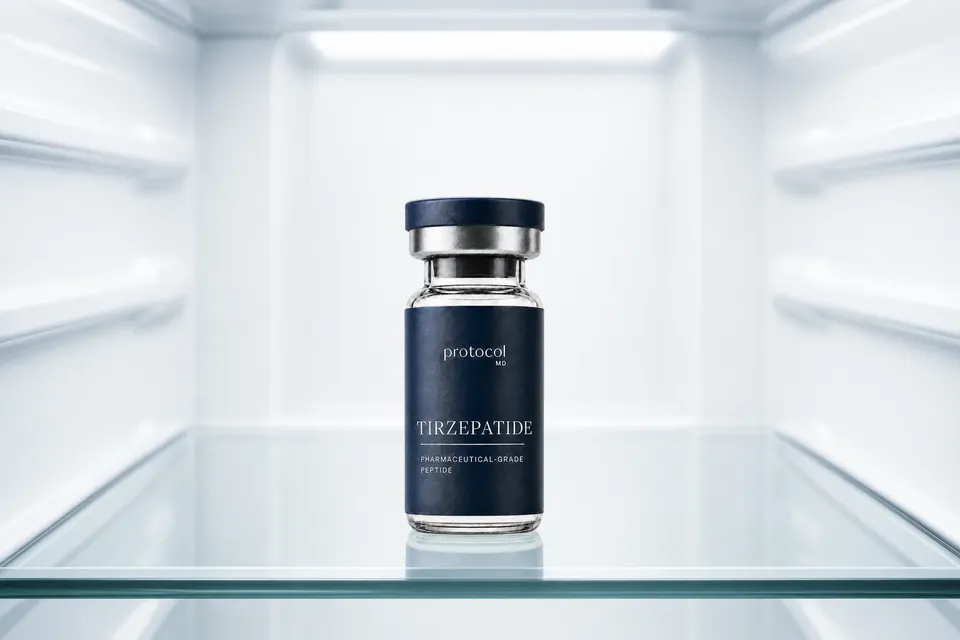
At the time of this writing, the Protocol MD formulary is compounded GLP-1 medication (semaglutide and tirzepatide, our flagship), Sermorelin, NAD+ and Glutathione. The GLP-1s are covered by the essentially-a-copy rule above; the other three depend on the bulk-substance framework. None are permanently shielded — the FDA's review is active, and we update our formulary if the rules change.
Compounded GLP-1 (semaglutide and tirzepatide)
Each compounded GLP-1 prescription is written by a licensed physician for an individual patient after an intake review, and filled by a licensed 503A pharmacy. Compounded GLP-1 medications are not FDA-approved and are not the same as Ozempic, Wegovy, Mounjaro or Zepbound. Results vary, not everyone is a candidate, and the thyroid C-cell tumor boxed warning applies.
Sermorelin
Sermorelin is a growth hormone–releasing hormone (GHRH) analogue. It was FDA-approved as Geref for children's growth hormone deficiency and diagnostic testing until its 2008 discontinuation, which the FDA later determined was not for safety or effectiveness reasons. It prompts the pituitary to release its own growth hormone rather than supplying the hormone directly. A compounded Sermorelin preparation is not an FDA-approved drug. A physician prescribing it is making a clinical judgment that the potential benefit for a specific patient warrants the use of a compounded preparation — and is monitoring the outcome.
NAD+
NAD+ (nicotinamide adenine dinucleotide) injectable preparations have been available through the compounding framework. The molecule itself is a coenzyme involved in hundreds of enzymatic reactions across energy metabolism, DNA repair signaling, and mitochondrial function — it's not exotic, it's fundamental. Injectable preparations have been used in clinical settings. Injection avoids breakdown in the gut, but no human trial shows that injected NAD+ raises levels inside cells more than oral precursors do. The research continues to develop, and a compounded injectable requires physician oversight before it makes clinical sense for any individual patient.
Glutathione
Glutathione injectable preparations have similarly been available through compounding. The FDA has issued warnings in the context of specific intravenous skin-lightening uses — a different market segment and clinical context from physician-supervised longevity and performance medicine. That warning concerns skin lightening, which Protocol MD does not prescribe glutathione for. As with any compounded preparation, injectable glutathione is not FDA-approved.
The Protocol MD intake — an online assessment that screens for contraindications, then a US-licensed physician's review before any prescription — isn't a compliance formality. It's what physician oversight actually means in practice. Your card is authorized at checkout and charged only if a physician approves your prescription. Ask your physician what lab testing your protocol includes.
Whether any treatment is appropriate for you specifically is a clinical decision that belongs to a licensed provider who has reviewed your history and your goals.
The rule, then: a 503A pharmacy can compound for an individual patient with a valid prescription, but only within the FDA's limits on which ingredients qualify and on copying commercially available drugs, which is why a compliant pharmacy and physician oversight matter. The primary sources are public and worth reading directly rather than through a vendor's summary: the FDA's compounding laws and policies page sets out the 503A and 503B frameworks, its compounding questions and answers covers what compounded medicines are and are not, and its list of bulk drug substances that may present significant safety risks is where Category 2 designations actually live. If you want the shorter version of the legal question, we cover it in are peptides legal in 2026, and what peptide therapy involves explains the clinical side.
FAQ
Frequently Asked Questions
What is a 503A compounded peptide?
A 503A compounded peptide is a patient-specific peptide preparation made by a state-licensed compounding pharmacy against a prescription from a licensed physician for a specific identified patient. Section 503A of the Federal Food, Drug, and Cosmetic Act allows compounding pharmacies to prepare medications outside the standard FDA new-drug-approval process, provided the bulk drug substances they use meet eligibility requirements — including appearing on the FDA's 503A bulk substances nomination list, having a USP monograph, or being a component of an already-approved drug. Compounded peptides are not FDA-approved drugs. They are physician-prescribed preparations that must meet pharmacy board oversight and, for sterile injectables, USP Chapter 797 sterility standards.
Are compounded peptides FDA approved?
No. Compounded medications are not FDA-approved regardless of their bulk substance's list status. FDA approval applies to specific drug products that have gone through the full new drug approval process — clinical trials, manufacturing review, labeling approval. Compounded preparations are patient-specific medications prepared under section 503A or 503B exemptions, which allow compounding without full drug approval. A substance being in Category 1 on the FDA's bulk substances list means the FDA hasn't identified a reason to restrict its compounding while review is ongoing — it is not a safety endorsement or approval finding.
Are compounded peptides legal?
Yes, when a licensed 503A pharmacy compounds an eligible ingredient against a patient-specific prescription. Eligibility varies by peptide and changes with FDA review; for the peptide-by-peptide legal picture, including research chemicals and state rules, see are peptides legal in 2026.
What's the difference between 503A and 503B compounding?
503A governs state-licensed compounding pharmacies that prepare patient-specific prescriptions — this is the pathway for telehealth and outpatient clinical use. 503B governs FDA-registered outsourcing facilities that compound for healthcare facilities without patient-specific prescriptions, under cGMP manufacturing standards comparable to pharmaceutical manufacturing. The bulk substances lists for each pathway are separate. An action on the 503A list doesn't automatically affect 503B eligibility, and vice versa. Most physician-prescribed peptide therapy moves through 503A.
What does Category 1 vs. Category 2 mean for peptides?
Category 1 means the FDA has accepted a bulk substance nomination for review and has not identified significant safety concerns that would restrict compounding while that review is ongoing. It is not a completed safety review or approval. Category 2 means the FDA has identified significant safety concerns with a nominated substance. While category determinations are technically guidance rather than binding regulation — and formal objection pathways exist — reputable 503A pharmacies generally treat Category 2 substances as off-limits for compounding, given the regulatory and liability exposure involved.
How does a licensed 503A pharmacy differ from an online peptide vendor?
A licensed 503A pharmacy operates under state pharmacy board oversight, compounding standards, and USP Chapter 797 sterility requirements for sterile preparations. It compounds only against patient-specific prescriptions from licensed physicians, sources bulk substances from FDA-registered manufacturers with Certificates of Analysis, and dispenses through an accountable chain from prescription to patient. Online "research chemical" vendors operate with none of these requirements, and nothing obliges them to test what they ship. The structural accountability difference is not primarily legal — it's the presence or absence of verified sourcing, sterile manufacturing, and physician oversight.
What is USP Chapter 797 and why does it matter for injectable peptides?
USP Chapter 797 is the enforceable standard that governs sterile compounding at licensed pharmacies. It specifies clean room classifications, environmental monitoring, personnel training and competency requirements, beyond-use dating, and release testing for sterile preparations. For injectable peptides — where sterility failure carries direct infection risk — USP 797 compliance is the infrastructure that ensures a preparation is safe to inject, not just chemically accurate. A research-chemical vial was not prepared under USP 797 conditions. That gap is not a technicality.
Why does Protocol MD require a physician review before prescribing?
Because a compounded prescription is a clinical decision for one patient. A US-licensed physician reviews your intake, history and medications, screens for contraindications, and decides whether any treatment is appropriate before anything is compounded. Labs are ordered where the physician judges them necessary; ask what testing your protocol includes. Your card is authorized at checkout and charged only if a physician approves your prescription.
Citations & Sources
- U.S. Food and Drug Administration. Compounding Laws and Policies. https://www.fda.gov/drugs/human-drug-compounding/compounding-laws-and-policies
- U.S. Food and Drug Administration. FDA clarifies policies for compounders as national GLP-1 supply begins to stabilize. https://www.fda.gov/drugs/drug-alerts-and-statements/fda-clarifies-policies-compounders-national-glp-1-supply-begins-stabilize
- U.S. Food and Drug Administration. Certain bulk drug substances for use in compounding that may present significant safety risks. https://www.fda.gov/drugs/human-drug-compounding/certain-bulk-drug-substances-use-compounding-may-present-significant-safety-risks
- 21 CFR 216.23, Bulk drug substances that can be used to compound drug products in accordance with section 503A. https://www.ecfr.gov/current/title-21/chapter-I/subchapter-C/part-216/subpart-B/section-216.23
Educational only — not medical advice. Compounded medications are not FDA-approved. Protocol MD sells compounded GLP-1 medication, Sermorelin, NAD+ and Glutathione and has a commercial interest in this topic. A licensed provider determines whether any treatment is appropriate for you based on your individual history and clinical presentation. Consult a licensed physician before starting any compounded medication.
Published April 26, 2026. Last updated October 7, 2026.