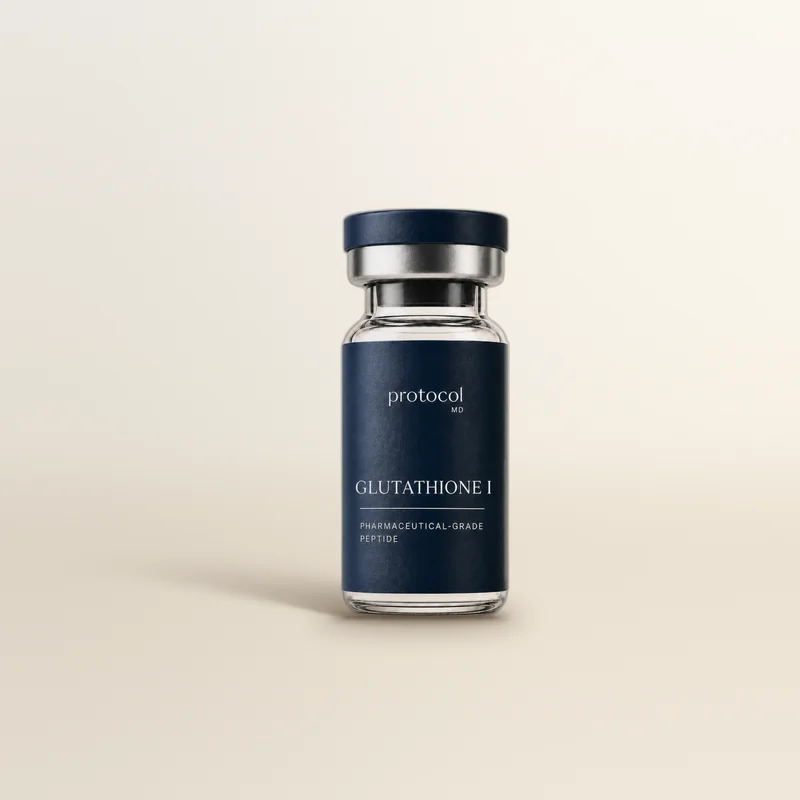
 Available in all 50 states
Glutathione Injections
A key cellular antioxidant.
Starting at
$116/mo
- A US-licensed physician reviews your intake and decides if it’s right for you
- Async physician review within 24 hours
- Ships ready to inject — no reconstitution
- Subscription · cancel anytime
Glutathione injections are physician-prescribed, 503A-compounded injections of glutathione, the tripeptide antioxidant the body builds from glutamate, cysteine, and glycine. Protocol MD prescribes them online in all 50 states, and a US-licensed physician reviews your intake and decides whether glutathione is appropriate for you. There are no FDA-approved glutathione products in the United States, so compounded glutathione is not FDA-approved. Protocol MD does not prescribe glutathione for skin lightening and promises no cosmetic outcome.
Glutathione is a tripeptide composed of three amino acids: glutamate, cysteine, and glycine. It's one of the body's most abundant intracellular antioxidants.
What is glutathione and what does it do?
Glutathione is a tripeptide (glutamate, cysteine, glycine) often called the body's 'master antioxidant' — the most abundant intracellular antioxidant and a key cofactor for liver detoxification. Levels decline with age and oxidative stress, which is why some protocols work to restore it.
What are the benefits of glutathione?
Patients commonly pursue glutathione for antioxidant support and recovery. It's a cofactor the body uses for oxidative-stress defense and liver detoxification. Individual response varies, and we make no disease-treatment claims.
Why an injection instead of oral glutathione?
Oral glutathione has poor bioavailability — much of it is broken down in the gut before absorption. An injection bypasses the gut, which is the reason the injectable route is used at all; no human trial has shown that it raises glutathione inside cells. Protocol MD dispenses glutathione only as a subcutaneous injection and does not administer intravenous infusions.
How It Works
Physician-prescribed, in three simple steps.
Free assessment, 100% online
Answer a few questions about your health history, lifestyle, and goals through our secure online medical intake. It takes about five minutes.
Physician review & prescription
A US-licensed physician reviews your intake and prescribes Glutathione only if it's clinically appropriate for you. We place a hold on your card at checkout and charge it only if they prescribe.
Delivered to your door
If prescribed, your medication ships cold-chain and discreetly to your door, with continuous physician oversight and simple refills.
Overview
What Is Glutathione?
Glutathione is a tripeptide composed of three amino acids: glutamate, cysteine, and glycine. It's one of the body's most abundant intracellular antioxidants.
Glutathione levels decline with age and are depleted by oxidative stress. Injection is used to bypass the gut, where swallowed glutathione is largely broken down before absorption; whether that raises glutathione inside cells has not been established in human trials.
Sourcing & safety
Pharmaceutical-grade vs. Dietary-supplement-grade Glutathione
On August 27, 2026, the FDA reminded compounders not to use dietary-supplement-grade glutathione to make injectable drugs, after reports of at least 30 patients who had adverse events following intravenous glutathione. Every affected preparation traced back to one lot of supplement-grade glutathione, and two Texas pharmacies recalled injectable glutathione over elevated endotoxin levels. The FDA notice lists fever, chills, pain, dizziness, and signs of shock or sepsis among the reported reactions, with some hospitalizations; the CDC is investigating alongside it and notes reactions can be severe enough to need emergency care. So the useful question before you buy glutathione injections online is not what they cost. It is what grade of ingredient went in, and which pharmacy put it there.
- Ingredient grade — Supplement-grade glutathione is manufactured to be swallowed, not injected. The FDA's position is that ingredients labeled for dietary-supplement use may carry impurities and contaminants, including endotoxins, that can be harmful when administered by injection. Protocol MD's glutathione is compounded from pharmaceutical-grade active ingredient intended for the injectable route.
- The pharmacy — Protocol MD's glutathione is prepared by a US-licensed 503A compounding pharmacy: state-board licensed, USP <797> compliant for sterile preparations, and a PCCA member. The pharmacy is named on your paperwork, not left vague.
- Batch testing — Every batch is third-party lab tested for purity, identity, and sterility. Worth saying out loud, because the FDA said it first: testing alone is not a quality program. Quality has to be built into ingredient sourcing, stock-solution preparation, and finished-drug release, which is why a pharmacy's process matters more than any single certificate of analysis.
- Route — Protocol MD dispenses glutathione as a subcutaneous injection that ships ready to inject. We do not administer intravenous infusions, and the 2026 adverse-event reports the FDA and CDC are investigating involved intravenous glutathione. Route is a clinical decision your physician makes with you, not a preference you select at checkout.
- Three questions for any provider — Ask who compounds the glutathione, whether the active ingredient is pharmaceutical-grade and intended for injection, and whether batches are third-party tested. The FDA's own recommendation to clinicians after the 2026 reports was to check with their compounder about the source of the glutathione. A seller who cannot answer those three questions in writing is the risk, whatever the price is.
Disclosure: Protocol MD sells physician-prescribed compounded glutathione, so we have a commercial interest in what you decide on this page. That is also the reason this section exists rather than a longer benefits list — in this category the honest pitch is a sourcing answer. There are no FDA-approved glutathione products in the United States, compounded glutathione is not FDA-approved, and no outcome is promised. A US-licensed physician reviews your intake and will tell you if glutathione is not appropriate for you, and you are never charged if that is the answer.
Who It's For
Who Glutathione Is For.
Heavy Oxidative-stress Exposure
Patients managing high oxidative load from lifestyle or chronic stress.
Antioxidant Support
Patients seeking cellular antioxidant support.
Recovery Support
Athletes and high-output professionals managing chronic oxidative load.
Longevity Stacks
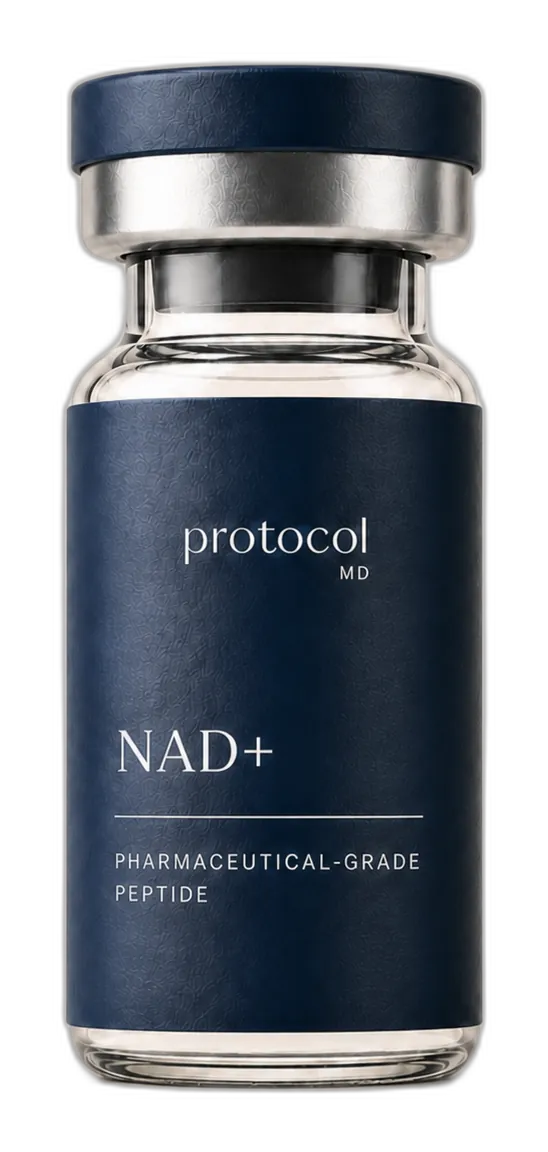
Often paired with NAD+ in foundational longevity stacks.
How Glutathione works
Defends the cell. Helps clear what it can't use.
Glutathione is the most abundant antioxidant inside human cells. It donates electrons to unstable molecules and helps bind compounds into a form the body can excrete. Levels decline with age.
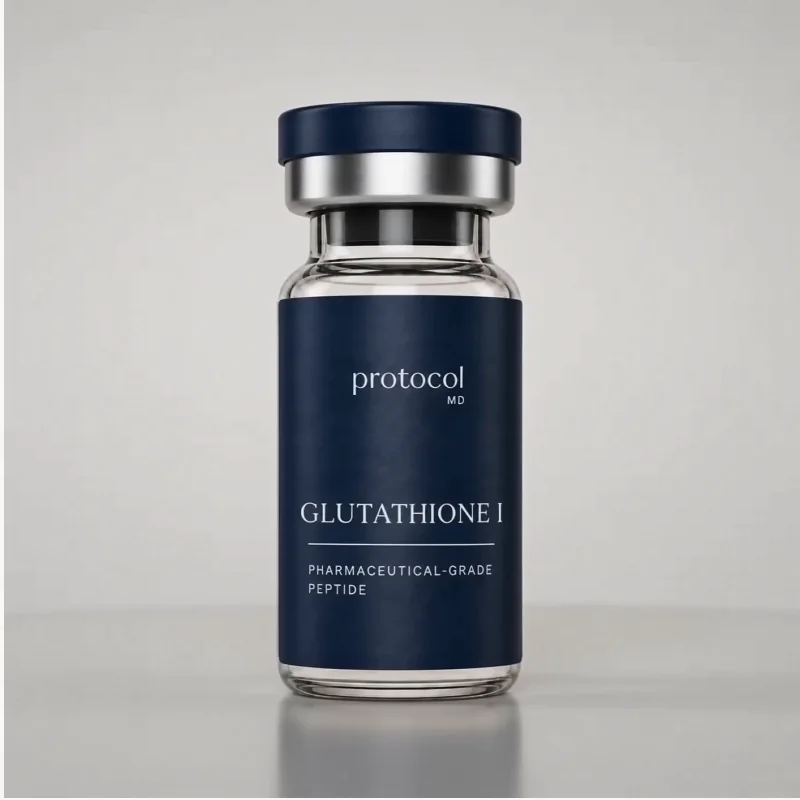
Neutralises free radicals
Glutathione gives up an electron to reactive oxygen species, stabilising them before they can damage DNA, proteins and cell membranes.
Supports detoxification
In phase II liver detoxification, glutathione attaches to compounds and makes them water-soluble enough for the body to clear.
Involved in immune regulation
Glutathione is present at high concentrations inside immune cells and participates in how they activate and then resolve a response.
Why glutathione
Glutathione drops as you age.
It is the antioxidant your cells use to neutralise free radicals.
Lower in healthy older adults
Blood glutathione was measured in healthy adults across a wide age range. Older adults had markedly lower levels than younger ones, and the people with the highest levels tended to be in better general health.
Source: Lang CA, Naryshkin S, Schneider DL, Mills BJ, Lindeman RD. J Lab Clin Med. 1992;120(5):720-5.
The whole redox system shifts
It is not only the amount that changes. With age, more of the body's glutathione is found in its spent, oxidised form, so less of it is available to do the work of neutralising free radicals.
Source: Erden-Inal M, Sunal E, Kanbak G. Cell Biochem Funct. 2002;20(1):61-6.
Charts are illustrative representations of published research and of the known properties of a medication class or active ingredient. They may simplify or normalise study data for clarity, describe general biology rather than any individual's result, and are not a prediction or guarantee of an outcome. A reference to a study or mechanism does not establish that any specific medication, formulation or treatment plan produces the same result. Compounded medications are not FDA-approved and are not evaluated by the FDA for safety, quality or effectiveness.
Explore other treatments
View all peptidesTirzepatideRx
Weight Loss
Compounded medications are not FDA-approved and are not the same as the brand-name versions.
SemaglutideRx
Weight Loss
Compounded medications are not FDA-approved and are not the same as the brand-name versions.
FAQ
Common questions about Glutathione.
What is glutathione and what does it do?
Glutathione is a tripeptide (glutamate, cysteine, glycine) often called the body's 'master antioxidant' — the most abundant intracellular antioxidant and a key cofactor for liver detoxification. Levels decline with age and oxidative stress, which is why some protocols work to restore it.
What are the benefits of glutathione?
Patients commonly pursue glutathione for antioxidant support and recovery. It's a cofactor the body uses for oxidative-stress defense and liver detoxification. Individual response varies, and we make no disease-treatment claims.
Why an injection instead of oral glutathione?
Oral glutathione has poor bioavailability — much of it is broken down in the gut before absorption. An injection bypasses the gut, which is the reason the injectable route is used at all; no human trial has shown that it raises glutathione inside cells. Protocol MD dispenses glutathione only as a subcutaneous injection and does not administer intravenous infusions.
What are the possible side effects of glutathione?
Injectable glutathione is generally well tolerated; mild, temporary injection-site reactions are the most common report. Your physician reviews your history and sets an appropriate protocol — share all medications and conditions during intake.
glutathione side effectsHow is glutathione dosing decided?
A US-licensed physician sets and adjusts dosing to your history and tolerance for the subcutaneous route Protocol MD dispenses. We don't publish protocols because glutathione should be dosed under medical supervision.
How is Glutathione prescribed through Protocol MD?
You complete a short online intake, and a US-licensed physician (MD or DO) reviews your history and goals to decide whether Glutathione is appropriate — a physician makes the call, never an algorithm. We place a hold on your card at checkout, and if they decide it isn't right for you, the hold is released and you're never charged.
Do I need insurance?
No insurance is required — Protocol MD is cash-pay and transparently priced, with no surprise fees. HSA and FSA debit cards are accepted at checkout, and every charge has an itemized receipt in your patient portal for reimbursement. Physician-prescribed medication is generally an eligible expense, but plans vary, so check with your plan administrator.
Ready to start?
Buy Glutathione Injections online, physician-prescribed.
Complete your medical intake. A US-licensed physician reviews it and prescribes only if appropriate. We place a hold at checkout and charge it only if a physician prescribes.