%20scale(0.008000%20-0.008000)'%3e%3cpath%20d='M74%20714H250L447%20155H449L641%20714H815V0H696V551H694L496%200H393L195%20551H193V0H74Z'/%3e%3c/g%3e%3cg%20transform='translate(114.2240%2035.7)%20scale(0.008000%20-0.008000)'%3e%3cpath%20d='M76%20714H372Q454%20714%20514.0%20686.0Q574%20658%20612.0%20609.5Q650%20561%20668.5%20496.0Q687%20431%20687%20357Q687%20283%20668.5%20218.0Q650%20153%20612.0%20104.5Q574%2056%20514.0%2028.0Q454%200%20372%200H76ZM201%20102H324Q397%20102%20443.5%20121.5Q490%20141%20516.5%20175.5Q543%20210%20552.5%20256.5Q562%20303%20562%20357Q562%20411%20552.5%20457.5Q543%20504%20516.5%20538.5Q490%20573%20443.5%20592.5Q397%20612%20324%20612H201Z'/%3e%3c/g%3e%3c/g%3e%3c/svg%3e)
Key takeaways
- NMN is a precursor molecule that your body converts into NAD+, the active coenzyme.
- NAD+ levels decline with age, which is why maintaining them has become a longevity focus.
- Oral NAD+ breaks down readily in digestion, while oral NMN is comparatively more stable.
- Injectable or IV NAD+ avoids gut breakdown, but infused NAD+ is rapidly broken down in the blood, and no human trial shows it raises cellular NAD+ more than oral precursors.
01
NMN vs NAD+ at a glance
| NMN | NAD+ | |
|---|---|---|
| What it is | A precursor (building block) | The active coenzyme |
| Role | Gets converted into NAD+ | Powers hundreds of cellular reactions |
| Molecular size | Smaller (~334 g/mol) | Larger (~663 g/mol) |
| Needs conversion? | Yes, one enzymatic step into NAD+ | No, it is already the end product |
| Oral stability | More stable through digestion | Breaks down readily in the gut |
| Human evidence | Oral NMN raised blood NAD+ in trials | IV NAD+ is rapidly cleared from plasma and metabolized |
| Typical forms | Capsules, powder (oral) | Injection, IV; oral is inefficient |
| In short | Supply the raw material | Supply the end product, which the body largely breaks down and rebuilds |
02
NMN vs NAD+: what is the actual difference?
The single most useful thing to understand is the relationship. NAD+ is the coenzyme your cells depend on for energy metabolism and repair. It is involved in hundreds of reactions, and its levels naturally decline as you age, which is why it has become a longevity talking point (Conlon, 2022).
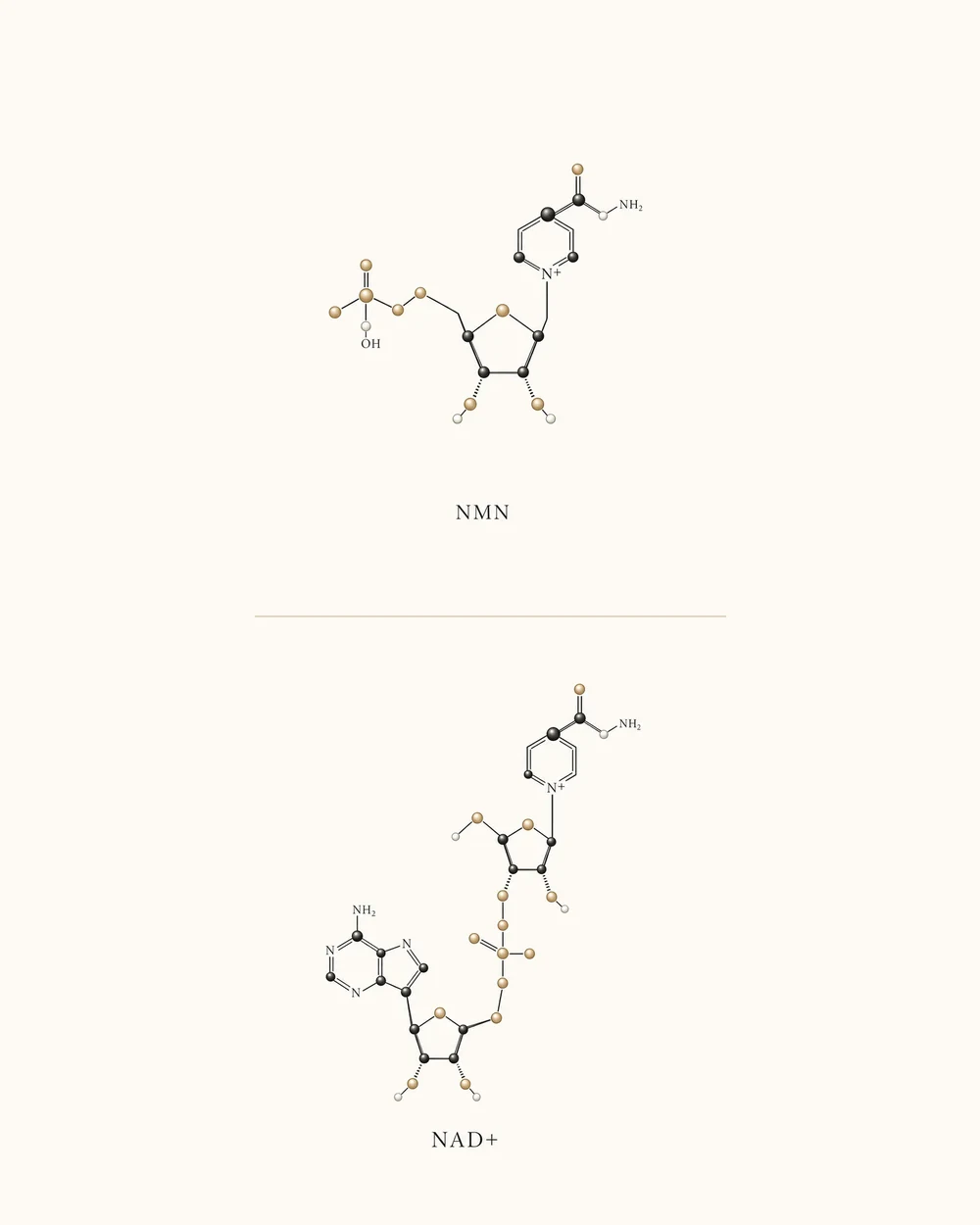
NMN is one of the last steps your body uses to make NAD+. Through a single enzymatic conversion (via the salvage pathway), NMN becomes NAD+. So when you take NMN, you are giving your body the raw material to build its own NAD+. When you take NAD+ directly, you are supplying the finished coenzyme.
That is the whole difference in one sentence: NMN is the precursor, NAD+ is the product. Everything else (size, absorption, which form to take) follows from that.
03
Why NAD+ matters, and why it declines with age
NAD+ is not a niche molecule. It is a coenzyme present in every cell, and it sits at the center of two jobs your body cannot do without: turning food into usable cellular energy, and running the repair and signaling enzymes (the sirtuins and PARPs) that maintain your DNA. When people talk about "boosting NAD+," this is the machinery they are trying to support.
The reason the entire NMN-and-NAD+ conversation exists is that NAD+ levels fall as you age. That decline is significant and well documented, and it is why NAD+ has become a longevity focus in the first place (Conlon, 2022). Lower NAD+ means less of the coenzyme available for energy metabolism and cellular repair. Whether someone approaches that gap with a precursor like NMN or with direct NAD+, the underlying goal is identical: keep cellular NAD+ from running low. That shared goal is what makes the whole "NMN versus NAD+" question coherent.
04
Difference between NAD and NMN
Beyond "precursor vs product," three concrete differences matter:
- Molecular size. NMN is the smaller molecule (around 334 g/mol) and NAD+ is nearly twice as large (around 663 g/mol). Size affects how easily each crosses cell membranes and survives digestion.
- Stability in the gut. NAD+ is fragile in the digestive tract and degrades before much of it is absorbed. NMN is more stable, which is part of why oral NMN supplements are popular.
- Whether conversion is needed. NMN must still be converted into NAD+ once it is inside you. NAD+ does not need converting, but it faces the absorption problem above when taken orally.
So the two are closely related but genuinely distinct: same pathway, different points on it, different practical behavior.
05
How NMN converts into NAD+
The conversion itself is straightforward, which is a big part of NMN's appeal. Your body runs a recycling route called the salvage pathway to keep NAD+ topped up, and NMN sits near the end of it. A single enzymatic step (via NMN adenylyltransferase, or NMNAT) turns NMN directly into NAD+. That is why NMN is often called the "final precursor": it is only one reaction away from the finished coenzyme.
This one-step conversion is why NMN is a popular oral choice. Compared with starting further back in the pathway, NMN hands your cells material that is already close to the end product. The limitation is not the conversion, it is everything before it: the NMN still has to survive digestion and get absorbed, which is where oral bioavailability, dose, and product quality all come into play. Put simply, the conversion is the easy step and the absorption is the variable one.
06
Is NMN the same as NAD+?
No. NMN and NAD+ are related but not the same molecule. NMN is a precursor, and NAD+ is the active coenzyme your body makes from it. Think of NMN as an ingredient and NAD+ as the finished dish. You will sometimes see them used loosely as if interchangeable, especially in marketing, but they are chemically different and behave differently in the body. (You will also see the question typed as "is nmn and nad the same" or the common misspelling "mnm vs nad." Same question, same answer: closely related, not identical.)
07
Is NMN better than NAD+?
This is the question everyone actually wants answered, and the honest answer is: it depends on the form, not just the molecule.
- For oral supplements, NMN generally has the edge, because NAD+ itself is poorly absorbed when swallowed (it breaks down in the gut), while NMN is more stable and only needs one conversion step. That is why most oral "NAD" products are actually NMN or another precursor.
- Once you move to injection or IV, the gut drops out of the picture. Injectable and IV NAD+ bypass digestion, so there is no gut absorption loss. That is not the same as delivering the coenzyme intact into cells: in the first human study of IV NAD+, infused NAD+ was rapidly and completely removed from plasma for the first two hours, with a breakdown-product profile showing enzymes in the blood degrading it (Grant et al., 2019). Cells then rebuild NAD+ from those pieces, much as they do from precursors.
So "is NMN better than NAD+" has no universal winner. Oral NMN beats oral NAD+ on absorption. Direct NAD+ (injectable or IV) avoids the gut entirely, but it is also broken down and rebuilt, and no head-to-head human trial has compared injectable NAD+ with oral NMN on cellular NAD+ levels. The right question is not "which molecule," it is "which delivery method fits my goal," which we get to below.
08
What about NR? (NAD vs NMN vs NR)
You will also run into NR (nicotinamide riboside), another NAD+ precursor that sits one step earlier in the pathway than NMN. NR and NMN are both oral precursors that your body converts toward NAD+. The practical takeaway is the same as the NMN story: they are precursors that must be absorbed and converted, whereas injected NAD+ skips gut absorption (though it is still broken down and rebuilt in the body). For most people comparing "NAD vs NMN vs NR," the more decisive variable is still the delivery method, not which precursor.
09
The part that matters most: bioavailability and delivery
Here is the theme running through every comparison above. The molecule matters less than how you take it. Oral precursors like NMN and NR have to survive digestion, get absorbed, and then convert. Oral NAD+ barely survives the gut at all. Both oral routes face real, well-documented absorption limits.
Oral NMN does have real advantages inside that oral category. Human trials show it works at the most basic level: in a 14-day randomized, placebo-controlled study of 65 healthy adults, oral NMN and NR comparably raised circulating NAD+, while nicotinamide did not (Christen et al., 2026). That study, run by Nestlé researchers, also suggested part of the effect runs through gut bacteria converting the precursors into nicotinic acid, so "stable and easy to convert" is not the whole story either. The oral bioavailability of these molecules is still an active research question rather than a settled number. Oral NAD+ has the bigger problem of the two: because it is large and fragile, much of a swallowed dose degrades in the digestive tract before it can be used, which is the core reason capsule NAD+ is considered inefficient and most oral "NAD" products are actually precursors like NMN.
Injectable and IV NAD+ sidestep the gut problem. That is why clinical and physician-supervised NAD+ is almost always given by injection or IV rather than a capsule. They do not sidestep metabolism: infused NAD+ is cleared from plasma and broken down quickly, and how much of the dose ends up as intracellular NAD+ is still being studied (Grant et al., 2019). Consumer-health coverage reaches a similar place: NAD+ supplements are generally considered safe, and the research on what they do is still early (Cleveland Clinic).
10
Which one should you actually take?
If you are set on an oral product, NMN is the more sensible precursor, since oral NAD+ is largely wasted in the gut. If your priority is bypassing gut absorption, injection or IV is the route that does it. Cost, convenience and evidence all factor in: oral precursors are cheaper, simpler and better studied, while injected NAD+ is more involved and removes the gut-absorption variable without a proven advantage inside cells. There is no single right answer for everyone, which is exactly why it is worth deciding with a clinician who can match the approach to your goals rather than picking based on a supplement label.
11
How Protocol MD approaches NAD+
The Protocol MD NAD+ protocol is physician-prescribed, compounded by a licensed 503A pharmacy, and given as a subcutaneous injection, so it avoids the gut breakdown that makes oral NAD+ inefficient. Compounded NAD+ is not FDA-approved. That means a real evaluation up front and a dose set by a prescriber. It does not mean injected NAD+ is proven to raise cellular NAD+ more than oral NMN; no human trial has compared them. See how Protocol MD's physician-prescribed NAD+ works, or read our complete NAD+ guide for the full picture, including NAD+ benefits and side effects.
12
The bottom line
NMN vs NAD+ is not really a contest between two rivals. NMN is the precursor and NAD+ is the active coenzyme your body builds from it. Oral NMN absorbs better than oral NAD+, which is why most swallowed "NAD" products are actually precursors. Oral NMN has raised blood NAD+ in human trials. Injectable or IV NAD+ avoids the gut but is broken down and rebuilt by the body, so neither route is a simple pipe into your cells. If you want the gut-absorption variable removed and a physician setting the dose, physician-supervised injectable NAD+ does that, without a proven advantage over oral NMN.
FAQ
Frequently Asked Questions
What is the difference between NMN and NAD+?
NMN is a precursor that your body converts into NAD+, the active coenzyme that powers hundreds of cellular processes. NMN is the ingredient; NAD+ is the finished product. NMN is smaller and more stable in the gut, while NAD+ is larger and degrades when swallowed, which is why direct NAD+ is usually given by injection or IV.
Is NMN the same as NAD+?
No. They are related but chemically different. NMN is a precursor; NAD+ is the coenzyme your body makes from it. They are often used loosely in marketing, but they are not interchangeable.
Is NMN better than NAD+?
It depends on the form. Oral NMN absorbs better than oral NAD+ (which breaks down in the gut), and it has raised blood NAD+ in human trials. Injectable or IV NAD+ bypasses the gut, though the body breaks much of it down and rebuilds it. No head-to-head human trial has settled which raises cellular NAD+ more.
Is NMN and NAD the same thing? (also searched as "mnm vs nad")
No. "MNM vs NAD" is a common misspelling of "NMN vs NAD." NMN is the precursor, NAD+ is the active coenzyme it converts into. Closely related, not identical.
What is the difference between NAD, NMN, and NR?
NAD+ is the active coenzyme. NMN and NR are both precursors your body converts toward NAD+, with NR sitting one step earlier than NMN in the pathway. Both precursors must be absorbed and converted; injected NAD+ skips gut absorption but is still metabolized once in the blood.
Should I take NMN or NAD+ (or both)?
For oral supplementation, NMN is the more practical precursor. If your goal is to bypass gut absorption, injectable or IV NAD+ does that, though the body still metabolizes it. Which fits you depends on your goals and is a conversation worth having with a physician rather than guessing.
Why is NAD+ given by injection or IV instead of a pill?
Because NAD+ is a large, fragile molecule that largely breaks down in the digestive tract, oral NAD+ is inefficient. Injection and IV bypass the gut and deliver it into circulation, which is why physician-supervised NAD+ is almost always administered that way. Once there, enzymes break much of it down and cells rebuild NAD+ from the pieces.
Citations & Sources
- Conlon NJ, et al. The Role of NAD+ in Regenerative Medicine. Plast Reconstr Surg, 2022. PMID 36170435. https://pubmed.ncbi.nlm.nih.gov/36170435/
- Grant R, et al. A Pilot Study Investigating Changes in the Human Plasma and Urine NAD+ Metabolome During a 6 Hour Intravenous Infusion of NAD+. Front Aging Neurosci, 2019. PMID 31572171. https://pubmed.ncbi.nlm.nih.gov/31572171/
- Christen S, et al. The differential impact of three different NAD+ boosters on circulatory NAD and microbial metabolism in humans. Nat Metab, 2026 (Nestlé-funded). PMID 41540253. https://pubmed.ncbi.nlm.nih.gov/41540253/
- Cleveland Clinic. NAD+ supplements: can they really slow down aging? https://health.clevelandclinic.org/nad-supplement
Educational only. This article does not diagnose, prevent, treat, or cure any condition, and it is not medical advice. NAD+ therapy is available by prescription following evaluation by a licensed physician, and individual results vary. Compounded NAD+ is not an FDA-approved drug, and Protocol MD has a commercial interest in the NAD+ it prescribes. Always speak with your physician before starting any supplement or therapy.
Published July 14, 2026. Last updated October 2, 2026.