%20scale(0.008000%20-0.008000)'%3e%3cpath%20d='M74%20714H250L447%20155H449L641%20714H815V0H696V551H694L496%200H393L195%20551H193V0H74Z'/%3e%3c/g%3e%3cg%20transform='translate(114.2240%2035.7)%20scale(0.008000%20-0.008000)'%3e%3cpath%20d='M76%20714H372Q454%20714%20514.0%20686.0Q574%20658%20612.0%20609.5Q650%20561%20668.5%20496.0Q687%20431%20687%20357Q687%20283%20668.5%20218.0Q650%20153%20612.0%20104.5Q574%2056%20514.0%2028.0Q454%200%20372%200H76ZM201%20102H324Q397%20102%20443.5%20121.5Q490%20141%20516.5%20175.5Q543%20210%20552.5%20256.5Q562%20303%20562%20357Q562%20411%20552.5%20457.5Q543%20504%20516.5%20538.5Q490%20573%20443.5%20592.5Q397%20612%20324%20612H201Z'/%3e%3c/g%3e%3c/g%3e%3c/svg%3e)
Key takeaways
- Sermorelin does not add growth hormone; it asks your pituitary to release more of your own, in the pulses it already uses.
- The realistic order of change is sleep (weeks 1–4), then energy and recovery (weeks 4–12), then body composition (months 3–6), if at all.
- The adult human evidence is small and mostly short-term; dramatic before-and-after galleries are marketing, not documentation.
- Results depend on your baseline, sleep, training, protein intake and consistency — and on a physician confirming sermorelin is appropriate for you.
01
What Sermorelin Before and After Actually Means
Before sermorelin, the typical adult who ends up asking about it describes a familiar cluster: sleep that is shallower than it was, recovery from training that takes days instead of hours, energy that fades by mid-afternoon, and body composition that drifts toward the middle despite unchanged habits. None of these is a disease. All of them track the natural decline in growth hormone output, which falls by something like half between the twenties and the fifties as the pituitary's nightly pulses shrink.*
After sermorelin — for the people it helps — the same cluster reverses, partially, in a fairly consistent order. The order matters more than any single outcome, because it is what separates a genuine physiological response from wishful thinking. If a clinic tells you body composition changes in week two, you are not reading physiology.
The honest framing is this: sermorelin before and after is a shift from running at roughly eighty percent of your own baseline back toward it. It is not a shift to somebody else's baseline. The molecule can only amplify a signal your pituitary is still capable of sending.
02
How Sermorelin Works — and Why the Timeline Follows From It
Your pituitary releases growth hormone in pulses, most of them during the first hours of deep sleep. Growth hormone-releasing hormone from the hypothalamus triggers each pulse; somatostatin shuts it off. With age, the triggering signal weakens, the pulses get smaller, and the downstream messenger — insulin-like growth factor 1, made in the liver — falls with them.
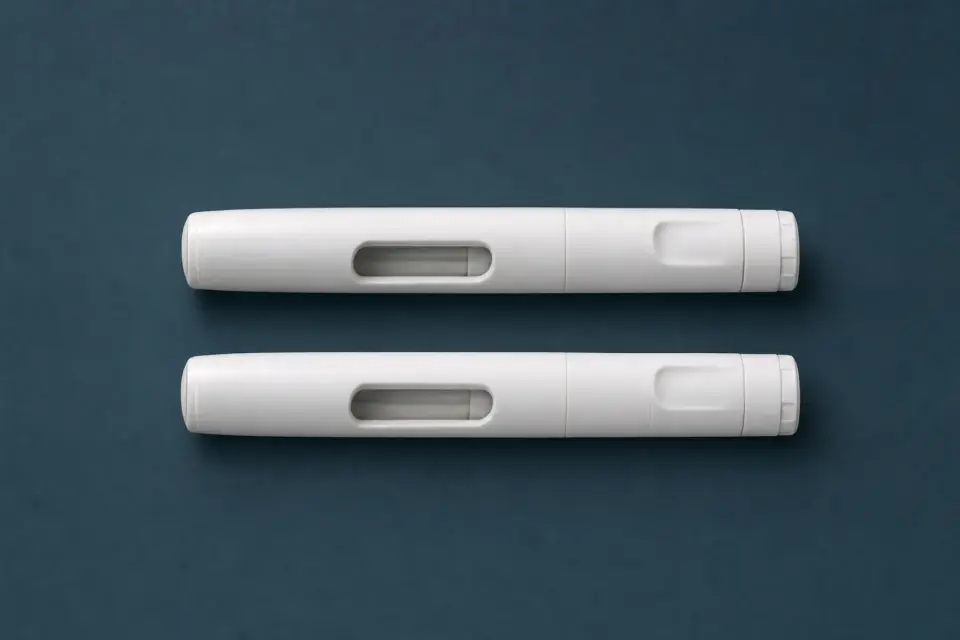
Sermorelin is the first 29 amino acids of that triggering hormone, which turn out to be the part that does the work. Given by subcutaneous injection, usually at night, it binds the same pituitary receptors and increases the size of the pulse the gland was already going to release. Two consequences follow. First, the release stays pulsatile and stays under your own feedback control — somatostatin still applies the brakes — which is the safety argument for sermorelin over injected growth hormone. Second, you cannot force more out than your pituitary can make, which is the ceiling argument.
This is also why the timeline runs sleep → energy → recovery → body composition. Sleep changes reflect the pulse itself arriving in the right window. Energy and recovery reflect IGF-1 rising over weeks. Body composition reflects months of slightly altered lipolysis and protein synthesis, layered on top of whatever training and diet you bring. The order is the mechanism, read forwards.
03
Sermorelin Results Timeline: Month by Month
| Period | What people commonly report | What it reflects | How confident to be |
|---|---|---|---|
| Weeks 1–4 | Deeper sleep, waking less, feeling more rested; occasional injection-site redness, flushing or a mild headache early on | The overnight GH pulse arriving in the deep-sleep window | Moderate — the most consistently reported early change |
| Weeks 4–8 | Steadier daytime energy; less of the mid-afternoon fade; training soreness resolving faster | IGF-1 rising toward a new steady state | Moderate — expected from mechanism, variable in size |
| Weeks 8–12 | Recovery between sessions clearly shorter; some notice skin feels less dry; mood and focus steadier for some | Sustained IGF-1 plus better sleep compounding | Modest — real for many, subtle for others |
| Months 3–6 | Gradual shift in body composition: some fat loss around the middle, some lean mass retained or gained — with training and adequate protein | Months of altered lipolysis and protein synthesis | Low-to-modest — the smallest and least reliable change, and the one most dependent on your own effort |
| Beyond 6 months | Maintenance of the above; no new categories of change | Steady state | Whatever you have by month six is roughly what you have |
Two honest caveats on the table. The percentages of people who experience each change are not known, because the adult trials were small and short. And every row assumes you are sleeping enough, training, and eating adequate protein. Sermorelin does not substitute for any of those; it amplifies what they were already doing.
04
What Most People Notice First
Sleep. Almost every credible account, clinical and anecdotal, puts sleep first, and the mechanism agrees: the pulse sermorelin amplifies is the one that coincides with slow-wave sleep. People describe falling asleep about as easily as before but staying asleep, and waking with the sense of having actually rested. This usually appears inside the first two to four weeks, and for some it is the only change they would swear to.
It is worth saying plainly that better sleep is not a side benefit. It is likely the main channel through which everything else on the timeline happens. Recovery, mood, appetite regulation and body composition all run through sleep quality, which is why people who already sleep well tend to report less from sermorelin than people who do not.
The gear-shift question, then: if sleep is what improves first and most, is sermorelin just an expensive sleep aid? Not quite — the IGF-1 changes are real and measurable — but if sleep is your only complaint, there are cheaper and better-studied places to start, and a good physician will say so.
05
Sermorelin Before and After for Women
Women ask about sermorelin before and after slightly differently: less about muscle, more about sleep, skin, energy and body composition through perimenopause. The mechanism is identical, and growth hormone secretion declines in women on the same curve, so the timeline above applies. What differs is context. Perimenopausal sleep disruption has several drivers — falling progesterone and oestrogen among them — and sermorelin addresses only one. A woman evaluating sermorelin for sleep should have the others looked at too, or she may be treating the smallest contributor first.
The evidence in women specifically is thinner than in men, which was already thin. Treat claims about "sermorelin for females before and after" with the same scepticism as the general ones, and expect the same order of change.
06
What Sermorelin Will Not Do
- It will not produce a visible physique change in weeks. If body composition moves at all, it moves over months, modestly, and only alongside training and protein.
- It will not change your face. "Sermorelin before and after face" galleries are lighting and marketing. Growth hormone does affect skin thickness and hydration over long periods, but not in a way a camera captures.
- It will not replace sleep, training, or an adequate diet. It amplifies their effects; it does not substitute for them.
- It will not work if your pituitary cannot respond. Adults with true pituitary damage need actual growth hormone under an endocrinologist, not a secretagogue.
- It will not build muscle like anabolic steroids or injected growth hormone. That is the point — the ceiling is the safety feature — but it disappoints people who arrived expecting the other thing.
The cons of sermorelin, honestly listed: it is a nightly injection; early injection-site reactions, flushing and headache are common and usually fade; it is a long-term commitment for a modest, gradual return; and the adult evidence base does not justify strong promises. Anyone who does not tell you these things is selling, not advising.
07
What the Evidence Actually Supports
Sermorelin has a real regulatory history. It was approved by the FDA in 1997 under the brand name Geref for diagnosing and treating growth hormone deficiency in children, and was withdrawn from the market in 2008 for commercial rather than safety reasons.* Its use in adults for age-related decline has never carried an approved indication; it is prescribed and compounded off-label, and that is the honest status of every sermorelin protocol in the country, including ours.
The adult evidence is small. Short trials in older men and women in the 1990s and 2000s showed that daily sermorelin restored growth hormone pulses and IGF-1 toward younger levels, with modest improvements in lean mass and reductions in fat in some studies, over periods of a few months.* Sleep and wellbeing findings are mostly secondary or observational. There are no large, long, placebo-controlled trials of sermorelin for healthy-ageing outcomes, and there is no long-term safety dataset of the kind that exists for testosterone.
So the calibrated position is: enough to pay attention to, not enough to promise anything. The mechanism is sound, the biochemistry reliably moves, the subjective changes are consistently reported, and the hard outcome data is thin. That is a reasonable basis for a physician-supervised trial in the right person. It is not a basis for a before-and-after gallery.
08
What Happens When You Stop Taking Sermorelin
Because sermorelin stimulates rather than replaces, stopping it does not crash your own production the way stopping injected growth hormone or testosterone can. Your pituitary simply returns to releasing its own pulses at their previous size. In practice, people report that sleep quality drifts back first, over weeks, and that energy and recovery follow. Body-composition changes that were supported by training and diet tend to hold better than those that were not, for the obvious reason.
There is no recognised withdrawal syndrome and no rebound below baseline that the evidence supports. What you lose when you stop is roughly what you gained — gradually, in reverse order — which is one more reason to think of sermorelin as a long-horizon decision rather than a course.
09
Is Sermorelin Worth It? A Physician's Honest Framing
It depends on what you are buying. If you are buying a dramatic transformation, no — it does not sell one, and any clinic that says otherwise is not being straight with you. If you are buying a plausible, physician-supervised nudge to a declining signal, with sleep as the likely first return and modest gains beyond, then it can be a reasonable choice, provided the basics are already in place and someone has confirmed it is appropriate for you.
The people who are happiest with sermorelin, in our experience, are the ones who arrived with realistic expectations, tracked their sleep and training, and judged it at six months rather than six weeks. The people who are disappointed almost always expected the photograph.
10
How ProtocolMD Handles Sermorelin
ProtocolMD's physician-prescribed sermorelin starts with a review rather than a checkout. A licensed physician evaluates your history and goals and decides whether sermorelin is appropriate at all — it is not for everyone, and it is not for anyone with an active malignancy or an untreated pituitary problem. Where it is appropriate, the prescription is filled by a 503A compounding pharmacy against your individual prescription, shipped cold-chain, and dosing is set and adjusted by the prescriber against how you respond. We do not publish dosing figures on this site, because a number on a blog is not a prescription.
The realistic before-and-after, in one line: most people go from running at about eighty percent of their own baseline back toward it — sleep first, then energy and recovery, then, modestly, body composition — over months, with consistency, to a degree that varies by individual. That is a genuinely worthwhile outcome. It is not the one the internet sells.
Realistically, sermorelin before and after looks like sleep first, energy and recovery second, and modest body-composition change last — over months, varying by person, and never guaranteed.
FAQ
Frequently Asked Questions
How quickly will I see results with sermorelin?
Sleep is usually the first change, inside two to four weeks. Steadier energy and faster recovery typically follow over weeks four to twelve as IGF-1 rises. Body composition, if it changes, moves last and most modestly, over three to six months, and only alongside training and adequate protein. Individual timelines vary.
What are the cons of sermorelin?
It is a nightly injection and a long-term commitment for a modest, gradual return. Early injection-site redness, flushing and headache are common and usually fade. The adult evidence base is small and short-term, and there is no approved adult indication — sermorelin for age-related decline is prescribed off-label.
How quickly does sermorelin burn fat?
It does not "burn fat" on any quick timeline. Growth hormone modestly increases fat breakdown over months, and small studies in older adults showed modest fat reduction over several months of daily use. Any change depends heavily on diet and training, and it is the smallest and least reliable part of sermorelin before and after.
What should I not mix with sermorelin?
Tell your prescribing physician about everything you take. Corticosteroids and some thyroid, insulin and diabetes medications interact with growth hormone signalling, and stacking sermorelin with other growth hormone secretagogues or with unprescribed peptides is not something to do without medical supervision. Your physician, not a forum, should answer this for your specific medications.
Does sermorelin work for women?
The mechanism and timeline are the same in women, and growth hormone declines on the same curve. Women most often report sleep, energy and skin changes rather than muscle. Perimenopausal sleep problems have several hormonal drivers, so sermorelin should be evaluated alongside them rather than instead of them. The evidence in women specifically is thin.
What happens when you stop taking sermorelin?
Your pituitary returns to its previous pulse size. Sleep quality tends to drift back first over weeks, then energy and recovery. There is no recognised withdrawal or rebound below baseline. Body-composition changes supported by training and diet hold better than those that were not.
Is sermorelin the same as HGH?
No. HGH is growth hormone itself, injected directly, bypassing your pituitary and its feedback control. Sermorelin is a fragment of the releasing hormone that asks your pituitary to release more of its own growth hormone, in pulses, still under your body's brakes. That is why sermorelin's effects are gentler, slower and capped by your own gland.
Citations & Sources
- Growth hormone secretion declines progressively with age ("somatopause"); reviews estimate roughly a 14% fall per decade after early adulthood. See: Veldhuis JD, et al. Aging and hormones of the hypothalamo-pituitary axis. Endocr Rev. 2005. https://pubmed.ncbi.nlm.nih.gov/?term=veldhuis+aging+growth+hormone+secretion+review
- Sermorelin acetate (Geref) — FDA approval 1997 for paediatric growth hormone deficiency; discontinued 2008 for commercial reasons. FDA Drugs@FDA record: https://www.accessdata.fda.gov/scripts/cder/daf/index.cfm?event=BasicSearch.process&searchterm=geref
- Adult studies of GHRH(1-29) in older men and women restoring GH/IGF-1 with modest body-composition changes over months: Corpas E, et al. Growth hormone (GH)-releasing hormone-(1-29) twice daily reverses the decreased GH and IGF-I levels in old men. J Clin Endocrinol Metab. 1992; Walker RF. Sermorelin: a better approach to management of adult-onset growth hormone insufficiency? Clin Interv Aging. 2006. https://pubmed.ncbi.nlm.nih.gov/?term=sermorelin+adult+growth+hormone
Medically reviewed by Dr. Richard Dentico, MD. Educational only — this article does not diagnose, prevent, treat, or cure any condition and is not medical advice. The timelines described are commonly reported patterns and mechanistic expectations, not guarantees; individual results vary and some people notice little change. Sermorelin has no FDA-approved indication in adults for age-related decline and is prescribed off-label; ProtocolMD's sermorelin is physician-prescribed and compounded by a 503A pharmacy, and compounded medications are not FDA-approved. ProtocolMD sells sermorelin and therefore has a commercial interest in this topic. Do not start, stop, or change any medication without your prescribing physician.
Medically reviewed by Dr. Richard Dentico, MD. Published September 17, 2026.
Take the assessment