%20scale(0.008000%20-0.008000)'%3e%3cpath%20d='M74%20714H250L447%20155H449L641%20714H815V0H696V551H694L496%200H393L195%20551H193V0H74Z'/%3e%3c/g%3e%3cg%20transform='translate(114.2240%2035.7)%20scale(0.008000%20-0.008000)'%3e%3cpath%20d='M76%20714H372Q454%20714%20514.0%20686.0Q574%20658%20612.0%20609.5Q650%20561%20668.5%20496.0Q687%20431%20687%20357Q687%20283%20668.5%20218.0Q650%20153%20612.0%20104.5Q574%2056%20514.0%2028.0Q454%200%20372%200H76ZM201%20102H324Q397%20102%20443.5%20121.5Q490%20141%20516.5%20175.5Q543%20210%20552.5%20256.5Q562%20303%20562%20357Q562%20411%20552.5%20457.5Q543%20504%20516.5%20538.5Q490%20573%20443.5%20592.5Q397%20612%20324%20612H201Z'/%3e%3c/g%3e%3c/g%3e%3c/svg%3e)

Key takeaways
- NAD IV therapy enters the bloodstream directly; an NAD+ injection is absorbed from under the skin or from muscle. Both avoid the gut, where oral precursors must first be absorbed and converted.
- An IV delivers a larger dose over one to four hours in a clinic; an at-home injection takes seconds and suits an ongoing routine.
- In the first human study of an NAD+ infusion, plasma NAD+ did not rise for the first two hours because the infused NAD+ was cleared as fast as it went in.
- No human trial has shown that IV or injected NAD+ raises NAD+ inside cells more than oral precursors, and large outcome trials are lacking.
- Protocol MD's NAD+ is physician-prescribed and 503A-compounded for at-home injection; compounded NAD+ is not FDA-approved, and Protocol MD has a commercial interest in this topic.
01
NAD IV vs. injection vs. oral, at a glance
| IV infusion | Injection (SubQ/IM) | Oral (NMN / NR capsules) | |
|---|---|---|---|
| How it's given | Drip into a vein, in a clinic | Small shot, at home or clinic | Swallowed |
| Absorption | Directly into bloodstream | Absorbed from under the skin or muscle | Precursor, absorbed from the gut and converted |
| Time per session | 1–4 hours | Seconds | Instant |
| Setting | Clinic or IV bar | At home (if prescribed) | Anywhere |
| Relative cost | Highest per session | Lower per dose | Lowest |
| Best suited to | A large single dose in a clinic | An ongoing routine without clinic visits | Lowest cost; the most trial data |
02
Why the delivery route matters for NAD+
NAD+ (nicotinamide adenine dinucleotide) is a coenzyme your cells use for energy metabolism, DNA repair, and cellular signaling, and its levels decline with age, which is the mechanistic rationale behind NAD therapy (Covarrubias et al., 2021). The practical question is delivery. Researchers have spent years searching for safe and effective ways to boost NAD+ (Rajman et al., 2018). Oral options are usually precursors — NMN or NR — that your body absorbs and converts into NAD+, and a randomized trial showed oral NR does raise NAD+ in middle-aged and older adults (Martens et al., 2018). IV and injection avoid the gut, but they do not avoid metabolism: infused NAD+ is broken down in the blood. So "which is best" is a trade-off between practicality, cost and evidence, not a contest the injectable routes have been shown to win.
03
What is NAD IV therapy?
A NAD+ IV drip delivers NAD+ directly into a vein over a clinic session that typically runs one to four hours, often as part of a larger bag of fluids. Because it goes straight into the bloodstream, none of the dose is lost to digestion. Providers usually recommend an initial "loading" series of sessions followed by maintenance infusions. The trade-offs are the ones the IV-clinic pages tend to gloss over: each session is a real time commitment (hours in a chair, sometimes with a fasting requirement beforehand), it happens at a location you have to travel to, and the per-session clinic cost repeats every visit.
04
What NAD+ actually does in the body
NAD+ is not a nutrient in the vitamin sense — it's a coenzyme, a molecule your cellular machinery needs to function. It helps shuttle electrons through the process that produces cellular energy (ATP), and it's the substrate for NAD+-sensing enzyme families such as sirtuins that are central to aging research (Rajman et al., 2018).
Because NAD+ levels fall with age, people pursue NAD therapy to support these processes. An honest note, because the IV-clinic marketing tends to overshoot: NAD+ is genuinely important biochemistry, but the mechanism being well established is not the same as guaranteed outcomes. The large human trials on NAD+ outcomes — especially for IV or injectable NAD+ — are still early, and individual results vary and depend on a clinical evaluation. Anyone promising a dramatic transformation from a drip is getting ahead of the evidence.
Even the basic pharmacology of an NAD IV drip is thinly studied. A small 2019 pilot study that measured blood and urine during a six-hour intravenous NAD+ infusion found that plasma NAD+ and its metabolites did not change for the first two hours, because the infused NAD+ was rapidly cleared from the plasma, and only rose later in the session (Grant et al., 2019). That is one reason Protocol MD treats NAD IV therapy claims about instant effects with caution.
05
NAD IV therapy benefits: what people seek and what has been shown
The NAD IV therapy benefits people seek are more energy, clearer thinking, faster recovery and healthier aging. Controlled human trials have not confirmed any of these for IV NAD+. What has been measured is pharmacology, not symptoms: in the one published infusion pilot, plasma NAD+ did not rise for the first two hours and rose only later in the six-hour session (Grant et al., 2019). Oral NR raised blood NAD+ in a randomized trial (Martens et al., 2018), but that too was a blood biomarker, not a felt benefit.
So an NAD+ IV drip is a way to get NAD+ into the bloodstream. It has not been shown to produce a benefit you would feel, and individual reports are hard to separate from expectation, rest and the fluids that often come in the same bag.
06
NAD+ injections: the at-home alternative
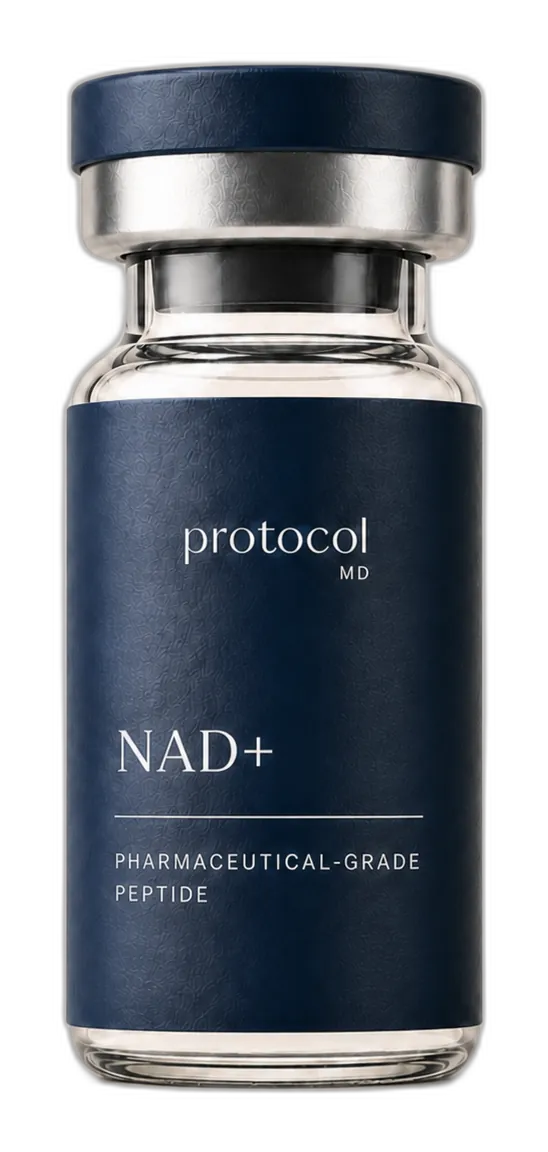
A NAD+ injection delivers the same molecule as a small subcutaneous or intramuscular shot that takes seconds. Like the IV, it avoids the gut. Unlike the IV, it is absorbed from under the skin or from muscle rather than entering a vein, and it doesn't require an infusion chair, a fasting window, or hours of your day, and when it's physician-prescribed and compounded by a licensed pharmacy, it can be self-administered at home.
Where it fits: injections suit people who want an ongoing routine without repeated clinic trips. They are not a proven equivalent of an IV dose, and no trial has compared the two routes head to head. This is the route Protocol MD's physician-prescribed NAD+ uses, compounded by a licensed 503A pharmacy and shipped for at-home use. Compounded NAD+ is not FDA-approved, and Protocol MD sells it, so weigh this comparison with that commercial interest in mind.
07
NAD IV vs. injection: the honest head-to-head
Here's the part the IV-only pages skip. An IV and an injection deliver the same molecule by different routes. No trial has compared their effects. Here is how they differ:
- Convenience: injection wins. Seconds at home versus one to four hours in a clinic.
- Single-dose volume: IV wins. It can carry a larger dose plus other fluids in one sitting.
- Ongoing cost and time: injection wins for a routine; the clinic premium and travel repeat every IV.
- Getting started nationally: injection wins. IV requires a local clinic; a prescribed at-home injection can be arranged through telehealth from anywhere it's licensed.
08
How much does NAD IV therapy cost?
Cost is often what decides this. NAD IV sessions are typically the most expensive route per visit, because you're paying for the clinic, the infusion time, and the added fluids — and that cost repeats with every session, on top of any loading series. At-home NAD+ injections carry a lower per-dose cost and remove the travel and appointment overhead entirely. Oral precursors are cheapest. Comparing a single treatment, the gap is modest; comparing an ongoing routine, the cost and time advantages of at-home injection compound month over month. Exact pricing depends on the provider and your prescribed protocol.
09
NAD IV therapy side effects and safety
NAD+ is generally well tolerated across routes. The effect people notice most during an IV is a wave of flushing, chest tightness, or nausea if the drip is pushed too fast, which is exactly why clinic infusions are run slowly over hours. A subcutaneous injection has no drip rate to slow, and its common effects are injection-site soreness or redness rather than the infusion rush. We cover the full picture in our NAD side effects guide; the short version is that both routes are generally mild when dosed appropriately under physician supervision, and with an IV, going slower is the main way to stay comfortable.
10
NAD IV therapy near me vs. an at-home NAD+ injection
NAD IV therapy needs a clinic near you. A physician-prescribed NAD+ injection is a different route that can be arranged through telehealth wherever it's licensed and shipped to you; our NAD+ injections near me guide covers how to compare local and telehealth options.
11
How Protocol MD approaches NAD+
Protocol MD's NAD+ is physician-prescribed and 503A-pharmacy compounded, delivered as an at-home injection. In the Protocol MD NAD+ protocol, a physician evaluation comes before any prescription, a licensed physician sets the dose, and the medication is delivered to your door — rather than booking and paying for an infusion every few weeks. If you're weighing IV versus injection, the honest first step is an evaluation, not "add to cart." See how Protocol MD's physician-prescribed NAD+ works, or read our complete NAD+ guide for the full picture.
12
The bottom line
NAD IV therapy and NAD+ injection deliver the same molecule by different routes: an IV enters the bloodstream directly, and an injection is absorbed from under the skin. Both avoid the gut, but oral precursors raise blood NAD+ too, and no human trial has shown that either injectable route raises NAD+ inside cells more than oral. The real decision is practical: an IV suits a large, one-time, clinic-based dose, while an at-home injection suits an ongoing routine without the hours, the travel and the per-visit cost.
FAQ
Frequently Asked Questions
What is NAD IV therapy?
NAD IV therapy delivers NAD+ — a coenzyme central to cellular energy and DNA repair — directly into a vein over a clinic infusion that usually lasts one to four hours. Because it goes straight into the bloodstream, none of the dose is lost to digestion, unlike oral NAD precursors.
Is NAD IV better than an injection?
Neither has been shown to be better. An IV enters the bloodstream directly and allows a larger single dose in a clinic; an injection is absorbed from under the skin, takes seconds and suits an ongoing routine. No trial has compared their effects head to head. For most people building a routine, injection is more practical; for a large one-time dose, IV has a use case.
How much does NAD IV therapy cost?
NAD IV sessions typically carry the highest per-visit cost because you're paying for the clinic, the infusion time, and added fluids, and it repeats each visit (often after a loading series). At-home injections have a lower per-dose cost and remove travel and appointment overhead. Exact pricing depends on the provider and your prescribed protocol.
What are the side effects of NAD IV therapy?
The most common effects are flushing, chest tightness, or nausea during the infusion if it's pushed too quickly, which is why IVs are run slowly over hours. Subcutaneous injections have no drip rate to slow; their common effects are injection-site soreness or redness. Both are generally mild when dosed appropriately under physician supervision.
Is there NAD IV therapy near me, or can I do it at home?
An NAD+ IV drip needs a local clinic, but a physician-prescribed at-home NAD+ injection can be arranged through telehealth wherever it's licensed, so you don't need a nearby infusion clinic. It is a different route, absorbed from under the skin, not a home IV.
How often do you need NAD+ therapy?
Clinics often use an initial series followed by maintenance sessions, but there's no universal schedule — the right frequency depends on your goals and a physician's assessment, which is one more reason to use it under medical supervision rather than a fixed drip package.
Citations & Sources
- Covarrubias AJ, Perrone R, Grozio A, Verdin E. NAD+ metabolism and its roles in cellular processes during ageing. Nat Rev Mol Cell Biol. 2021;22(2):119-141. PMID 33353981. https://pubmed.ncbi.nlm.nih.gov/33353981/
- Rajman L, Chwalek K, Sinclair DA. Therapeutic Potential of NAD-Boosting Molecules: The In Vivo Evidence. Cell Metab. 2018;27(3):529-547. PMID 29514064. https://pubmed.ncbi.nlm.nih.gov/29514064/
- Grant R, et al. A Pilot Study Investigating Changes in the Human Plasma and Urine NAD+ Metabolome During a 6 Hour Intravenous Infusion of NAD. Front Aging Neurosci. 2019;11:257. PMID 31572171. https://pubmed.ncbi.nlm.nih.gov/31572171/
- Martens CR, et al. Chronic nicotinamide riboside supplementation is well-tolerated and elevates NAD+ in healthy middle-aged and older adults. Nat Commun. 2018;9(1):1286. PMID 29599478. https://pubmed.ncbi.nlm.nih.gov/29599478/
Educational only — this article does not diagnose, prevent, treat, or cure any condition, and it is not medical advice. NAD+ therapy is available by prescription following evaluation by a licensed physician; compounded NAD+ is not FDA-approved, and Protocol MD sells it and has a commercial interest in this topic. Individual results and side effects vary. Always speak with your physician before starting or stopping any therapy.
Published July 18, 2026. Last updated October 2, 2026.