%20scale(0.008000%20-0.008000)'%3e%3cpath%20d='M74%20714H250L447%20155H449L641%20714H815V0H696V551H694L496%200H393L195%20551H193V0H74Z'/%3e%3c/g%3e%3cg%20transform='translate(114.2240%2035.7)%20scale(0.008000%20-0.008000)'%3e%3cpath%20d='M76%20714H372Q454%20714%20514.0%20686.0Q574%20658%20612.0%20609.5Q650%20561%20668.5%20496.0Q687%20431%20687%20357Q687%20283%20668.5%20218.0Q650%20153%20612.0%20104.5Q574%2056%20514.0%2028.0Q454%200%20372%200H76ZM201%20102H324Q397%20102%20443.5%20121.5Q490%20141%20516.5%20175.5Q543%20210%20552.5%20256.5Q562%20303%20562%20357Q562%20411%20552.5%20457.5Q543%20504%20516.5%20538.5Q490%20573%20443.5%20592.5Q397%20612%20324%20612H201Z'/%3e%3c/g%3e%3c/g%3e%3c/svg%3e)

Key takeaways
- NAD+ side effects differ by form: oral causes mild GI upset, IV can cause an infusion rush, and SubQ shots mostly cause injection-site soreness.
- The IV infusion rush, including nausea and flushing, is reported to ease once the drip is slowed down.
- Serious allergic reactions to NAD+ are uncommon but require immediate medical attention.
- Appropriate dosing and a physician-supervised infusion rate are the biggest factors in safety.
01
NAD+ side effects at a glance (by form)
| Form | What to expect |
|---|---|
| IV infusion | The infusion "rush": nausea, flushing, chest or abdominal tightness, lightheadedness. Described as rate-dependent; usually eases when the drip is slowed. |
| Subcutaneous injection | Mostly local: redness, soreness or mild swelling at the injection site. Occasional nausea, headache or flushing has been reported; there is no drip rate to slow. |
| Oral (capsules, NAD+/NMN/NR) | Mild, transient GI: nausea, stomach discomfort, headache, occasional diarrhea. |
| Call your doctor | A true allergic reaction (rash, swelling of face or throat, trouble breathing), or anything severe that does not settle after slowing or stopping. |
02
Why the form changes what you feel
NAD+ is a coenzyme your body makes and uses in every cell. How you take it changes both how much reaches your bloodstream and which side effects show up. Oral NAD+ (and precursors like NMN and NR) is processed through your gut, so its side effects are digestive. IV NAD+ goes directly into circulation and produces the well-known infusion reaction; a subcutaneous injection is absorbed more gradually from under the skin, so its side effects are mostly at the injection site. Because most "NAD+ side effects" articles only cover the oral supplement, they miss the injectable routes most readers are weighing, so let's start there.
03
The NAD+ IV "rush" (and why SubQ shots are different)
If you have looked into NAD+ IV therapy, you have probably heard about the "rush," and it is real. When NAD+ is delivered quickly, many people feel a wave of nausea, warmth or flushing, a tight or pressured feeling in the chest or abdomen, and lightheadedness. Some describe it as intense but short. Infusion clinics consistently tie it to speed: the faster the drip, the stronger the reaction, and slowing the infusion usually settles it. That account comes from clinical practice rather than trials. In the one published human pharmacokinetic study, eight healthy men received NAD+ by slow IV infusion over six hours and no adverse events were observed (Grant et al., 2019). That is why supervised NAD+ IVs are run slowly and adjusted to how you feel. Subcutaneous NAD+ is different: there is no drip to slow, and the dose is absorbed gradually from under the skin, so the infusion rush is not the typical experience. Some people report brief nausea, flushing or headache after a shot, and those reports have not been well studied.
In a supervised setting, this reaction is generally not considered dangerous. It is uncomfortable and transient, and the rate is the lever clinicians use to control it.
04
Oral NAD+ and precursor side effects
For oral NAD+, NMN, and NR, the side effects are mild and centered on digestion. Consumer-health coverage lists the common ones as nausea or stomach discomfort, headaches, lightheadedness, diarrhea, muscle cramps, and skin irritation (Cleveland Clinic). They are usually transient and settle as your body adjusts. Oral precursors are converted along the way, yet randomized trials show oral nicotinamide riboside raises blood NAD+ (Martens et al., 2018). Injection avoids gut breakdown, but no human trial shows it raises NAD+ inside cells more than oral precursors do, and injected NAD+ has far less human safety data behind it.
The trial data say the same thing. A 2024 systematic review of NAD supplementation pooled 10 studies and 489 participants, mostly using oral NADH and NAD+ precursors. Supplementation was well tolerated. Every study recorded some side effects, and the most common were muscle pain, nervous-system complaints, fatigue, sleep disturbance and headaches, none of which posed a serious health risk to participants (Gindri et al., 2024).*
05
Injection-site reactions
With subcutaneous NAD+ injections, the most common local effect is what you would expect from any injectable: redness, soreness, or mild swelling at the injection site. Rotating sites, using a fresh sterile needle, and letting any alcohol dry before injecting prevents most of it.
06
Serious side effects and high doses
Serious reactions to NAD+ are uncommon, but you should know the signs and act on them: a true allergic reaction (rash or hives, swelling of the face, lips, or throat, or any trouble breathing) is a medical emergency, so seek care immediately.
On dosing: NAD+ and its building blocks appear well tolerated at typical doses, but very high intakes are a different story. A review of high-dose nicotinamide (a NAD+ precursor) found that headache, dizziness, and vomiting occurred in healthy people at large oral doses, and flagged that safety data at the top of the dose range is still limited (Hwang & Song, 2020). The practical takeaway is the same one that runs through this whole article: dose and rate matter, and both belong with a prescriber rather than a guessing game.
07
How long do NAD+ side effects last?
For IV, the infusion "rush" is the shortest-lived: by clinical accounts it settles soon after the drip is slowed and does not outlast the session. Oral GI effects are usually mild and pass as your body adjusts. Injection-site redness or soreness typically fades within a day or two, as with other under-the-skin injections. No trial has measured these timelines for NAD+ specifically. Anything persistent, worsening, or allergic is a reason to contact your prescriber rather than wait it out.
08
Are NAD+ injections and IV therapy safe?
For most people, physician-supervised NAD+ at appropriate doses and infusion rates is well tolerated. The infusion reaction, while unpleasant, is transient and is managed by slowing the delivery. The situations where NAD+ becomes genuinely risky are the familiar ones: unsupervised high-dose IVs pushed too fast, gray-market product of uncertain purity, and no one monitoring you. Supervised NAD+ from a licensed pharmacy reduces those risks, which is the point of doing it through a medical provider.
09
How to reduce your chances of side effects
- Go slow on IVs. The single most effective step. A slower infusion, titrated to how you feel, prevents most of the rush.
- Start under a prescriber's guidance. The right dose and delivery for you is the difference between barely noticing anything and a rough session.
- Hydrate and eat something first. Going in well-hydrated and not on a completely empty stomach tends to make the experience smoother.
- Nail injection technique (for subcutaneous): rotate sites, sterile needle each time, let alcohol dry.
- Report anything allergic immediately. Breathing changes, swelling, or hives are never "wait and see."
10
How Protocol MD approaches NAD+ safety
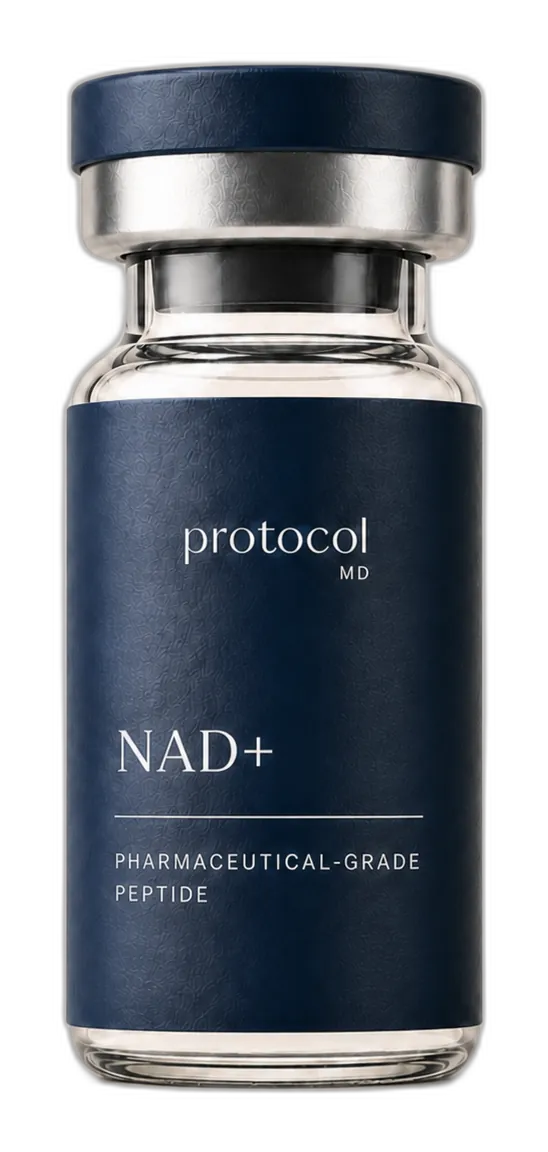
The Protocol MD NAD+ protocol is physician-prescribed and delivered as a subcutaneous injectable, with the dose set by a prescriber, so you are not betting on an unsupervised drip or a gray-market vial. It is compounded by a licensed 503A pharmacy, and compounded NAD+ is not an FDA-approved drug. That means a real evaluation up front, a dose and delivery set by a prescriber, and someone accountable if a side effect shows up. Those are the safeguards that keep NAD+ on the well-tolerated end of the spectrum. See how Protocol MD's physician-prescribed NAD+ works, or read our complete NAD+ guide for the full picture. (For the upside side of the ledger, see our rundown of NAD+ benefits.)
11
The bottom line
NAD+ side effects are, for most people, mild and closely tied to form. Oral means occasional digestive upset. IV means the characteristic infusion "rush," which is uncomfortable but transient and, by clinical accounts, controlled mainly by how slowly it is given. Subcutaneous injections mostly mean injection-site soreness. Serious reactions are uncommon. As with most things in this space, the factors that actually determine your experience are appropriate dosing, a sensible infusion rate, and a physician-supervised product from a licensed pharmacy rather than an unsupervised or gray-market one.
FAQ
Frequently Asked Questions
What are the most common NAD+ side effects?
For IV, the infusion "rush" (nausea, flushing, chest or abdominal tightness, lightheadedness) is most common and is tied to how fast it is given. For subcutaneous injections, redness or soreness at the injection site is most common. For oral NAD+, mild digestive effects (nausea, stomach discomfort, headache) are most common. Most effects are mild and short-lived.
Are NAD+ injections safe?
For most people, physician-supervised injections at appropriate doses are well tolerated, with injection-site soreness the usual complaint. The infusion reaction with IV forms is transient and managed by slowing delivery. Serious reactions are uncommon.
What is the NAD+ IV "rush," and is it dangerous?
It is a short wave of nausea, flushing, and chest or abdominal tightness that happens when NAD+ is infused quickly. It is uncomfortable but generally not dangerous in a supervised setting, and it usually eases when the drip is slowed. Rate is the main lever.
How long do NAD+ side effects last?
The IV rush usually settles soon after the infusion is slowed. Oral GI effects usually settle as your body adjusts. Injection-site reactions typically fade within a day or two. Anything persistent or allergic is a reason to call your prescriber.
Do IV and oral NAD+ have different side effects?
Yes. Oral effects are digestive because it goes through the gut. IV skips the gut but produces the rate-dependent infusion rush instead, and subcutaneous injections mostly cause injection-site soreness. The delivery method, more than the molecule, determines what you feel.
Who should be cautious with NAD+?
Anyone pregnant or breastfeeding, and anyone with a significant medical condition, should only use NAD+ after a physician evaluation. That evaluation exists to catch the situations where it is not appropriate.
Citations & Sources
- Hwang ES, Song SB. Possible adverse effects of high-dose nicotinamide: mechanisms and safety assessment. Biomolecules. 2020;10(5):687. https://pmc.ncbi.nlm.nih.gov/articles/PMC7277745/
- Cleveland Clinic. NAD+ supplements: can they really slow down aging? https://health.clevelandclinic.org/nad-supplement
- Grant R, et al. A Pilot Study Investigating Changes in the Human Plasma and Urine NAD+ Metabolome During a 6 Hour Intravenous Infusion of NAD+. Front Aging Neurosci. 2019;11:257. PMID 31572171. https://pubmed.ncbi.nlm.nih.gov/31572171/
- Martens CR, et al. Chronic nicotinamide riboside supplementation is well-tolerated and elevates NAD+ in healthy middle-aged and older adults. Nat Commun. 2018;9(1):1286. PMID 29599478. https://pubmed.ncbi.nlm.nih.gov/29599478/
- * Gindri IM, Ferrari G, Pinto LPS, et al. Evaluation of safety and effectiveness of NAD in different clinical conditions: a systematic review. Am J Physiol Endocrinol Metab. 2024;326(4):E417-E427. PMID 37971292. https://pubmed.ncbi.nlm.nih.gov/37971292/
Educational only. This article does not diagnose, prevent, treat, or cure any condition, and it is not medical advice. NAD+ therapy is available by prescription following evaluation by a licensed physician; compounded NAD+ is not FDA-approved, and individual results and side effects vary. Always speak with your physician about side effects and before starting or stopping any therapy.
Published July 13, 2026. Last updated October 2, 2026.