%20scale(0.008000%20-0.008000)'%3e%3cpath%20d='M74%20714H250L447%20155H449L641%20714H815V0H696V551H694L496%200H393L195%20551H193V0H74Z'/%3e%3c/g%3e%3cg%20transform='translate(114.2240%2035.7)%20scale(0.008000%20-0.008000)'%3e%3cpath%20d='M76%20714H372Q454%20714%20514.0%20686.0Q574%20658%20612.0%20609.5Q650%20561%20668.5%20496.0Q687%20431%20687%20357Q687%20283%20668.5%20218.0Q650%20153%20612.0%20104.5Q574%2056%20514.0%2028.0Q454%200%20372%200H76ZM201%20102H324Q397%20102%20443.5%20121.5Q490%20141%20516.5%20175.5Q543%20210%20552.5%20256.5Q562%20303%20562%20357Q562%20411%20552.5%20457.5Q543%20504%20516.5%20538.5Q490%20573%20443.5%20592.5Q397%20612%20324%20612H201Z'/%3e%3c/g%3e%3c/g%3e%3c/svg%3e)
Compounded GLP-1 Injections
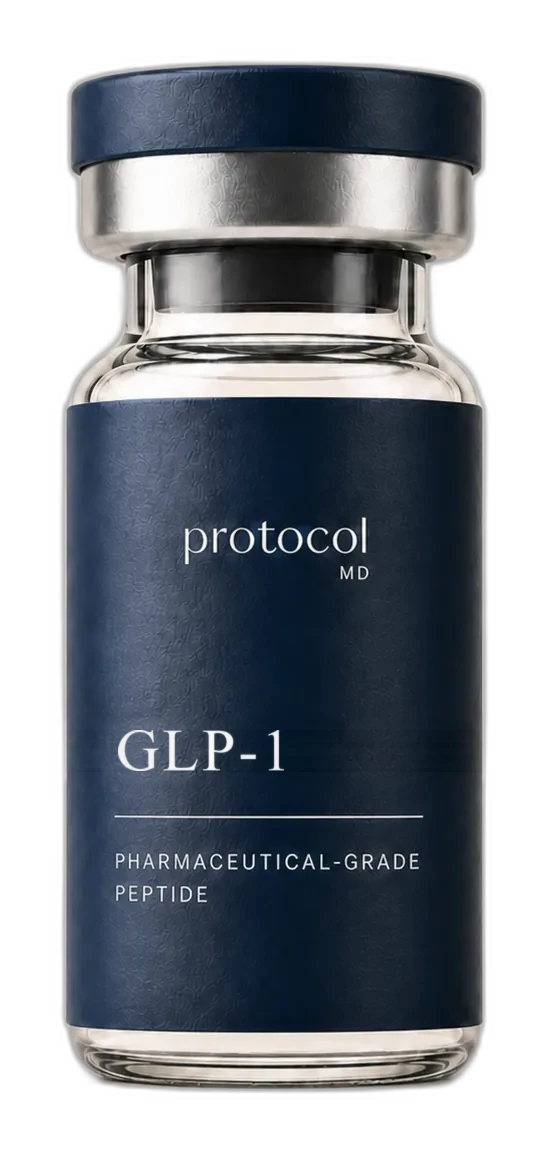
Compounded GLP-1 injections — semaglutide and tirzepatide — are physician-prescribed, 503A-compounded medications available online through Protocol MD in all 50 states. A US-licensed physician reviews your intake and decides whether treatment is appropriate for you. Compounded medications are not FDA-approved and are not the same as the brand-name versions.
Starting at
$135/mo
Get StartedNot sure which is right for you? Take the full assessmentIncludes physician review, 503A-compounded medication, and overnight cold-chain shipping. Refunded in full if a physician declines.
How It Works
Physician-prescribed, in three simple steps.
Free assessment, 100% online
Answer a few questions about your health history, lifestyle, and goals through our secure online medical intake. It takes about five minutes.
Physician review & prescription
A US-licensed physician reviews your intake and prescribes GLP-1 only if it's clinically appropriate for you. Your card is charged at checkout and refunded in full if they decide not to prescribe.
Delivered to your door
If prescribed, your medication ships cold-chain and discreetly to your door, with continuous physician oversight and simple refills.
Overview
What Is a GLP-1?
GLP-1 (glucagon-like peptide-1) is an incretin hormone your gut releases after you eat. It's part of the body's own appetite and blood-sugar signalling system — it communicates fullness to the brain, slows how quickly the stomach empties, and supports glucose-dependent insulin release.
A GLP-1 receptor agonist is a medication that acts on those same receptors. It's prescribed as a once-weekly subcutaneous injection, and it's used as part of a broader plan alongside nutrition and activity — not as a replacement for them.
Protocol MD's GLP-1 is compounded by a US-licensed 503A pharmacy. Compounded medications are not FDA-approved, and a US-licensed physician decides whether this treatment is appropriate for you.
Options
Compounded Semaglutide and Tirzepatide
Protocol MD offers two compounded GLP-1 options, and a physician decides which one — if either — is appropriate for you:
- Compounded semaglutide — a single GLP-1 receptor agonist, taken as a once-weekly injection.
- Compounded tirzepatide — a dual GIP and GLP-1 receptor agonist, also once weekly.
Both are prepared by a US-licensed 503A compounding pharmacy. Compounded medications are not FDA-approved and are not generic equivalents or substitutes for any brand-name product. Which one is right for you, and at what dose, is a decision your physician makes based on your history and how you respond. If you're weighing the two, read how the two compare.
What It Does
What Patients Use GLP-1 For.
These are common reasons patients pursue GLP-1 — not guaranteed outcomes. Individual results vary and require evaluation by a licensed physician, who may determine this therapy is not appropriate for you.
Appetite Signalling
Acts on the receptors involved in the body's own satiety signalling.
Gastric Emptying
Slows the rate at which the stomach empties after a meal.
Glucose-dependent Insulin Release
Supports insulin release in response to rising glucose.
Once-weekly Dosing
A single subcutaneous injection on the same day each week.
Structured Dose Escalation
A step-up schedule your physician sets to support tolerance.
Ongoing Physician Oversight
Your physician reviews how you respond and adjusts if appropriate.
Mechanism of Action
Acting on the Body's Own Incretin Signalling Pathway.
GLP-1 receptor agonists bind the same receptors as the natural incretin hormone. The relevant mechanisms are well characterised: signalling to the brain's appetite centres, slowing gastric emptying, and supporting glucose-dependent insulin secretion.
Because the effect builds with dose, treatment follows a gradual escalation schedule rather than starting at a full dose — which is why physician supervision and regular check-ins matter throughout.
Who It's For
Who a GLP-1 May Be Considered For.
Physician-assessed Weight Management
Adults whose physician determines treatment is clinically appropriate after review.
Alongside Nutrition and Activity
Intended as part of a broader plan, not a standalone substitute for it.
People Who Want Oversight
Ongoing physician review rather than a one-time transaction.
Not for Everyone
Certain histories rule it out entirely — the intake screens for them before any charge.
Research
The Evidence Base.
GLP-1 receptor biology is among the most extensively studied areas in metabolic medicine, and the mechanism of action is well characterised in the published literature.
Important distinction: the large clinical trial programs in this area (such as STEP and SURMOUNT) studied specific FDA-approved branded medications. They did not study compounded preparations, and their results should not be read as applying to one. Compounded medications are not FDA-approved and have not been evaluated by the FDA for safety or effectiveness. For an overview of what that literature does and doesn't establish, compare semaglutide and tirzepatide.
Your physician weighs the available evidence against your individual history and decides whether treatment is appropriate for you.
503A-pharmacy compounded under USP-797 standards.
Dosing
Educational Only — Your Physician Sets the Protocol.
A GLP-1 is given as a once-weekly subcutaneous injection, on the same day each week unless your physician instructs otherwise.
Treatment follows a step-by-step escalation schedule. Your physician sets your starting dose, the pace of any increase, and whether to adjust — we don't publish dosing charts, because this is dosed under medical supervision, not from a template.
Common side effects may include nausea, vomiting, diarrhea, and constipation, which is part of why the escalation schedule exists. Tell your physician about any side effects you experience.
Every protocol is reviewed and prescribed by a US-licensed physician. The information here is educational and not a substitute for clinical judgment.
FAQ
Common questions about GLP-1.
What is a compounded GLP-1?
GLP-1 (glucagon-like peptide-1) is an incretin hormone involved in appetite and blood-sugar signalling. A GLP-1 receptor agonist acts on those same receptors and is given as a once-weekly injection. Ours is prepared by a US-licensed 503A compounding pharmacy — compounded medications are not FDA-approved, and a physician decides whether treatment is appropriate for you.
What's the difference between compounded semaglutide and tirzepatide?
Semaglutide is a single GLP-1 receptor agonist; tirzepatide acts on two receptors (GIP and GLP-1). Both are once-weekly injections with broadly similar, mostly gastrointestinal side effects. In clinical trials of the brand-name products, tirzepatide produced greater average weight loss, but which is appropriate for you is a physician's decision based on your health history. Compounded medications are not FDA-approved. Read our full comparison.
How is it taken?
As a once-weekly subcutaneous injection, on the same day each week unless your physician says otherwise. Treatment follows a gradual dose-escalation schedule your physician sets to support tolerance.
What are the common side effects?
Gastrointestinal effects are the most commonly reported — nausea, vomiting, diarrhea, and constipation. They're a major reason treatment starts low and escalates gradually. Report any side effects to your physician, and seek medical attention for severe or persistent symptoms such as intense abdominal pain.
Who should not take a GLP-1?
GLP-1 receptor agonists are not appropriate for people with a personal or family history of medullary thyroid carcinoma or Multiple Endocrine Neoplasia syndrome type 2 (MEN2), and they're not for use during pregnancy or while trying to become pregnant. We're also not able to prescribe online for someone with a history of pancreatitis — that needs a direct conversation with a physician rather than an online intake. Our intake screens for all of these before any charge.
Is compounded GLP-1 the same as the brand-name medication?
No. Compounded medications are prepared by a licensed compounding pharmacy and are not FDA-approved — the FDA has not evaluated them for safety or effectiveness. They are not generic equivalents of, or substitutes for, any brand-name product. Your physician can discuss the difference and whether compounded treatment is appropriate for you.
How is dosing determined?
Individually. A US-licensed physician sets your starting dose and any escalation based on your history and how you respond, then adjusts over time. We don't publish dosing charts, because GLP-1 therapy should be dosed under medical supervision.
How much does it cost?
Protocol MD is cash-pay and transparently priced, with no membership fee and no surprise charges. Plans are billed upfront for the term you choose: the 12-month plan is $1,620 charged today, which works out to $135 per month. Shorter terms are available at a higher monthly rate, down to $179 for a single month. Your card is charged at checkout and refunded in full if a physician reviews your intake and decides not to prescribe.
What happens if a physician decides it isn't right for me?
You're refunded in full. A US-licensed physician reviews every intake and makes the prescribing decision — never an algorithm — and you're not charged for a treatment you aren't prescribed.
Can I stop treatment?
Yes — you can cancel anytime. Talk with your physician before stopping so they can advise on the right approach for you, and be aware that weight regain after discontinuing GLP-1 treatment is commonly reported.
How is a compounded GLP-1 prescribed through Protocol MD?
You complete a short online intake, and a US-licensed physician (MD or DO) reviews your history and goals to decide whether a compounded GLP-1 is appropriate — a physician makes the call, never an algorithm. Your card is charged at checkout, and if they decide it isn't right for you, you're refunded in full.
Where is my medication compounded?
Compounded by a US-licensed 503A compounding pharmacy — state-board licensed, USP <797> compliant, and a PCCA member, with every batch third-party lab tested for purity, identity, and sterility.
Do I need insurance?
No insurance is required — Protocol MD is cash-pay and transparently priced, with no surprise fees. We provide an itemized receipt you can submit for reimbursement.
Which states do you serve, and is an in-person visit required?
Care is available in all 50 states, 100% online — no in-person visit required. Intake, physician review, and follow-up all happen remotely with your care team.
How is my order shipped?
Once a physician approves, your medication ships the next business day from the pharmacy in plain, unbranded, discreet packaging, with everything you need to begin.
How do I get started?
Start the online intake and tell us about your goals. A US-licensed physician reviews it and, if a compounded GLP-1 is a fit, approves your protocol. Your care team stays available by message the whole way through.
Who reviews my intake and writes the prescription?
A US-licensed physician (MD or DO) credentialed in your state. They review your intake within 24 hours and make the prescribing call — not an AI, not a non-clinician operator.
How quickly does it ship?
FedEx overnight, refrigerated cold-chain. Orders placed before 2pm ET typically ship same-day after physician approval and arrive the next business day.
Ready to start?
Buy Compounded GLP-1 Injections online, physician-prescribed.
Complete your medical intake. A US-licensed physician reviews it and prescribes only if appropriate. Your card is charged at checkout and refunded in full if a physician decides not to prescribe.