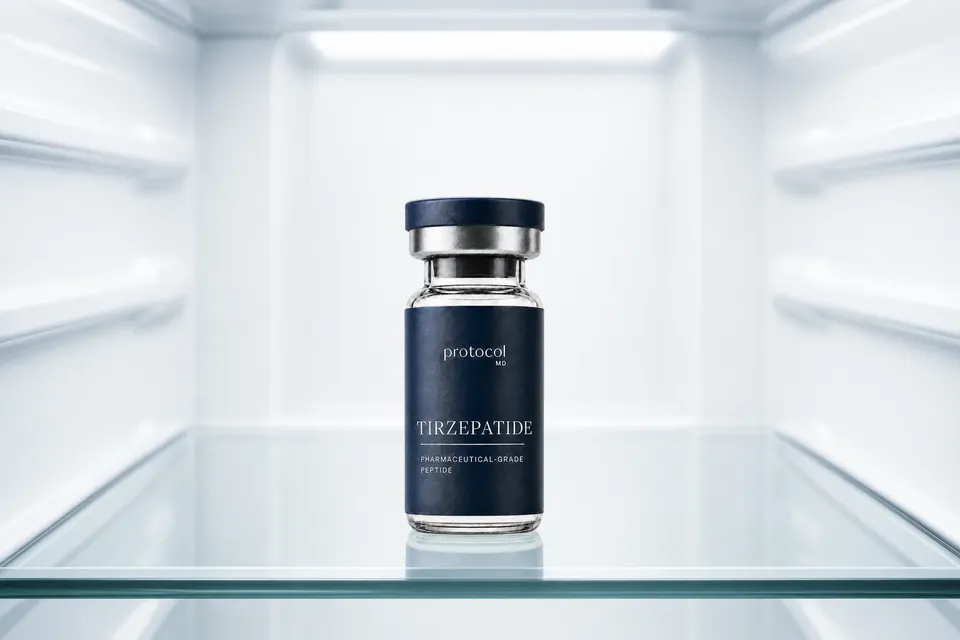
%20scale(0.008000%20-0.008000)'%3e%3cpath%20d='M74%20714H250L447%20155H449L641%20714H815V0H696V551H694L496%200H393L195%20551H193V0H74Z'/%3e%3c/g%3e%3cg%20transform='translate(114.2240%2035.7)%20scale(0.008000%20-0.008000)'%3e%3cpath%20d='M76%20714H372Q454%20714%20514.0%20686.0Q574%20658%20612.0%20609.5Q650%20561%20668.5%20496.0Q687%20431%20687%20357Q687%20283%20668.5%20218.0Q650%20153%20612.0%20104.5Q574%2056%20514.0%2028.0Q454%200%20372%200H76ZM201%20102H324Q397%20102%20443.5%20121.5Q490%20141%20516.5%20175.5Q543%20210%20552.5%20256.5Q562%20303%20562%20357Q562%20411%20552.5%20457.5Q543%20504%20516.5%20538.5Q490%20573%20443.5%20592.5Q397%20612%20324%20612H201Z'/%3e%3c/g%3e%3c/g%3e%3c/svg%3e)

Key takeaways
- In the body within hours. The Zepbound and Mounjaro labels put peak blood concentration at 8 to 72 hours after an injection and steady state at four weeks of once-weekly dosing.
- Food intake: measured at week 3. A 6-week trial found lower food intake at week 3. The trials cited here did not measure the first days.
- Weight: most analyzed participants by week 12. In a SURMOUNT-1 analysis, 82% had lost at least 5% of their body weight by week 12.
- These are brand-trial figures. Compounded tirzepatide is not FDA-approved and was not studied in these trials, so the timelines do not transfer to it.
01
Tirzepatide Timeline at a Glance: What Was Measured, and When
| What was measured | When | Source |
|---|---|---|
| Peak blood concentration after one injection | 8 to 72 hours (median 24 hours on the Zepbound label) | Zepbound and Mounjaro labels, section 12.3 |
| Steady-state blood levels | After 4 weeks of once-weekly dosing | Labels, section 12.3 |
| Lower food intake at a test meal | Week 3, the trial's primary time point | 6-week phase 1 trial, adults without diabetes |
| HbA1c below 7.0%, adults with type 2 diabetes | Median 8.1 weeks | SURPASS-2 and SURPASS-3 analysis |
| At least 5% weight loss, adults with type 2 diabetes | Median 12.4 to 16.0 weeks, by dose | SURPASS-2 analysis |
| At least 5% weight loss, adults without diabetes | 82% of analyzed participants by week 12 | SURMOUNT-1 post hoc analysis |
Every row describes Zepbound or Mounjaro, Eli Lilly's two FDA-approved tirzepatide products, or tirzepatide as tested in trials Eli Lilly funded. The label rows were read on October 9, 2026 from the current prescribing information on DailyMed (Zepbound label; Mounjaro label).
Protocol MD sells compounded tirzepatide, so we have a commercial interest in this topic. We do not sell Zepbound or Mounjaro.
02
How Long After a Tirzepatide Injection Does It Work in the Body?
Tirzepatide is absorbed over hours to days after an injection. Section 12.3 of the Mounjaro label states that the time to maximum plasma concentration ranges from 8 to 72 hours. The Zepbound label gives the same range and adds a median of 24 hours.
The Mounjaro label gives an elimination half-life of approximately 5 days, and the Zepbound label gives approximately 5 to 6 days in patients with overweight or obesity (section 12.3). Section 12.1 explains why: the molecule carries a C20 fatty diacid that binds albumin and prolongs the half-life. With a half-life of about 5 days, simple arithmetic says more than a third of a dose is still in circulation a week later, when the next one is due.
Because each weekly dose lands on top of what remains of the last one, blood levels build before they level off. Both labels state that steady-state plasma concentrations were achieved following 4 weeks of once-weekly administration, and that exposure increases in a dose-proportional manner (section 12.3).
A drug level is not a result. The labels do not attach a symptom or a number on the scale to peak concentration or steady state. How fast tirzepatide works on appetite, blood sugar and weight was measured separately, in trials.
03
The Label's Dose Schedule Sets the Pace of the First Months
Tirzepatide is started low and raised in steps, which both labels say reduces the risk of gastrointestinal adverse reactions. What follows is what the labels state. It is not a schedule to follow; the prescribing physician sets and changes the dose.
- Zepbound. Section 2.1 gives a recommended starting dosage of 2.5 mg injected once weekly for 4 weeks, and states: "The 2.5 mg dosage is for treatment initiation and is not approved as a maintenance dosage." After 4 weeks the label raises the dosage to 5 mg. It may then be increased in 2.5 mg increments after at least 4 weeks on the current dose. Section 2.2 lists maintenance dosages of 5 mg, 10 mg or 15 mg once weekly for weight reduction.
- Mounjaro. Section 2.1 gives a recommended starting dosage of 2.5 mg once weekly and says that, if additional glycemic control is needed, the dosage is increased in 2.5 mg increments after at least 4 weeks on the current dose.
SURMOUNT-1 ran for 72 weeks including a 20-week dose-escalation period (Jastreboff et al., 2022), and the Zepbound label notes that weight reduction was assessed after 72 weeks, at least 52 of them at the maintenance dose (section 14.1).
Lower doses have been studied directly, for blood sugar. A 26-week phase 2 trial in adults with type 2 diabetes randomized 1 mg, 5 mg, 10 mg and 15 mg arms and found a dose-dependent effect on HbA1c: a mean change of -1.06% at 1 mg against -0.06% with placebo, and -1.94% at 15 mg (Frias et al., 2018). That is a blood-sugar result, and it is not a reason to stay on or leave any dose.
04
How Long Does It Take for Tirzepatide to Suppress Appetite?
The earliest point at which the trials cited here measured food intake on tirzepatide is week 3. None of them measured appetite in the first days, so any account of what the first week on tirzepatide feels like is patient-reported and not established.
The week-3 figure comes from a 6-week phase 1 trial that randomized 114 adults without diabetes to once-weekly tirzepatide, placebo or a daily GLP-1 comparator. Its primary outcome was energy intake at a lunch where participants could eat as much as they wanted. At week 3, the drop in calories eaten at that meal was 524.6 kcal larger with tirzepatide than with placebo. On self-report measures, tirzepatide also decreased overall appetite, food cravings, perceived hunger and the tendency to overeat (Martin et al., 2025).
For appetite, the Zepbound label gives a mechanism but no onset time. Section 12.2 states that tirzepatide decreases calorie intake and that the effects are likely mediated by affecting appetite. The same section says tirzepatide delays gastric emptying, that the delay is largest after the first dose, and that it diminishes over time.
The cited trials do not say whether hunger changes right away, and they do show that reduced appetite is not universal. In the 26-week phase 2 trial, decreased appetite was recorded as an adverse event in 3.8% of participants at 1 mg, 20.0% at 5 mg, 25.5% at 10 mg and 18.9% at 15 mg (Frias et al., 2018). An adverse-event count is not a measurement of appetite in everyone, and it carries no date of onset.
Our guide to food noise covers what the research shows about quieter appetite on GLP-1 medications.
05
How Long Does It Take to Lose Weight on Tirzepatide? The Trial Timeline
In an analysis of SURMOUNT-1, a trial of brand-name tirzepatide, most participants had lost at least 5% of their body weight by week 12. The full result was measured at week 72. The tirzepatide weight loss timeline below is what was published.
- Week 12, adults without diabetes. A post hoc analysis of SURMOUNT-1 looked at 1,545 tirzepatide-treated participants who had received at least 75% of their assigned doses. At week 12, 1,267 of them (82%) had lost at least 5% of their body weight (Ard et al., 2025). Week 12 falls inside the trial's dose-escalation period.
- Weeks 12 to 16, adults with type 2 diabetes. In a pre-planned exploratory analysis of SURPASS-2, the median time to first reach a 5% weight loss was 12.4 weeks in the 10 mg and 15 mg groups and 16.0 weeks in the 5 mg group (Viljoen et al., 2023).
- Week 24, the slower group. Of the 278 SURMOUNT-1 participants (18%) who had not lost 5% by week 12, 70% had done so by week 24, the end of dose titration in that analysis. Their mean time to a 5% reduction was 24.8 weeks, with a standard deviation of 12.7 weeks.
- Week 72. SURMOUNT-1's coprimary endpoints were measured here: a mean weight change of -15.0% at 5 mg, -19.5% at 10 mg and -20.9% at 15 mg, against -3.1% with placebo. By this point 90% of the slower week-12 group had also reached a 5% reduction.
These are averages and proportions from randomized trials of brand-name tirzepatide, in which every participant also received counseling on a reduced-calorie diet and increased physical activity from the first dose (Zepbound label, section 14.1). They are not a forecast for any individual or a week-by-week schedule.
None of the sources cited here reports a weight result for the first week of treatment, so this page gives none.
When the pace slows
In a post hoc analysis of SURMOUNT-1, the median time to a weight plateau ranged from 24.3 weeks in participants with overweight to 36.1 weeks in those with class II or class III obesity (Horn et al., 2025). Our guide to why the scale stalls on tirzepatide covers that phase.
06
How Fast Does Tirzepatide Work for Blood Sugar?
In adults with type 2 diabetes, tirzepatide's effect on blood sugar was measured earlier than its effect on weight. Mounjaro is the tirzepatide product approved for type 2 diabetes.
The clearest timing data come from a pre-planned exploratory analysis of the SURPASS-2 and SURPASS-3 trials, which checked participants at 4, 12 and 24 weeks. The median time to reach an HbA1c below 7.0% was 8.1 weeks with each tirzepatide dose, and the median time to reach 6.5% or lower was 12.1 weeks. Both were shorter than with the comparators in those trials, semaglutide 1 mg and insulin degludec (Viljoen et al., 2023).
An A1C test reflects average blood glucose over the past 3 months (NIDDK), so it moves more slowly than a single glucose reading does. Our comparison of semaglutide and tirzepatide covers how the two molecules differ.
07
Why Tirzepatide Works Faster for Some People Than for Others
How quickly tirzepatide works differed between participants in every trial that looked. Three factors have published data on the pace or size of the response. Each is an association in a trial population, not a proven cause.
- Dose. In SURPASS-2, the median time to a 5% weight loss was 12.4 weeks at 10 mg and 15 mg, against 16.0 weeks at 5 mg.
- Sex and starting weight. SURMOUNT-1 participants who had not lost 5% by week 12 were more likely to be male (45% against 30% of early responders) and had a higher mean baseline weight (110.2 kg against 103.6 kg).
- Type 2 diabetes. SURMOUNT-2, in adults with type 2 diabetes, reported a mean weight change at week 72 of -12.8% at 10 mg and -14.7% at 15 mg (Garvey et al., 2023). SURMOUNT-1 excluded diabetes and reported -19.5% and -20.9%. That compares two separate trials, not a head-to-head result.
The label does not point to drug levels as the explanation. Section 12.3 of the Zepbound label states that age, sex, race, ethnicity and body weight do not have a clinically relevant effect on the pharmacokinetics of tirzepatide.
Among the SURMOUNT-1 participants below 5% at week 12, nine in ten had passed it by week 72. Whether to continue, and at what dose, is a decision for the prescribing physician.
08
Side Effects Cluster During Dose Escalation
Tirzepatide's most common adverse effects cluster in the dose-escalation period. In SURMOUNT-1, the most common adverse events were gastrointestinal, most were mild to moderate, and they occurred primarily during dose escalation (Jastreboff et al., 2022).
Semaglutide and tirzepatide carry a boxed warning for thyroid C-cell tumors, based on rodent studies, and are contraindicated in anyone with a personal or family history of medullary thyroid carcinoma or multiple endocrine neoplasia syndrome type 2 (MEN 2).
Severe or persistent abdominal pain, vomiting that prevents you from keeping fluids down, or a lump or swelling in the neck are reasons to contact a physician promptly. Our guide to tirzepatide side effects covers the label's warnings in full.
09
How Long Does Compounded Tirzepatide Take to Work?
There is no trial that answers this. Compounded tirzepatide is not FDA-approved, is not the same as the brand-name products, and was not studied in these trials. The SURMOUNT and SURPASS timelines describe tirzepatide as it was tested in trials funded by Eli Lilly, the maker of Zepbound and Mounjaro, and they do not transfer to a compounded preparation.
The FDA's position is that compounded drugs are not FDA-approved, and that unapproved versions do not undergo the agency's review for safety, effectiveness and quality before they are marketed (FDA, content current as of October 1, 2026).
A question about pace on a compounded vial goes to the prescribing physician. Our guide to whether Zepbound is the same as tirzepatide sets out the difference between the brand-name products and compounded tirzepatide.
10
How Protocol MD Starts Tirzepatide
Protocol MD sells compounded tirzepatide, so read this page with that commercial interest in mind.
The Protocol MD tirzepatide protocol has three steps: an online intake that screens for the contraindications above, a review by a US-licensed physician who decides whether a prescription is appropriate, and dispensing by a licensed compounding pharmacy only if the physician approves. Protocol MD serves all 50 states. Your card is authorized at checkout and charged only if a physician approves your prescription.
The prescribing physician sets the starting dose and decides whether and when it changes. If you want a physician to review whether treatment is appropriate for you, start with the assessment.
11
The Bottom Line
Tirzepatide reaches peak blood concentration 8 to 72 hours after an injection and steady state after four weeks of weekly injections. Its effects were measured later: lower food intake at week 3, an HbA1c below 7.0% at a median of 8.1 weeks in adults with type 2 diabetes, and at least 5% weight loss by week 12 in 82% of analyzed SURMOUNT-1 participants. None of those timelines was established for compounded tirzepatide, and the pace of one person's treatment is a question for the prescribing physician.
FAQ
Frequently Asked Questions
How long does tirzepatide take to kick in after the first injection?
The Zepbound and Mounjaro labels state that tirzepatide reaches maximum plasma concentration 8 to 72 hours after an injection, and that the delay in stomach emptying is largest after the first dose. The trials cited on this page did not measure appetite or weight in the first days. Their earliest food-intake measurement was at week 3.
How long does it take for Zepbound to start working?
Zepbound is brand-name tirzepatide. Its label gives a median time to peak concentration of 24 hours and steady state after 4 weeks of once-weekly dosing. In a SURMOUNT-1 analysis, 82% of participants had lost at least 5% of their body weight by week 12. Individual results vary.
How long until tirzepatide works if I have not lost weight by week 12?
In SURMOUNT-1, 18% of analyzed participants had lost less than 5% at week 12. Of that group, 70% reached a 5% reduction by week 24 and 90% by week 72, with a mean time of 24.8 weeks. Those are trial proportions, not a prediction. Raise a slow start with your prescribing physician.
Is the timeline the same for compounded tirzepatide?
It has not been studied. Compounded tirzepatide is not FDA-approved, is not the same as the brand-name products, and was not studied in the SURMOUNT or SURPASS trials. The timelines from those trials describe Zepbound and Mounjaro and do not transfer to a compounded preparation.
Citations & Sources
- Zepbound (tirzepatide) injection prescribing information, Eli Lilly and Company. Sections 2.1, 2.2, 12.1, 12.2, 12.3 and 14.1. DailyMed, National Library of Medicine. Accessed October 9, 2026. https://dailymed.nlm.nih.gov/dailymed/drugInfo.cfm?setid=487cd7e7-434c-4925-99fa-aa80b1cc776b
- Mounjaro (tirzepatide) injection prescribing information, Eli Lilly and Company. Sections 2.1, 12.2 and 12.3. DailyMed, National Library of Medicine. Accessed October 9, 2026. https://dailymed.nlm.nih.gov/dailymed/drugInfo.cfm?setid=d2d7da5d-ad07-4228-955f-cf7e355c8cc0
- Jastreboff AM, Aronne LJ, Ahmad NN, et al. Tirzepatide Once Weekly for the Treatment of Obesity (SURMOUNT-1). N Engl J Med. 2022;387(3):205-216. https://pubmed.ncbi.nlm.nih.gov/35658024/
- Ard J, Lee CJ, Gudzune K, et al. Weight reduction over time in tirzepatide-treated participants by early weight loss response: Post hoc analysis in SURMOUNT-1. Diabetes Obes Metab. 2025;27(9):5064-5071. https://pubmed.ncbi.nlm.nih.gov/40677091/
- Viljoen A, Pantalone KM, Galindo RJ, et al. Time to Reach Glycaemic and Body Weight Loss Thresholds with Tirzepatide in Patients with Type 2 Diabetes: A Pre-planned Exploratory Analysis of SURPASS-2 and SURPASS-3. Diabetes Ther. 2023;14(5):925-936. https://pubmed.ncbi.nlm.nih.gov/37000390/
- Martin CK, Carmichael OT, Carnell S, et al. Tirzepatide on ingestive behavior in adults with overweight or obesity: a randomized 6-week phase 1 trial. Nat Med. 2025;31(9):3141-3150. https://pubmed.ncbi.nlm.nih.gov/40555748/
- Frias JP, Nauck MA, Van J, et al. Efficacy and safety of LY3298176, a novel dual GIP and GLP-1 receptor agonist, in patients with type 2 diabetes: a randomised, placebo-controlled and active comparator-controlled phase 2 trial. Lancet. 2018;392(10160):2180-2193. https://pubmed.ncbi.nlm.nih.gov/30293770/
- Horn DB, Kahan S, Batterham RL, et al. Time to weight plateau with tirzepatide treatment in the SURMOUNT-1 and SURMOUNT-4 clinical trials. Clin Obes. 2025;15(3):e12734. https://pubmed.ncbi.nlm.nih.gov/39800653/
- Garvey WT, Frias JP, Jastreboff AM, et al. Tirzepatide once weekly for the treatment of obesity in people with type 2 diabetes (SURMOUNT-2). Lancet. 2023;402(10402):613-626. https://pubmed.ncbi.nlm.nih.gov/37385275/
- National Institute of Diabetes and Digestive and Kidney Diseases. The A1C Test & Diabetes. Accessed October 9, 2026. https://www.niddk.nih.gov/health-information/diagnostic-tests/a1c-test
- U.S. Food and Drug Administration. FDA's Concerns with Unapproved GLP-1 Drugs Used for Weight Loss. Content current as of October 1, 2026. Accessed October 9, 2026. https://www.fda.gov/drugs/drug-alerts-and-statements/fdas-concerns-unapproved-glp-1-drugs-used-weight-loss
Educational only — this article does not diagnose, prevent, treat, or cure any condition, and it is not medical advice, a dosing recommendation, or a recommendation of any specific medication. Dose figures are quoted from FDA-approved labeling and from published trials to describe what was studied; nothing here should be used to start, stop, increase, decrease, re-time or otherwise change any medication, and those decisions belong to your prescribing physician. Label statements for Zepbound and Mounjaro were read on October 9, 2026; labels are revised, so check the current version. Trial figures are average or between-group outcomes from named published clinical trials of brand-name tirzepatide; individual results vary widely and the figures are not predictions. Protocol MD sells compounded tirzepatide and compounded semaglutide and therefore has a commercial interest in this topic; we do not sell Zepbound or Mounjaro, and brand names are used only to identify medications and do not imply any affiliation or endorsement. Compounded medications are not FDA-approved, are not the same as the brand-name products, were not studied in the brand-name clinical trials, and the timelines and approvals of brand products do not apply to them. Tirzepatide carries a boxed warning for thyroid C-cell tumors, based on rodent studies, and is contraindicated in people with a personal or family history of medullary thyroid carcinoma or multiple endocrine neoplasia syndrome type 2 (MEN 2). GLP-1 medications are available only by prescription following evaluation by a licensed physician and are not appropriate for everyone.
Published October 15, 2026.