%20scale(0.008000%20-0.008000)'%3e%3cpath%20d='M74%20714H250L447%20155H449L641%20714H815V0H696V551H694L496%200H393L195%20551H193V0H74Z'/%3e%3c/g%3e%3cg%20transform='translate(114.2240%2035.7)%20scale(0.008000%20-0.008000)'%3e%3cpath%20d='M76%20714H372Q454%20714%20514.0%20686.0Q574%20658%20612.0%20609.5Q650%20561%20668.5%20496.0Q687%20431%20687%20357Q687%20283%20668.5%20218.0Q650%20153%20612.0%20104.5Q574%2056%20514.0%2028.0Q454%200%20372%200H76ZM201%20102H324Q397%20102%20443.5%20121.5Q490%20141%20516.5%20175.5Q543%20210%20552.5%20256.5Q562%20303%20562%20357Q562%20411%20552.5%20457.5Q543%20504%20516.5%20538.5Q490%20573%20443.5%20592.5Q397%20612%20324%20612H201Z'/%3e%3c/g%3e%3c/g%3e%3c/svg%3e)

Key takeaways
- Half-life is about 5 days. Approximately 5 days on the Mounjaro label; approximately 5 to 6 days in overweight or obesity on the Zepbound label (section 12.3).
- Near-complete clearance: roughly 25 to 30 days. Five half-lives leave about 3%. Derived from the label's half-life, not printed on it.
- Steady state takes about 4 weeks. Both labels state it was achieved following 4 weeks of once-weekly administration.
- These are brand-label figures. Compounded tirzepatide is not FDA-approved and was not studied in those trials, so the numbers do not transfer.
01
How Long Tirzepatide Stays in Your System: The Numbers
| Question | Figure | Where it comes from |
|---|---|---|
| Elimination half-life | About 5 days (Mounjaro); about 5 to 6 days in overweight or obesity (Zepbound) | Label section 12.3 |
| Peak blood concentration after an injection | 8 to 72 hours (Zepbound gives a median of 24 hours) | Label section 12.3 |
| Steady state on weekly dosing | After 4 weeks of once-weekly administration | Label section 12.3 |
| Near-complete clearance after a last dose | Roughly 25 to 30 days (five half-lives) | Derived from the label half-life, not stated on the label |
| Intact drug in urine or feces | Not observed; metabolites exit by both routes | Label section 12.3 |
| Effect of kidney or liver impairment | No change observed; no dosage adjustment recommended | Label sections 8.6 and 8.7 |
Every row describes Zepbound or Mounjaro, read on October 10, 2026 from SPL version 40 on DailyMed (Zepbound label; Mounjaro label). Labels are revised, so check the current version.
02
Tirzepatide's Half-Life Is About 5 Days, and It Sets Everything Else
A half-life is the time blood levels of a drug take to fall by half. Section 12.3 of the Mounjaro label gives tirzepatide an elimination half-life of approximately 5 days, and says this enables once-weekly dosing. The Zepbound label gives approximately 5 to 6 days in patients with overweight or obesity.
Two phase 1 studies outside the pivotal program landed in the same place: a multiple-ascending-dose study in Japanese adults with type 2 diabetes reported approximately 5 days (Furihata et al., 2022), and a multiple-dose study in Chinese adults with type 2 diabetes reported approximately 5 to 6 days (Feng et al., 2023).
Section 12.1 of both labels gives the mechanism rather than leaving the number as a brute fact. Tirzepatide carries a C20 fatty diacid that enables albumin binding and prolongs the half-life, and section 12.3 adds that the molecule is 99% bound to plasma albumin, which keeps it circulating instead of being filtered away. That is engineering, not biology: the fatty acid chain is why a peptide that would otherwise last hours lasts days.
Tirzepatide is cleared by being taken apart, not excreted whole. Section 12.3 states that it is metabolized by proteolytic cleavage of the peptide backbone, beta-oxidation of the C20 fatty diacid, and amide hydrolysis.
03
Three Different Clocks, One Question
The phrase "how long does tirzepatide stay in your system" hides three separate questions with three different answers. Answering one and implying it covers all three is where most answers go wrong.
- Clock one: is the drug present? Measured in blood concentration and answered by the half-life: roughly 25 to 30 days from a last dose to near-complete clearance.
- Clock two: is it still working? Measured by appetite, blood sugar and weight — the withdrawal evidence below covers weight. In a withdrawal trial the effects faded over months, not weeks.
- Clock three: are side effects still happening? Measured by adverse events, which clustered during dose escalation rather than tracking the drug level.
Stopping treatment usually means clock two; a procedure means clock one; feeling unwell means clock three.
04
Clock One: How Long Tirzepatide Is Detectable After Your Last Dose
With a half-life of about 5 days, what remains after a final dose halves on a predictable schedule. The arithmetic below is not printed on any label; it is what the label's half-life implies.
- Day 5 — one half-life. About 50% of the dose remains.
- Day 10 — two half-lives. About 25% remains.
- Day 15 — three half-lives. About 12.5% remains.
- Day 20 — four half-lives. About 6.25% remains.
- Day 25 — five half-lives. About 3% remains, which is the point conventionally treated as effectively cleared.
On the Zepbound figure of 5 to 6 days, the same five halvings run to about 30 days instead of 25. So how long tirzepatide stays in your system is roughly 25 to 30 days after a last injection, with the caveat that "effectively cleared" describes a decaying curve, not a moment when the drug is gone.
The labels reason this way themselves: the overdosage section advises a period of observation taking into account the half-life of approximately 5 days.
Does tirzepatide show up on a drug test?
Routine clinical panels and workplace drug screens are not designed to detect tirzepatide; they look for defined classes of substances, and a GIP and GLP-1 receptor agonist is not among them. Section 12.3 of both labels adds a pharmacokinetic reason a urine screen would be a poor way to look: the primary excretion routes for its metabolites are urine and feces, but intact tirzepatide is not observed in either.
05
Clock Two: How Long Tirzepatide Keeps Working After You Stop
The drug leaving the bloodstream and the effect fading are different events, and the gap is measured in months. The clearest evidence is SURMOUNT-4, a randomized withdrawal trial.
In SURMOUNT-4, 783 adults with obesity or overweight entered a 36-week open-label lead-in on tirzepatide. The 670 who completed it lost a mean of 20.9% of their body weight and were then randomized to continue tirzepatide or switch to placebo for 52 weeks. From week 36 to 88 the continuing group lost a further 5.5%; the placebo group regained 14.0% (Aronne et al., 2024).
The regain was gradual across a year, not a cliff at day 25 when the drug had cleared, and the trial's own conclusion is that withdrawing tirzepatide led to substantial regain of lost weight.
Weekly dosing rests on the same arithmetic. With a 5-day half-life, more than a third of each dose is still circulating when the next is due, which is why both labels state that steady state was achieved following 4 weeks of once-weekly administration, with exposure increasing dose-proportionally. A late dose lands on a lower trough, not an empty tank. Our guide to why the scale stalls on tirzepatide covers plateaus during continued treatment.
06
Clock Three: How Long Tirzepatide Side Effects Last
Tirzepatide and semaglutide carry a boxed warning for thyroid C-cell tumors, based on rodent studies, and are contraindicated in anyone with a personal or family history of medullary thyroid carcinoma or multiple endocrine neoplasia syndrome type 2 (MEN 2).
The common effects cluster in time rather than scale with blood level. In SURMOUNT-1 the most common adverse events were gastrointestinal, mostly mild to moderate, occurring primarily during dose escalation (Jastreboff et al., 2022). Section 12.2 of the Zepbound label adds that the delay in stomach emptying is largest after the first dose and diminishes over time.
None of the sources cited here reports how many days a given side effect persists after a final dose, so this page gives no such figure. The pharmacokinetics supports only an outer bound: an effect driven by the drug being present cannot much outlast the drug, which is largely gone by about 25 to 30 days. That bound does not apply to complications the labels warn about separately, such as gallbladder disease or pancreatitis, which follow their own course and need a physician.
Severe or persistent abdominal pain, vomiting that prevents you keeping fluids down, or a lump or swelling in the neck are reasons to contact a physician promptly, not to wait out a clearance window. Our guide to tirzepatide side effects covers the label's warnings in full.
07
What Actually Changes How Long Tirzepatide Stays in Your System
Articles on this topic routinely list metabolism, age, weight and kidney function as factors that change how long tirzepatide stays in your system. The label contradicts most of it.
- Kidney function: no measured change. Section 8.6 of both labels states that no dosage adjustment is recommended for renal impairment, and that in subjects with renal impairment including end-stage renal disease, no change in tirzepatide pharmacokinetics was observed — consistent with a drug broken down rather than filtered out intact.
- Liver function: no measured change. Section 8.7 states that no dosage adjustment is recommended for hepatic impairment, and that a clinical pharmacology study across varying degrees of it observed no change in pharmacokinetics.
- Age, sex, race, ethnicity, body weight: no clinically relevant effect. Section 12.3 lists these intrinsic factors explicitly and states that they do not have a clinically relevant effect on the pharmacokinetics of tirzepatide.
- Dose: changes how much, not how long. Exposure increases dose-proportionally, so a higher dose leaves more behind at every point on the curve. The half-life is a property of the molecule.
Where the labels do flag monitoring, the reason is downstream rather than clearance: the Zepbound label advises monitoring renal function in patients reporting adverse reactions that could lead to volume depletion, and the Mounjaro label advises it when initiating or escalating doses in patients with renal impairment who report severe gastrointestinal reactions. That is dehydration, not a kidney struggling to remove the drug.
Can you flush tirzepatide out of your system faster?
No published method shortens it. Tirzepatide is 99% albumin-bound with an apparent volume of distribution of roughly 10 L, so it largely stays in the circulation attached to a protein. Drinking more water does not strip a drug off albumin, and intact tirzepatide is not leaving in urine anyway.
08
Surgery, Procedures and Pregnancy Plans
This is where the question stops being academic, and where the labels decline to give a number. Section 5.9 of both describes rare postmarketing reports of pulmonary aspiration in patients on GLP-1 receptor agonists undergoing elective surgery or procedures requiring general anesthesia or deep sedation, who had residual stomach contents despite following preoperative fasting instructions.
The labels then say plainly that available data are insufficient to inform recommendations to mitigate that risk, including whether temporarily discontinuing would reduce retained gastric contents. The instruction they do give is to tell your healthcare providers before any planned surgery or procedure.
So any specific "stop N days before surgery" interval you read is not coming from the FDA labeling. That decision belongs to your surgeon, anesthesiologist and prescribing physician together, and how long tirzepatide stays in your system is one input rather than the answer.
On pregnancy, section 8.1 of the Zepbound label states that it may cause fetal harm and should be discontinued when pregnancy is recognized. Timing a planned pregnancy against a clearance window is a physician conversation, not a calculation to run alone.
09
Compounded Tirzepatide: What These Numbers Do and Do Not Cover
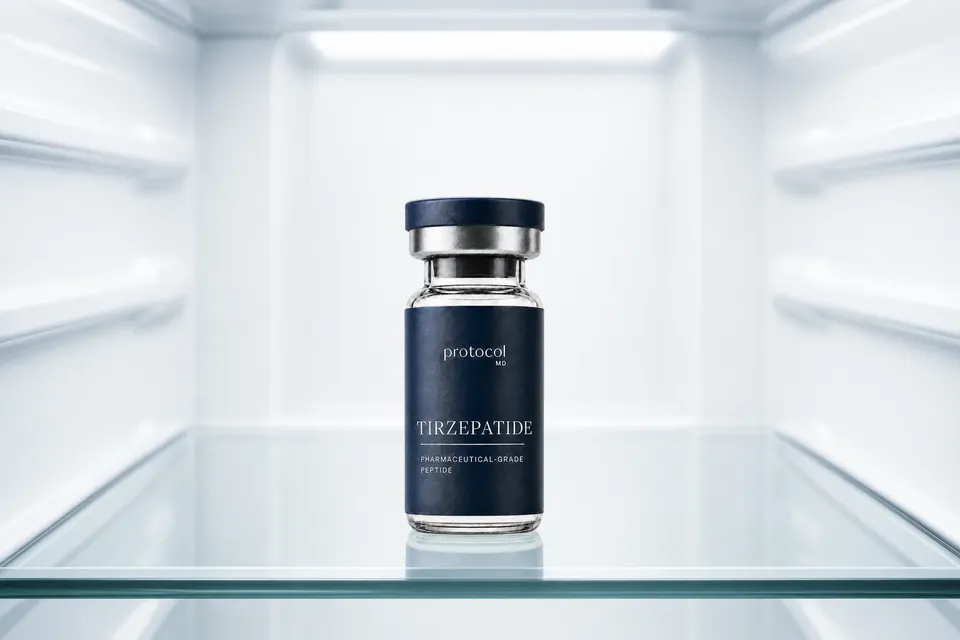
Every pharmacokinetic figure on this page was measured on Zepbound, Mounjaro, or tirzepatide as supplied in studies of those molecules. Compounded tirzepatide is not FDA-approved, is not the same as the brand-name products, and was not studied in those trials. No half-life or clearance figure exists for a compounded preparation.
The FDA's position is that compounded drugs are not FDA-approved, and that unapproved versions do not undergo the agency's review for safety, effectiveness and quality before they are marketed (FDA, content current as of October 1, 2026).
The brand numbers are quoted here because they are the only primary-source pharmacokinetics that exist for this molecule. Citing them while implying they were measured on a compounded vial would be the real error. Our guide to whether Zepbound is the same as tirzepatide sets out the difference in full.
10
How Protocol MD Handles Tirzepatide
Protocol MD sells compounded tirzepatide and therefore has a commercial interest in this topic, stated here in the body rather than only in the small print.
The Protocol MD tirzepatide pathway has three steps: an online intake screening for the contraindications above, including a personal or family history of medullary thyroid carcinoma or MEN 2; a review by a US-licensed physician; and dispensing by a licensed compounding pharmacy only if that physician approves. Protocol MD serves all 50 states, and your card is authorized at checkout and charged only after approval.
Laboratory work runs through the patient portal: you order the lab, blood is drawn at a Labcorp location, and results return to your portal as a results dashboard with feedback, with an email when they are ready. The prescribing physician determines the dose. Nothing on this page is a dose to follow.
If you want a physician to review whether treatment is appropriate for you, start with the assessment.
11
The Bottom Line
Tirzepatide has an elimination half-life of approximately 5 days on the Mounjaro label and approximately 5 to 6 days on the Zepbound label, which puts near-complete clearance at roughly 25 to 30 days after a last dose and steady state at about 4 weeks of weekly injections. Its effects run on a separate clock: in a randomized withdrawal trial, weight returned gradually over a year rather than when the drug cleared. None of those figures was established for compounded tirzepatide, and the decision to start, pause or stop belongs to your prescribing physician.
About 25 to 30 days of drug, months of effect, and one conversation with your prescribing physician.
FAQ
Frequently Asked Questions
How long does tirzepatide stay in your system after your last dose?
Roughly 25 to 30 days. That is five half-lives, derived from the elimination half-life of approximately 5 days on the Mounjaro label and approximately 5 to 6 days on the Zepbound label. After five half-lives about 3% remains, which is conventionally treated as effectively cleared. The labels do not print a 25-day figure.
Does tirzepatide show up on a drug test?
Standard workplace and clinical drug screens do not test for tirzepatide, because they look for defined classes of substances and a GIP and GLP-1 receptor agonist is not one of them. Section 12.3 of both labels also states that intact tirzepatide is not observed in urine or feces; only its metabolites leave by those routes.
When does tirzepatide wear off between weekly doses?
It does not fully wear off. With a half-life of about 5 days, more than a third of a dose is still circulating seven days later when the next is due, which is why both labels report steady state after 4 weeks of once-weekly administration. Feeling different late in the week reflects a lower trough, not an empty system. Raise it with your prescribing physician rather than changing timing yourself.
How long do tirzepatide side effects last after stopping?
No trial cited here measured that interval, so no number is given. The pharmacokinetics supports only an outer bound: the drug is largely gone by about 25 to 30 days. In SURMOUNT-1 the common gastrointestinal effects occurred primarily during dose escalation. Persistent or severe symptoms are a reason to contact a physician.
Does kidney or liver function change how long tirzepatide stays in your system?
Not in the studies the labels cite. Sections 8.6 and 8.7 of both labels state that no dosage adjustment is recommended for renal or hepatic impairment, and that no change in tirzepatide pharmacokinetics was observed in either group. Those are statements about the brand products.
Is the clearance timeline the same for compounded tirzepatide?
It has not been established. Compounded tirzepatide is not FDA-approved, is not the same as the brand-name products, and was not studied in the trials behind the Zepbound and Mounjaro labels. The half-life and clearance figures on this page describe those brand products and do not transfer to a compounded preparation.
Citations & Sources
- Zepbound (tirzepatide) injection prescribing information, Eli Lilly and Company. Sections 5.9, 8.1, 8.3, 8.6, 8.7, 10, 12.1, 12.2 and 12.3. SPL version 40, published September 2, 2026. DailyMed, National Library of Medicine. Accessed October 10, 2026. https://dailymed.nlm.nih.gov/dailymed/drugInfo.cfm?setid=487cd7e7-434c-4925-99fa-aa80b1cc776b
- Mounjaro (tirzepatide) injection prescribing information, Eli Lilly and Company. Sections 5.9, 8.3, 8.6, 8.7, 10, 12.1 and 12.3. SPL version 40, published September 2, 2026. DailyMed, National Library of Medicine. Accessed October 10, 2026. https://dailymed.nlm.nih.gov/dailymed/drugInfo.cfm?setid=d2d7da5d-ad07-4228-955f-cf7e355c8cc0
- Furihata K, Mimura H, Urva S, Oura T, Ohwaki K, Imaoka T. A phase 1 multiple-ascending dose study of tirzepatide in Japanese participants with type 2 diabetes. Diabetes Obes Metab. 2022;24(2):239-246. Reported a plasma tirzepatide half-life of approximately 5 days. https://pubmed.ncbi.nlm.nih.gov/34647404/
- Feng P, Sheng X, Ji Y, et al. A Phase 1 Multiple Dose Study of Tirzepatide in Chinese Patients with Type 2 Diabetes. Adv Ther. 2023;40(8):3434-3445. Reported a tirzepatide half-life of approximately 5 to 6 days. https://pubmed.ncbi.nlm.nih.gov/37285081/
- Aronne LJ, Sattar N, Horn DB, et al. Continued Treatment With Tirzepatide for Maintenance of Weight Reduction in Adults With Obesity: The SURMOUNT-4 Randomized Clinical Trial. JAMA. 2024;331(1):38-48. Week 36 to 88 mean weight change -5.5% with tirzepatide versus +14.0% with placebo. https://pubmed.ncbi.nlm.nih.gov/38078870/
- Jastreboff AM, Aronne LJ, Ahmad NN, et al. Tirzepatide Once Weekly for the Treatment of Obesity (SURMOUNT-1). N Engl J Med. 2022;387(3):205-216. https://pubmed.ncbi.nlm.nih.gov/35658024/
- U.S. Food and Drug Administration. FDA's Concerns with Unapproved GLP-1 Drugs Used for Weight Loss. Content current as of October 1, 2026. Accessed October 10, 2026. https://www.fda.gov/drugs/drug-alerts-and-statements/fdas-concerns-unapproved-glp-1-drugs-used-weight-loss
Educational only — this article does not diagnose, prevent, treat, or cure any condition, and it is not medical advice, a dosing recommendation, or a recommendation of any specific medication. The clearance interval given here is derived from the half-life stated on FDA-approved labeling; it is a general pharmacokinetic estimate, not a prediction for any individual and not a clearance certificate for a procedure, a pregnancy plan or a medication switch. Nothing here should be used to start, stop, increase, decrease, re-time or otherwise change any medication, and those decisions belong to your prescribing physician. Label statements for Zepbound and Mounjaro were read on October 10, 2026; labels are revised, so check the current version. Trial figures are average or between-group outcomes from named published clinical trials of brand-name tirzepatide; individual results vary widely and the figures are not predictions. Protocol MD sells compounded tirzepatide and compounded semaglutide and therefore has a commercial interest in this topic; we do not sell Zepbound or Mounjaro, and brand names are used only to identify medications and do not imply any affiliation or endorsement. Compounded medications are not FDA-approved, are not the same as the brand-name products, were not studied in the brand-name clinical trials, and the pharmacokinetics and approvals of brand products do not apply to them. Tirzepatide carries a boxed warning for thyroid C-cell tumors, based on rodent studies, and is contraindicated in people with a personal or family history of medullary thyroid carcinoma or multiple endocrine neoplasia syndrome type 2 (MEN 2). GLP-1 medications are available only by prescription following evaluation by a licensed physician and are not appropriate for everyone.
Published October 17, 2026.