%20scale(0.008000%20-0.008000)'%3e%3cpath%20d='M74%20714H250L447%20155H449L641%20714H815V0H696V551H694L496%200H393L195%20551H193V0H74Z'/%3e%3c/g%3e%3cg%20transform='translate(114.2240%2035.7)%20scale(0.008000%20-0.008000)'%3e%3cpath%20d='M76%20714H372Q454%20714%20514.0%20686.0Q574%20658%20612.0%20609.5Q650%20561%20668.5%20496.0Q687%20431%20687%20357Q687%20283%20668.5%20218.0Q650%20153%20612.0%20104.5Q574%2056%20514.0%2028.0Q454%200%20372%200H76ZM201%20102H324Q397%20102%20443.5%20121.5Q490%20141%20516.5%20175.5Q543%20210%20552.5%20256.5Q562%20303%20562%20357Q562%20411%20552.5%20457.5Q543%20504%20516.5%20538.5Q490%20573%20443.5%20592.5Q397%20612%20324%20612H201Z'/%3e%3c/g%3e%3c/g%3e%3c/svg%3e)

Key takeaways
- The common effects are digestive and usually transitional rather than permanent.
- They track the dose. Worst at the start and after each increase, settling in between.
- A short list is urgent — severe abdominal pain radiating to the back, persistent vomiting, signs of dehydration, or an allergic reaction.
- Compounded versions add a question the brand products don't: what else is in the vial.
01
The Boxed Warning, First
Tirzepatide carries a boxed warning — the FDA's most serious form of labeling — for thyroid C-cell tumors. In rodent studies, tirzepatide caused thyroid C-cell tumors. Whether it causes them in humans is not known.
Because of that:
- Do not take tirzepatide if you or a family member has had medullary thyroid carcinoma (MTC), or if you have Multiple Endocrine Neoplasia syndrome type 2 (MEN 2).
- Tell your physician about any history of thyroid nodules, thyroid cancer, or a lump or swelling in your neck, hoarseness, difficulty swallowing, or shortness of breath.
This isn't a footnote and we're not going to bury it below the reassuring material. It is the first thing a prescriber screens for, and it's a hard stop rather than a caution.
02
Why Tirzepatide Causes Side Effects
Tirzepatide activates two gut hormone receptors — GIP and GLP-1 — rather than one. Part of how it works is by slowing how quickly the stomach empties and by acting on the brain's appetite regulation.
Nearly every common side effect follows directly from that. Food sits longer, digestion is slower and less coordinated, and you eat considerably less than you used to. The effects aren't a sign the medication is malfunctioning; they're the same mechanism that produces the result, experienced from the inside.
That also explains the pattern: effects are most pronounced when levels are climbing — at the start, and after each dose increase — and settle as the body adapts to a given dose.
03
The Common Side Effects
These are the frequently reported ones. Gastrointestinal effects were the most common adverse events in the pivotal tirzepatide obesity trial, SURMOUNT-1 (Jastreboff et al., NEJM 2022). In its three-year extension, most GI effects were mild to moderate and occurred mainly during dose escalation in the first 20 weeks (Jastreboff et al., NEJM 2025).
| Effect | What's happening | Our detailed guide |
|---|---|---|
| Nausea | Slowed gastric emptying; the most common complaint | Nausea → |
| Diarrhea | Altered transit plus changes in fat and bile handling | Diarrhea → |
| Constipation | Slower transit plus eating far less | Constipation → |
| Vomiting | Usually alongside nausea, early or after dose increases | — |
| Reduced appetite | The intended effect, and the source of most problems when it goes too far | How much to eat → |
| Burping / sulfur burps | Food fermenting longer in a slower stomach | Sulfur burps → |
| Fatigue | Frequently under-eating rather than the drug itself | — |
| Injection site reactions | Usually mild and brief | Injection sites → |
| Hair shedding | Telogen effluvium from rapid weight loss | Hair loss → |
The single most useful thing to understand about the common effects is that most of them are made worse by under-eating, and appetite suppression makes under-eating extremely easy to do without noticing. Fatigue, hair shedding, facial volume loss, and muscle loss are largely downstream of that rather than of the molecule.
04
How Long They Last
For most people the common effects are an early-phase problem. They're most noticeable in the first weeks and for a few days to a couple of weeks after each dose increase, then ease at a stable dose.
What isn't expected: effects that persist for months without improving, worsen at a stable dose, or appear suddenly after a long stable stretch. Those are worth raising rather than tolerating — a symptom that arrives out of nowhere in month eight is behaving differently from a side effect.
Over a longer horizon the evidence thins out. The longest randomized data run about three years (176 weeks), in adults with obesity and prediabetes in the SURMOUNT-1 extension, and that trial reported no new safety signals (Jastreboff et al., NEJM 2025). Three years is still short next to treatment that may continue indefinitely, which is covered in what we know and don't know about long-term use.
05
Serious but Uncommon
These are less frequent and time-critical. Learning to recognise them is the point of this section.
Pancreatitis. Severe, persistent abdominal pain — classically in the upper abdomen radiating through to the back — with or without vomiting. This is a medical emergency, not something to sleep off.
Gallbladder problems. Pain in the upper right abdomen, particularly after fatty meals, sometimes with fever or yellowing of the skin or eyes. Rapid weight loss independently raises gallstone risk.
Severe dehydration and kidney injury. Usually a consequence of prolonged vomiting or diarrhea rather than a direct effect. Dizziness on standing, dark or scant urine, confusion, or a racing heart.
Hypoglycemia. Tirzepatide alone rarely causes low blood sugar. The genuine risk is in combination with insulin or a sulfonylurea — a conversation for whoever manages those prescriptions.
Allergic reactions. Difficulty breathing, swelling of the face, lips, tongue or throat, or widespread hives is an emergency.
Bowel obstruction or ileus. Because the medication slows gut motility, a small number of people develop more serious blockage-type problems. No bowel movement and no passing of gas at all, with a distended abdomen, is urgent.
Worsening diabetic retinopathy in people who have it, related to rapid improvements in blood sugar.
06
Eyes and Vision — The Newer Signal
This is a live question that most articles on tirzepatide don't yet address, and it deserves a plain account rather than silence.
A 2025 cohort study published in JAMA Network Open examined semaglutide and tirzepatide use and disorders of the optic nerve and visual pathway in people with type 2 diabetes, and reported an increased risk of non-arteritic anterior ischaemic optic neuropathy (NAION) and other optic nerve disorders (Wang et al., 2025). NAION is an uncommon condition involving sudden, usually painless vision loss in one eye.
What that does and doesn't mean:
- The absolute risk remains low. NAION is rare, and an increased relative risk of a rare event is still a rare event.
- Observational studies show association, not causation. People taking these medications differ from those who aren't in ways that are difficult to fully adjust for.
- It is not a reason to stop treatment on your own, and it isn't grounds for alarm.
- It is a reason to treat sudden vision changes in one eye as urgent and to mention any history of eye disease to your prescriber.
Separately, blurred vision can occur transiently with rapid blood-sugar changes, and people with existing diabetic retinopathy need monitoring. If you notice sudden loss or distortion of vision, seek care the same day.
07
If You're Taking a Compounded Version
Almost everything written about tirzepatide side effects describes Mounjaro and Zepbound — the FDA-approved brand products. If you're using a compounded version, there's an additional layer, and essentially nobody covers it.
The molecule is the same, so the effects above apply. What differs is what else is in the vial and who made it.
- Compounded medications are not FDA-approved and are not the same products as the brand-name versions.
- Compounded formulations frequently contain additional ingredients — vitamin B12 is common, as are preservatives such as benzyl alcohol. B12 is not in the brand products; benzyl alcohol is in the brands' multi-dose vials and KwikPens but not their single-dose pens, and they carry their own considerations: an allergy or sensitivity to B12 or to benzyl alcohol matters, and there are specific conditions in which certain forms of B12 are inappropriate.
- You are entitled to know exactly what's in yours. Ask which form of B12, if any, at what concentration, what preservative is used, which pharmacy prepared it, whether it's a 503A or 503B facility, and whether the preparation is tested for potency and sterility. Any legitimate provider — including us — should answer those directly.
If your side effects started when you changed pharmacies or formulations rather than when you started the medication, that distinction is worth putting to your prescriber.
08
Who Shouldn't Take Tirzepatide
Beyond the boxed-warning contraindications above, tirzepatide is generally not appropriate for people who are pregnant or trying to conceive, and it requires careful individual assessment in people with a history of pancreatitis, gallbladder disease, severe gastrointestinal disease including gastroparesis, diabetic retinopathy, kidney disease, or an allergy to any component of the formulation.
This is not a complete list, and it's the reason treatment starts with a medical review rather than a checkout page.
09
What Actually Helps
General measures, not a treatment plan:
- Smaller, more frequent, lower-fat meals — the highest-yield change for most GI effects.
- Eat slowly and stop earlier than feels necessary; fullness signals arrive late.
- Stay ahead on fluid, particularly with any vomiting or diarrhea.
- Eat enough, and enough protein. Under-eating causes more problems than it solves.
- Resistance training, to keep the weight you lose in the fat column.
- Ask about the pace of dose escalation if each step is rough. Do not adjust your own dose.
- Ask before taking anything over the counter for symptoms — this medication already alters gut motility.
10
When to Seek Care Immediately
- Severe abdominal pain, especially radiating to the back
- Persistent vomiting or inability to keep fluids down
- No bowel movement and no gas, with a swollen abdomen
- Sudden vision loss or distortion, particularly in one eye
- Difficulty breathing, or swelling of the face, lips, tongue, or throat
- A lump or swelling in the neck, hoarseness, or trouble swallowing
- Yellowing of the skin or eyes
- Signs of severe dehydration or of low blood sugar
11
What to Ask Your Physician
- Given my history, is tirzepatide appropriate for me at all?
- Does anything in my family history — particularly thyroid — rule this out?
- What exactly is in my formulation, and who compounds it?
- Which of my other medications interact with this?
- What symptoms should make me call you the same day?
12
How Protocol MD Approaches This
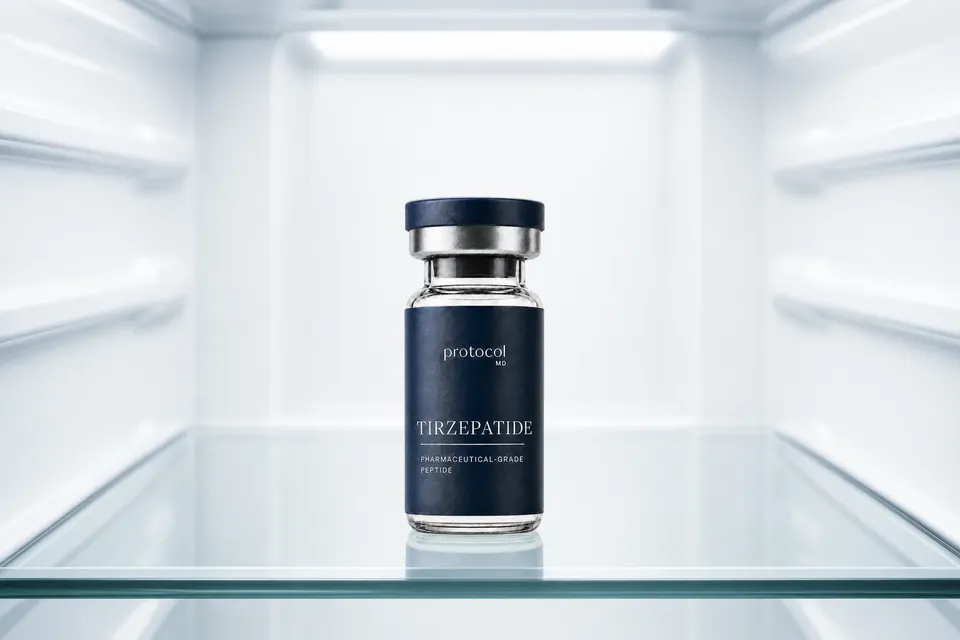
Protocol MD's semaglutide and tirzepatide are physician-prescribed and compounded. Compounded medications are not FDA-approved and are not the same as the brand-name products. A US-licensed physician reviews your history, decides whether treatment is appropriate, and manages it over time.
The screening matters more than it sounds. A medication with a boxed warning and a real contraindication list is not something to obtain from whoever will send it — the point of a prescriber is that someone checks whether the thing is safe for you specifically before you take it, and stays available when something changes.
If you're considering treatment, it starts with a physician evaluation.
13
The Bottom Line
Most of what people experience on tirzepatide is digestive, mechanical, and temporary: a stomach that empties slowly and a body eating far less than it used to. Those effects cluster at the start and after each dose increase, and they ease. A much shorter list — severe abdominal pain radiating to the back, persistent vomiting, no stool and no gas, sudden vision loss in one eye, or an allergic reaction — is urgent and should never be waited out. Over all of it sits a boxed warning for thyroid C-cell tumors that makes a personal or family history of medullary thyroid carcinoma or MEN 2 a hard stop. And if you're taking a compounded version, one question belongs on your list that doesn't appear on any brand-drug label: what else is in the vial, and who made it.
FAQ
Frequently Asked Questions
What are the side effects of tirzepatide?
The common ones are gastrointestinal — nausea, diarrhea, constipation, vomiting, reduced appetite, burping — plus fatigue, injection site reactions, and hair shedding related to rapid weight loss. Serious but less common effects include pancreatitis, gallbladder problems, severe dehydration, allergic reactions, and bowel obstruction. It also carries a boxed warning for thyroid C-cell tumors.
How long do tirzepatide side effects last?
Usually they're worst in the first weeks and after each dose increase, easing at a stable dose. Effects that persist for months, worsen at a stable dose, or appear suddenly after a long stable period should be discussed with your prescriber.
Does tirzepatide cause cancer?
Tirzepatide carries a boxed warning because it caused thyroid C-cell tumors in rodents; whether it does so in humans is not known, and anyone with a personal or family history of medullary thyroid carcinoma or MEN 2 should not take it. In human data, a 2025 systematic review and meta-analysis did not find tirzepatide associated with an increased risk of cancer overall (Kamrul-Hasan et al., 2025). Both of those facts are true and the warning stands regardless.
What are the long-term side effects of tirzepatide?
Genuinely long-term data is limited. Tirzepatide was first approved in 2022, the main SURMOUNT-1 obesity results ran 72 weeks, and the longest randomized data — a prediabetes subgroup followed for 176 weeks — reported no new safety signals. That's the honest answer, and anyone presenting a confident ten-year safety picture is going beyond the evidence. What is known is that the effects above persist as risks for as long as treatment continues.
Does tirzepatide cause eye problems?
A 2025 JAMA Network Open cohort study reported an increased risk of optic nerve disorders including NAION with semaglutide or tirzepatide in people with type 2 diabetes. Absolute risk remains low and association isn't causation, but sudden vision changes in one eye should be treated as urgent.
Are the side effects of compounded tirzepatide different?
The molecule is the same, so the same effects apply. What differs is that compounded products are not FDA-approved, are not identical to brand products, and often contain additional ingredients such as B12 and preservatives — which is worth knowing if you have any sensitivity. Ask your provider exactly what's in yours.
Is tirzepatide worse than semaglutide for side effects?
Both share the same class of gastrointestinal effects. A 2026 cohort study of adults with type 2 diabetes, with 46,620 matched pairs, found similar rates of severe GI events such as pancreatitis, biliary disease, and bowel obstruction with tirzepatide and semaglutide (Ann Intern Med, 2026). Milder effects like nausea are a separate question, and side effects alone shouldn't drive the choice. Our semaglutide vs tirzepatide comparison covers the broader differences.
Do the side effects mean it's working?
No. There's no established relationship between side-effect severity and how well the medication is working, and you shouldn't read anything into having them or not.
Citations & Sources
- Jastreboff AM, et al. Tirzepatide Once Weekly for the Treatment of Obesity (SURMOUNT-1). N Engl J Med. 2022. https://pubmed.ncbi.nlm.nih.gov/35658024/
- Jastreboff AM, et al. Tirzepatide for Obesity Treatment and Diabetes Prevention. N Engl J Med. 2025. PMID 39536238. https://pubmed.ncbi.nlm.nih.gov/39536238/
- Comparative Gastrointestinal Safety of Dulaglutide, Semaglutide, and Tirzepatide. Ann Intern Med. 2026 Jan. https://pubmed.ncbi.nlm.nih.gov/41183330/
- Kamrul-Hasan ABM, et al. Tirzepatide and Cancer Risk in Individuals with and without Diabetes: A Systematic Review and Meta-Analysis. Endocrinol Metab (Seoul). 2025 Feb. https://pubmed.ncbi.nlm.nih.gov/39814031/
- Wang L, et al. Semaglutide or Tirzepatide and Optic Nerve and Visual Pathway Disorders in Type 2 Diabetes. JAMA Netw Open. 2025 Aug. https://pubmed.ncbi.nlm.nih.gov/40788646/
Educational only — this article does not diagnose, prevent, treat, or cure any condition and is not medical advice, and it is not a complete list of side effects, warnings, contraindications, or interactions. Tirzepatide carries a boxed warning for thyroid C-cell tumors; it is contraindicated in people with a personal or family history of medullary thyroid carcinoma or Multiple Endocrine Neoplasia syndrome type 2. Do not start, stop, or change the dose of any medication without your prescribing physician. Seek emergency care for severe abdominal pain radiating to the back, persistent vomiting, sudden vision loss, difficulty breathing, or swelling of the face, lips, tongue, or throat. Brand names are used only to identify medications readers may be taking and do not imply any affiliation. Protocol MD's semaglutide and tirzepatide are physician-prescribed and compounded; compounded medications are not FDA-approved and are not the same as the brand-name products. Protocol MD sells compounded tirzepatide and has a commercial interest in this topic. GLP-1 medications are available only by prescription following evaluation by a licensed physician, are not appropriate for everyone, and can cause side effects; individual results vary.
Published August 17, 2026. Last updated October 7, 2026.