%20scale(0.008000%20-0.008000)'%3e%3cpath%20d='M74%20714H250L447%20155H449L641%20714H815V0H696V551H694L496%200H393L195%20551H193V0H74Z'/%3e%3c/g%3e%3cg%20transform='translate(114.2240%2035.7)%20scale(0.008000%20-0.008000)'%3e%3cpath%20d='M76%20714H372Q454%20714%20514.0%20686.0Q574%20658%20612.0%20609.5Q650%20561%20668.5%20496.0Q687%20431%20687%20357Q687%20283%20668.5%20218.0Q650%20153%20612.0%20104.5Q574%2056%20514.0%2028.0Q454%200%20372%200H76ZM201%20102H324Q397%20102%20443.5%20121.5Q490%20141%20516.5%20175.5Q543%20210%20552.5%20256.5Q562%20303%20562%20357Q562%20411%20552.5%20457.5Q543%20504%20516.5%20538.5Q490%20573%20443.5%20592.5Q397%20612%20324%20612H201Z'/%3e%3c/g%3e%3c/g%3e%3c/svg%3e)
Key takeaways
- The medication creates the deficit for you. Deliberately restricting on top of a suppressed appetite is how people get into trouble.
- Under-eating is the more common failure mode, and it shows up as fatigue, muscle loss, hair thinning, and worse gastrointestinal side effects.
- Protein is the priority, not the calorie number. When total intake falls, protein is what protects the muscle you're trying to keep.
- There is a floor. Sustained intake below roughly 1,200 calories a day for women or 1,500 for men is generally considered too low to meet basic nutritional needs without medical supervision.
01
The Short Answer: Let the Medication Do It
Here's the thing most people get backwards. GLP-1 medications work largely by reducing appetite and slowing gastric emptying, so you naturally eat less without trying. The calorie deficit is the medication's job. Your job is to make sure that what you eat is worth eating.
So the honest answer to “how many calories should I eat on a GLP-1” is usually: around your maintenance level, and let the reduced appetite bring the actual number down on its own. You can estimate your maintenance with our calorie calculator or TDEE calculator — but treat it as a reference point for what normal looks like, not a target to cut beneath.
Stacking a deliberate restriction on top of pharmacological appetite suppression is where people run into the problems below.
02
Why Under-Eating Is the Bigger Risk
This is the part that doesn't get said enough. When appetite drops sharply, a lot of people simply forget to eat, or stop when they've had a few bites, and end up well under what their body needs for weeks at a time. That produces a predictable set of problems:
- Muscle loss. Rapid weight loss with inadequate protein and inadequate total calories takes lean tissue along with fat. That's the difference between getting leaner and just getting smaller, and it's covered in depth in our guide to body recomposition.
- Fatigue and poor recovery. Under-fuelling reliably shows up as low energy long before anything else.
- Worse GI side effects. Nausea often gets worse, not better, on an empty stomach. Small, regular, protein-forward meals are generally easier to tolerate than nothing followed by a large meal.
- Nutrient gaps. Eating substantially less food means fewer vitamins and minerals, unless the food is dense in them.
- Hair thinning. Commonly reported during rapid weight loss and often related to inadequate protein and overall intake rather than the medication itself.
None of this means the medication isn't working. It means the eating pattern around it needs attention.
03
What to Prioritize Instead of a Number
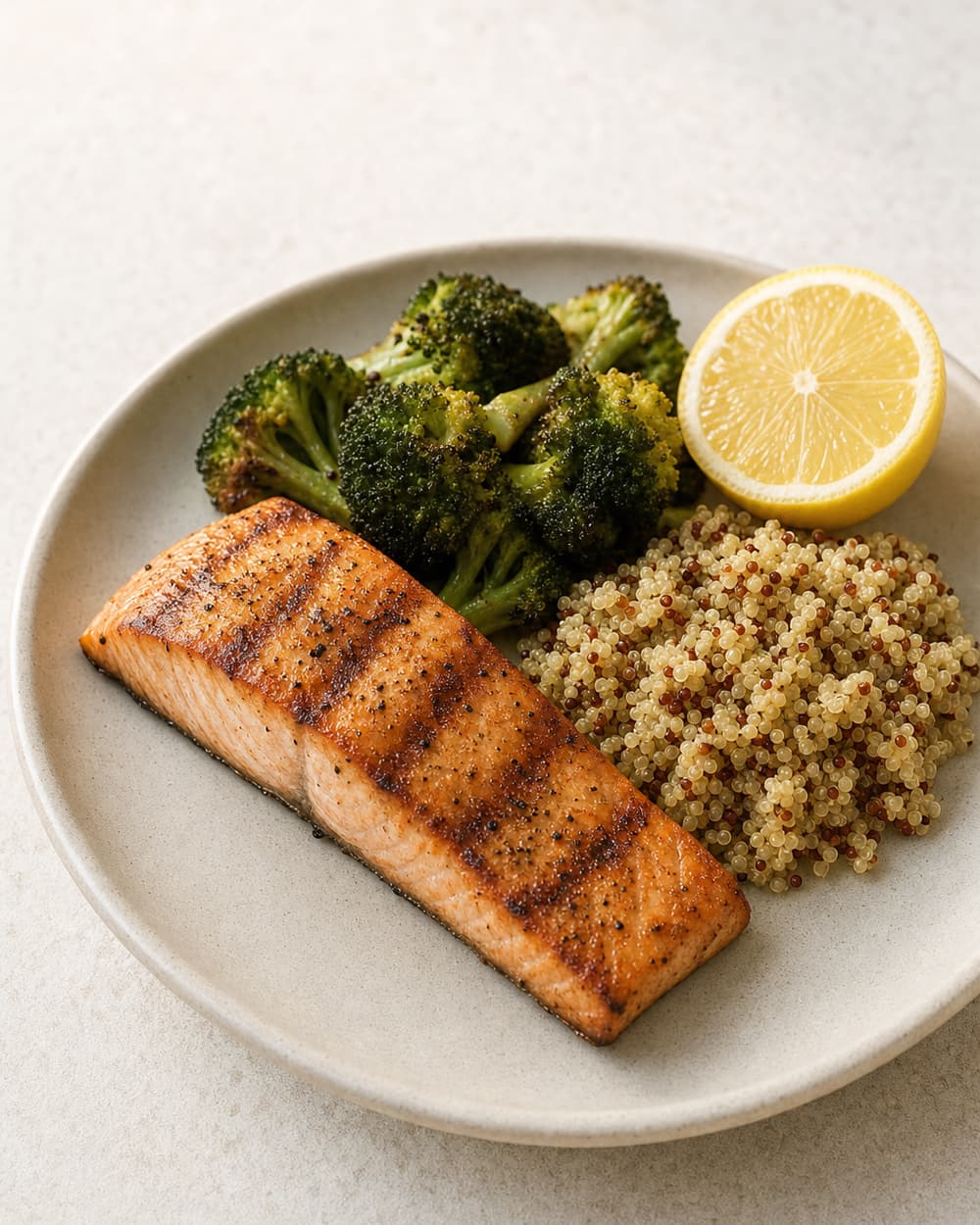
Protein first, every meal. When total intake drops, protein is what protects lean mass. A widely used target in the resistance-training literature is roughly 0.7 to 1 gram per pound of body weight per day (Morton et al., 2018). On a suppressed appetite that can be genuinely hard, which is why it goes first on the plate rather than last.
Eat on a schedule, not on hunger. If hunger cues are muted, waiting to feel hungry means under-eating. Regular smaller meals work better than waiting.
Make the calories count. Fewer total calories means each one needs to bring more with it: protein, fiber, vitamins, minerals. This is the moment when food quality stops being optional.
Hydrate and keep some fiber in. Both help with the gastrointestinal side of things.
Keep resistance training in. Protein gives your body the material to hold muscle; training is the signal telling it to. Neither works well alone.
04
Is There a Floor?
Yes, and it matters more here than in ordinary dieting because appetite suppression makes it easy to drop below it without noticing.
As a general reference, sustained intake below about 1,200 calories per day for women or 1,500 for men is widely considered too low to reliably meet protein, vitamin, and mineral needs, and is generally only used under medical supervision. If you're consistently landing under that on a GLP-1 — and plenty of people do without realizing it — that's a conversation with your prescribing physician, not something to push through.
Our calculators apply that same floor: if the math produces a target below it, we don't display a number, because a calculator isn't in a position to supervise anyone.
05
What About the Brand-Name Versions?
The principles are the same across the class. Semaglutide (marketed as Ozempic® and Wegovy®) and tirzepatide (marketed as Mounjaro® and Zepbound®) all reduce appetite through related mechanisms, so “how many calories on Zepbound” and “how many calories on Wegovy” have the same answer: eat around maintenance, prioritize protein, don't chase a deficit the medication is already producing.
Protocol MD provides physician-prescribed, compounded semaglutide and tirzepatide. Compounded medications are not FDA-approved and are not the same as the brand-name products, even though they share an active ingredient. If you're weighing the two molecules, we cover how semaglutide and tirzepatide compare.
06
When to Talk to Your Physician
Bring it up if you're regularly eating well under the floor above, if nausea is preventing you from eating at all, if you're losing weight much faster than expected, if you feel persistently exhausted, or if you're unsure whether what you're eating is enough. And if the scale has stalled, that's a different question with a different answer — we cover it in why you might not be losing weight on semaglutide.
If your relationship with food or with tracking feels compulsive or distressing, that's worth raising with a clinician. In the US you can text “NEDA” to 741741 to reach a trained volunteer at Crisis Text Line, any time.
07
The Bottom Line
So, how many calories should you eat on a GLP-1? For most people, about what you'd eat to maintain your weight — and then let the medication do the reducing. The number to watch isn't a ceiling, it's a floor: enough total food, and enough protein, to keep the weight you lose coming from fat rather than muscle. If you're routinely eating far below that floor, the answer isn't to push harder. It's to talk to your prescribing physician.
FAQ
Frequently Asked Questions
How many calories should I eat on semaglutide?
Most people should aim at roughly their maintenance calories and let the medication reduce intake naturally, rather than adding a deliberate deficit. Estimate maintenance with a calculator, prioritize protein, and have your prescribing physician set anything more specific for you.
Should I count calories on a GLP-1?
Many people don't need to, because appetite suppression handles the deficit. Tracking can be useful for the opposite reason: confirming you're eating enough, particularly enough protein. If tracking feels compulsive, that's a reason to stop and speak with a clinician.
What happens if I eat too few calories on a GLP-1?
Common consequences are muscle loss, fatigue, poor recovery, nutrient gaps, hair thinning, and often worse nausea. Under-eating is a frequent and underrecognized problem on these medications precisely because hunger cues are muted.
How much protein should I eat on a GLP-1?
A commonly cited evidence-based range is about 0.7 to 1 gram per pound of body weight daily, prioritized at each meal. It's the single most important nutrient for protecting muscle while losing fat, and the hardest to hit on a reduced appetite.
Is it normal to not feel hungry at all?
Substantially reduced appetite is the expected effect of the medication. Not eating at all is not the goal — if you genuinely cannot eat, or nausea is preventing meals, tell your prescribing physician rather than waiting it out.
Citations & Sources
- Morton RW, et al. A systematic review, meta-analysis and meta-regression of the effect of protein supplementation on resistance training-induced gains in muscle mass and strength in healthy adults. Br J Sports Med. 2018. https://pubmed.ncbi.nlm.nih.gov/28698222/
- US Departments of Agriculture and Health and Human Services. Dietary Guidelines for Americans. https://www.dietaryguidelines.gov/
Medically reviewed by Dr. Richard Dentico, MD. Educational only — this article does not diagnose, prevent, treat, or cure any condition, is not medical advice, and is not a nutrition prescription. Calorie and protein figures are general references, not targets for any individual. Do not start, stop, or change the dose of any medication without your prescribing physician. Protocol MD's semaglutide and tirzepatide are physician-prescribed and compounded; compounded medications are not FDA-approved and are not the same as the brand-name products. GLP-1 medications are available only by prescription following evaluation by a licensed physician, are not appropriate for everyone, and can cause side effects; individual results vary.
Medically reviewed by Dr. Richard Dentico, MD. Published August 2, 2026.
Take the assessment