%20scale(0.008000%20-0.008000)'%3e%3cpath%20d='M74%20714H250L447%20155H449L641%20714H815V0H696V551H694L496%200H393L195%20551H193V0H74Z'/%3e%3c/g%3e%3cg%20transform='translate(114.2240%2035.7)%20scale(0.008000%20-0.008000)'%3e%3cpath%20d='M76%20714H372Q454%20714%20514.0%20686.0Q574%20658%20612.0%20609.5Q650%20561%20668.5%20496.0Q687%20431%20687%20357Q687%20283%20668.5%20218.0Q650%20153%20612.0%20104.5Q574%2056%20514.0%2028.0Q454%200%20372%200H76ZM201%20102H324Q397%20102%20443.5%20121.5Q490%20141%20516.5%20175.5Q543%20210%20552.5%20256.5Q562%20303%20562%20357Q562%20411%20552.5%20457.5Q543%20504%20516.5%20538.5Q490%20573%20443.5%20592.5Q397%20612%20324%20612H201Z'/%3e%3c/g%3e%3c/g%3e%3c/svg%3e)
Key takeaways
- Three standard sites: abdomen, thigh, upper arm. Each is an acceptable place for a subcutaneous injection.
- There is no "most effective" site. People ask about this constantly, and the honest answer is that site selection is about comfort and skin health, not potency.
- Rotation is the part that actually matters. Repeatedly injecting the same spot can cause tissue changes that make absorption unpredictable.
- Follow the instructions that came with your medication. Especially with a vial and syringe, the specifics belong to your prescriber and pharmacy, not to an article.
01
The Three Standard Sites
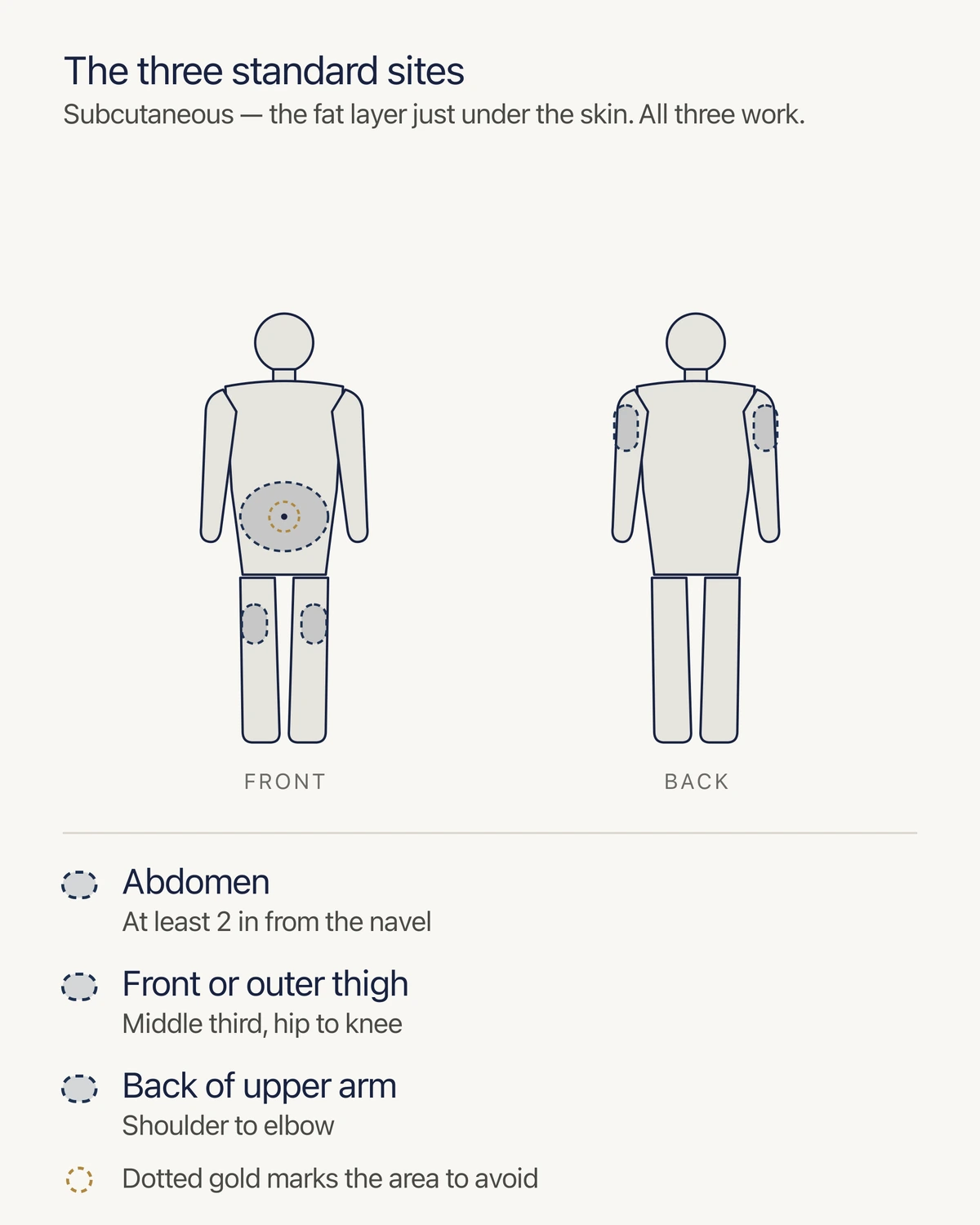
Semaglutide is injected subcutaneously, meaning into the layer of fat between the skin and muscle rather than into a vein or muscle. That layer absorbs the medication slowly and steadily, which is what this medication is designed for.
The abdomen. The most commonly used site, and the one most people find easiest to reach and least uncomfortable. The usable area is the soft tissue across the stomach, staying at least two inches away from the navel — the tissue immediately around the belly button is tethered differently and is a poor choice. Avoid the waistband line if clothing rubs there.
The thigh. The front and outer surface of the upper leg, roughly the middle third between hip and knee. Stay toward the front and outside rather than the inner thigh, where the tissue is more sensitive and there are structures you don't want to be near. This is a good option for people who find the abdomen uncomfortable or who have limited abdominal tissue to pinch.
The back of the upper arm. The fatty area on the back of the arm between shoulder and elbow. It's a legitimate site, but it's awkward to reach on yourself with one hand, which is why fewer people use it routinely.
What all three have in common is a pinchable layer of subcutaneous fat. That's the requirement. If you can't gather a fold of tissue at a site, it isn't a good site for you.
02
Does the Injection Site Change How Well It Works?
This is the question underneath most searches on this topic, and it deserves a direct answer: no, not in any way you should be trying to exploit.
People look for a "most effective" or "best" injection site because it feels like there should be one — some site that produces better appetite suppression or faster results. There isn't. A population pharmacokinetic analysis of 1,612 adults with type 2 diabetes in the semaglutide phase 3 trials found no clinically relevant effect of injection site on semaglutide exposure; body weight was the only covariate that mattered (Carlsson Petri et al., 2018). Semaglutide's long half-life is what allows once-weekly dosing (Yang et al., 2024), so small differences in absorption rate between sites don't translate into different outcomes.
What this means practically is that you should choose based on things you can actually feel:
- Which site is most comfortable for you
- Which you can reach and see properly
- Where you have enough tissue to pinch
- What lets you rotate properly
If someone tells you a particular site works better, ask what they're basing it on. The far more likely explanation for a change in someone's experience after switching sites is that they moved off tissue they had been overusing — which brings us to the part that does matter.
03
Rotation: The Part That Actually Matters
Here's the inversion worth holding onto. You came asking which site is best. The more useful question is whether you are moving around enough.
Repeatedly injecting into the same small area can cause the tissue there to change. In injection-technique literature — most of it developed around insulin, which is injected far more frequently than a weekly GLP-1 — this is called lipohypertrophy: a firm, rubbery thickening under the skin that develops where injections cluster. An international expert panel published consensus recommendations on it in 2026, and the core clinical point is consistent across that literature: injecting into affected tissue produces erratic, unpredictable absorption (Diabetes Res Clin Pract, 2026). The same panel named inadequate injection-site rotation as the strongest modifiable risk factor for it.
Two honest caveats. First, that evidence base is largely insulin, where people inject multiple times a day; a once-weekly injection carries considerably less cumulative exposure to any one spot. Second, the tissue is not always obvious — it can be easier to feel than to see, and areas of it are often less sensitive, which is exactly why people gravitate toward them.
That last point is worth sitting with. If one spot has become noticeably more comfortable to inject than everywhere else, that is not a reason to keep using it. It's a reason to check it and move on.
Rotating well isn't complicated:
- Move to a different spot every injection, not just a different site.
- Space injections roughly an inch or more apart within a site before returning to an area.
- Work systematically. Many people mentally divide the abdomen into quadrants and move around them in order, or alternate left and right week to week. A note on your phone or a mark on a calendar beats memory.
- Feel the area before you inject. You're checking for firmness, thickening, or lumps compared with surrounding tissue.
- Give an affected area a long rest if you find one, and mention it to your prescriber.
Because semaglutide is weekly, you have a large amount of skin and a small number of injections. There's no reason to reuse a spot.
04
A Rotation System You'll Actually Follow
"Rotate your sites" is advice everyone gives and almost nobody operationalizes. The failure mode isn't disagreement — it's that a week is long enough to forget where you went last time, so you default to whatever feels familiar. That default is the problem.
A system that survives real life:
Pick an order and never think about it again. The simplest version that works: four abdominal quadrants — upper left, upper right, lower left, lower right — used in the same order every week, so you return to any given quadrant roughly monthly. Within a quadrant, move an inch or so from wherever you were last time rather than landing on the same point.
Or alternate whole sites on a fixed pattern. Abdomen, thigh, abdomen, arm — whatever you can reach reliably. The pattern matters less than having one.
Write it down the moment you inject, not later. A note on your phone with the date and spot takes five seconds. A calendar entry works. A dot on a paper calendar works. Any external record beats trying to remember a decision you made seven days ago while thinking about something else.
Do a monthly check. Once a month, run your fingers over the areas you use and compare them to the tissue nearby. You're feeling for firmness, thickening, or a rubbery patch. Anything you find gets rested and mentioned to your prescriber.
The bar here is low. Weekly dosing means roughly 52 injections a year across an area with room for hundreds. You do not need a sophisticated scheme — you need any scheme at all, because the alternative is unconsciously returning to the same comfortable inch of skin.
05
Does It Hurt? And What Makes It More Comfortable
Most people describe a subcutaneous injection with a fine needle as a brief sting or pinch rather than real pain, and many report feeling almost nothing. If yours consistently hurts, that's usually a fixable circumstance rather than something you have to accept.
The things that most often make a difference:
Temperature. A common culprit. Medication injected straight from the fridge often stings more than medication that has been allowed to warm up. Ask your pharmacy what's appropriate for your specific product and how long — don't improvise storage on your own, since storage requirements are part of what keeps a compounded preparation stable.
Let the alcohol dry. If you swab the skin, give it a few seconds. Injecting through wet alcohol stings, and people misattribute that sting to the needle.
Relax the area. A tensed muscle underneath makes the whole thing less comfortable. Sitting for a thigh injection, rather than standing with the leg braced, is usually easier.
A fresh needle every single time. Needles are single-use. A reused needle is duller, hurts more, and carries an infection risk. This applies no matter how careful you were the first time.
Change the spot. If one site consistently hurts more, use a different one. There's no prize for persisting with the abdomen if your thigh is easier.
Don't chase painlessness. Worth repeating, because it's the trap: an area that has become noticeably less sensitive than everywhere else may be tissue that's been overused. Comfort is a good tiebreaker between healthy sites. It's not a reason to keep returning to one.
If injections are genuinely painful despite all of this, tell your prescriber. That's information, not a complaint to sit on.
06
Where Not to Inject
Regardless of which site you choose, avoid:
- Within two inches of the navel
- Skin that is bruised, tender, red, or broken
- Scars, stretch marks, tattoos, or moles
- Any area that feels firm, lumpy, or thickened compared with the tissue around it
- Directly into muscle — this medication is intended for subcutaneous tissue, not intramuscular
- A vein
- Areas where a waistband or clothing rubs persistently
If you have very little subcutaneous fat at a site, that's a reason to use a different site, and it's a reasonable thing to raise with your prescriber.
07
A Note on Vials and Syringes — and Why This Article Stops Here
Most articles on where to inject semaglutide are written about the branded pens: a pre-set device where the dose is dialed in.
If you're using compounded semaglutide, you likely have something different — a vial and a syringe. The sites and the rotation principles above apply identically. What does not carry over is the technique, and this is where we're going to stop rather than give you a walkthrough.
The reason is specific. With a pen, the dose is the number you dial. With a vial, the dose is the volume you draw up, and the volume that corresponds to your prescribed dose depends on the concentration of your particular vial — which varies between pharmacies and between preparations. A generic step-by-step on a website cannot know your concentration, and a walkthrough that produces a confident-looking number is precisely how someone draws the wrong amount.
So: the instructions that came with your medication, and your prescriber, are the authority on how to draw and administer your dose. Not an article, not a video, and not a Reddit comment from someone using a different pharmacy's formulation.
If those instructions weren't clear, or you didn't get any, that's not something to solve by searching. Call whoever prescribed it. Being unsure how to administer your own medication is a completely reasonable thing to phone about, and any legitimate provider will expect that call.
08
Injection Site Reactions: What's Normal and What Isn't
Mild reactions at the injection site are common with subcutaneous injections and usually settle on their own.
Generally ordinary:
- Mild stinging or burning during the injection, or briefly afterward. Cold medication injected straight from the fridge is a frequent and easily fixed cause — many people let it come toward room temperature first, which is worth asking your pharmacy about for your specific product.
- A small red mark or mild pinkness that fades over hours
- Slight tenderness at the spot
- A tiny amount of bleeding or a small bruise, particularly if you nicked a small vessel
Worth contacting your prescriber about:
- A rash at the injection site, especially spreading or recurring in the same place
- Redness, warmth, and swelling that increases over a day or two rather than fading
- A hard lump that persists or that appears repeatedly at the same area
- Pain that is severe, or that worsens instead of easing
- Any drainage or pus
- Fever alongside a site reaction
Seek prompt medical attention for signs of a serious allergic reaction — difficulty breathing, swelling of the face, lips, tongue, or throat, widespread hives, or feeling faint. That is an emergency and not a site reaction.
The pattern to notice: ordinary reactions get better over hours to a day. Anything that is escalating rather than settling is a reason to make a call.
09
Common Mistakes
- Using the same favorite spot every week. The most common one, and the one with real consequences.
- Injecting cold medication straight from the fridge, then concluding a site is painful when the temperature was the problem.
- Injecting too close to the navel.
- Choosing a site with too little tissue to pinch.
- Assuming a site is "working better" and abandoning rotation to chase it.
- Not tracking where you've injected, then defaulting to whatever feels familiar.
- Trying to work out draw-up volume from a general article rather than from your prescriber and pharmacy.
10
What to Ask Your Prescriber or Pharmacy
- Which sites do you recommend for me specifically?
- What is the concentration of my vial, and what volume corresponds to my prescribed dose?
- Should I let it come to room temperature before injecting, and how long?
- How should I be storing it?
- What should I do if I find a firm or lumpy area?
- Which site reactions should prompt me to call you?
11
How Protocol MD Approaches This
Protocol MD's semaglutide and tirzepatide are physician-prescribed and compounded. Compounded medications are not FDA-approved and are not the same as the brand-name products. Semaglutide and tirzepatide carry a boxed warning about thyroid C-cell tumors and are not used in anyone with a personal or family history of medullary thyroid carcinoma (MTC) or multiple endocrine neoplasia type 2 (MEN 2). In the Protocol MD GLP-1 program, a US-licensed physician reviews your history, decides whether treatment is appropriate, and manages it over time.
Administration is part of that. A patient who has a vial in the fridge and is piecing together how to use it from search results has been handed a product without the support that's supposed to come with it. If you're treating with us and anything about administration is unclear, that's a question to bring to us rather than to a comment thread.
If you're already on treatment, our guides on nausea and constipation cover what comes up most. If you're considering treatment, it starts with a physician evaluation.
12
The Bottom Line
Semaglutide goes into the fat layer under the skin, and the three standard places to put it are the abdomen at least two inches from your navel, the front or outer thigh, and the back of your upper arm. Pick based on what you can reach comfortably and pinch properly, because there is no site that makes the medication work better — that's a question with a genuinely boring answer. What isn't boring is rotation: injecting the same spot repeatedly can change the tissue and make absorption unpredictable, so move every time, space injections out, and check for firm or lumpy areas before you inject. Put your effort into moving the spot every time rather than into picking a winner. And if you're working from a vial and a syringe, get your draw-up instructions from your prescriber and your pharmacy rather than from any article, because the volume that equals your dose depends on your vial's concentration and nothing on the internet knows what that is.
FAQ
Frequently Asked Questions
Where do you inject semaglutide?
Into subcutaneous tissue at one of three standard sites: the abdomen (at least two inches from the navel), the front or outer thigh, or the back of the upper arm. Follow the instructions provided with your medication.
What is the best injection site for semaglutide?
There isn't one in terms of effectiveness. A large pharmacokinetic analysis found no clinically relevant effect of injection site on semaglutide exposure, and its long half-life smooths out small differences in absorption. The abdomen is most popular because it's easiest to reach and pinch, so choose on comfort and your ability to rotate rather than on a belief that one site works better.
Does the injection site affect how well semaglutide works?
Not meaningfully, when the standard sites are used correctly. What can affect absorption is repeatedly injecting into the same area until the tissue changes, because thickened tissue absorbs unpredictably. That's an argument for rotation, not for a particular site.
Where on the thigh should I inject semaglutide?
The front and outer surface of the upper leg, roughly the middle third between hip and knee, where you can pinch a fold of tissue. Avoid the inner thigh.
Can I inject semaglutide in my arm?
Yes, the back of the upper arm is a standard site. The practical difficulty is reaching it one-handed on yourself, which is why fewer people use it routinely.
How often should I change injection sites?
Every injection should go in a different spot — not merely a different broad site. Space injections about an inch or more apart within an area and work through a system so you aren't relying on memory.
Why does my semaglutide injection burn?
Mild stinging or burning is common and often relates to injecting the medication cold, straight from the fridge. Burning that is severe, lasting, or accompanied by spreading redness, swelling, or a rash is a reason to contact your prescriber.
Where do I inject tirzepatide?
The same three sites apply: abdomen, thigh, and the back of the upper arm, with the same rotation principles.
Citations & Sources
- Guo L, et al. Consensus Recommendations on Lipohypertrophy: Insights From an International Panel of Experts. Diabetes Res Clin Pract. 2026;239:113401. PMID 42398590. https://pubmed.ncbi.nlm.nih.gov/42398590/
- MedlinePlus (National Library of Medicine). Subcutaneous (SQ) injections. https://medlineplus.gov/ency/patientinstructions/000430.htm
- Carlsson Petri KC, et al. Semaglutide s.c. Once-Weekly in Type 2 Diabetes: A Population Pharmacokinetic Analysis. Diabetes Ther. 2018;9(4):1533-1547. PMID 29907893. https://pubmed.ncbi.nlm.nih.gov/29907893/
- Yang XD, et al. Clinical Pharmacokinetics of Semaglutide: A Systematic Review. Drug Des Devel Ther. 2024;18:2555-2570. PMID 38952487. https://pubmed.ncbi.nlm.nih.gov/38952487/
Educational only — this article does not diagnose, prevent, treat, or cure any condition and is not medical advice, and it is not instructions for preparing or administering a dose. Always follow the administration instructions supplied with your medication and by your prescribing physician and pharmacy; the volume corresponding to a prescribed dose depends on the concentration of your specific product. Do not start, stop, or change the dose of any medication without your prescribing physician. Seek emergency care for difficulty breathing, swelling of the face, lips, tongue, or throat, or widespread hives. Protocol MD's semaglutide and tirzepatide are physician-prescribed and compounded; compounded medications are not FDA-approved and are not the same as the brand-name products. Protocol MD sells compounded semaglutide and has a commercial interest in this topic. Semaglutide carries a boxed warning for thyroid C-cell tumors and is contraindicated with a personal or family history of medullary thyroid carcinoma or MEN 2. GLP-1 medications are available only by prescription following evaluation by a licensed physician, are not appropriate for everyone, and can cause side effects; individual results vary.
Published August 8, 2026. Last updated October 2, 2026.