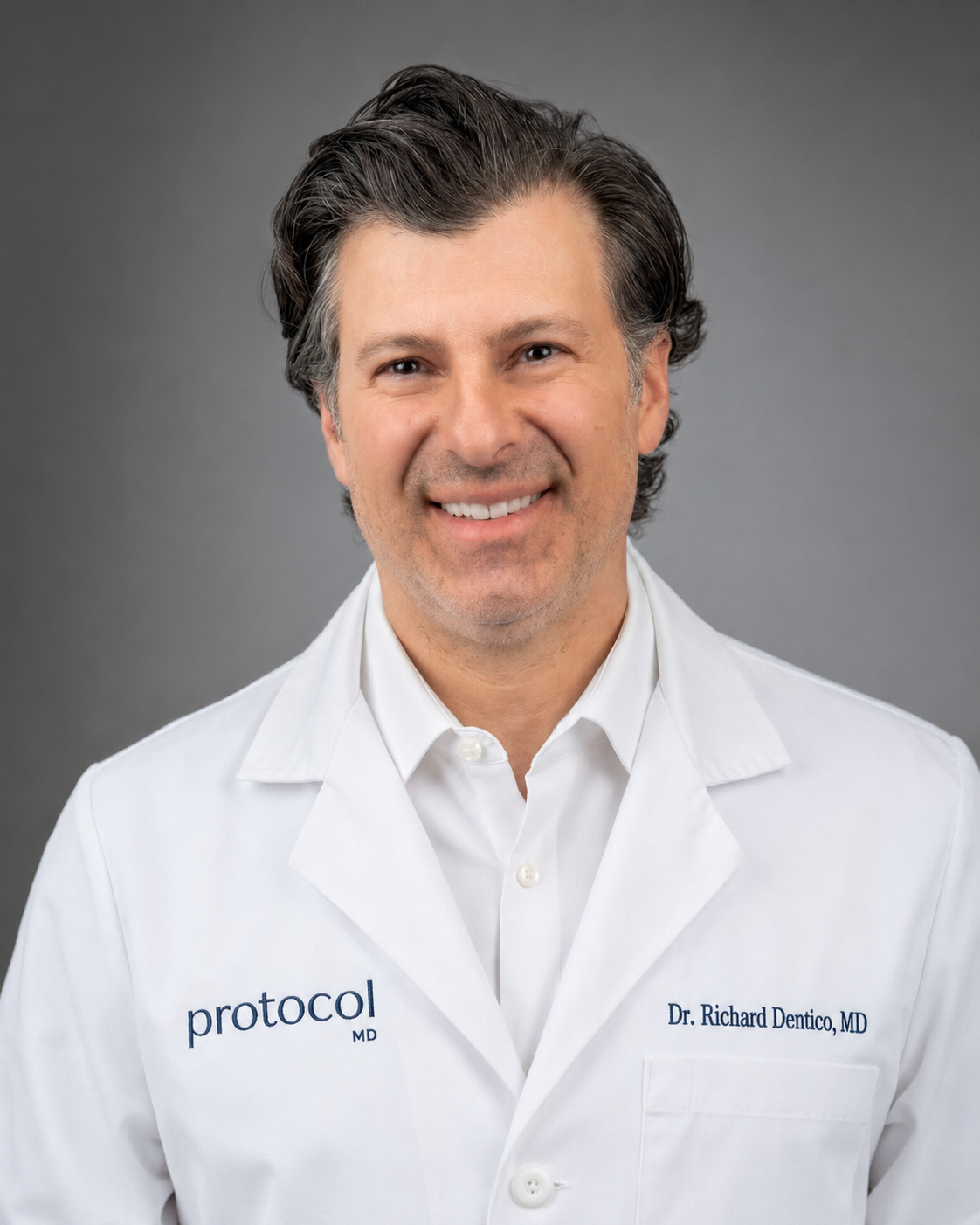
 Medically reviewed by Richard Dentico, MD

01
Why BPC-157 and TB-500 Are Combined
BPC-157 and TB-500 are combined because they work on different targets in the same injury cascade. BPC-157 upregulates growth hormone receptors, promotes angiogenesis through VEGF signaling, and shows particular strength in gut lining repair and nerve regeneration models. TB-500 — the synthetic version of thymosin beta-4 — promotes actin polymerization, enables cell migration into injured tissue, and suppresses pro-inflammatory cytokines systemically.
In practice: BPC-157 is considered more localized and GI-active; TB-500 is considered more systemic and muscle-fascial-active. The bpc 157 tb 500 combination is not redundant — the two peptides hit different signaling pathways in the healing process, which is the rationale for stacking them. This rationale comes from preclinical models; a head-to-head combination trial in humans has not been completed.
The bpc 157 and tb 500 benefits most commonly described in the research literature involve soft-tissue repair: tendon, ligament, muscle, and connective tissue healing. Neither peptide is FDA-approved. A prescribing physician evaluates individual candidacy before recommending either compound.
02
BPC-157 TB-500 Blend: 10mg and 20mg Vials Explained
BPC-157 and TB-500 are prescribed as a blend vial — a single reconstituted vial containing both peptides — or as separate vials dosed independently. The two most common blend configurations are the bpc-157 + tb-500 10mg blend and the bpc-157 tb-500 20mg blend peptide.
BPC-157 + TB-500 10mg blend
A bpc-157 + tb-500 10mg blend dosage vial typically contains 5mg BPC-157 and 5mg TB-500 in a single lyophilized (freeze-dried) powder. Reconstituted in 2ml of bacteriostatic water, this yields 2,500 mcg/ml of each peptide. A 10-unit draw (0.10ml) from this vial delivers 250 mcg of each compound. The bpc-157 + tb-500 10mg blend is the more common starting configuration.
BPC-157 TB-500 20mg blend peptide
The bpc-157 tb-500 20mg blend peptide typically contains 10mg BPC-157 and 10mg TB-500. Reconstituted in 2ml, this yields 5,000 mcg/ml of each peptide. A 10-unit draw delivers 500 mcg of each. The 20mg blend is used when the protocol calls for higher per-injection doses or when the physician wants to extend the number of doses per vial.
The blend ratio (equal parts BPC-157 and TB-500) is not a pharmacologically derived standard — it reflects manufacturing convention. A physician may specify the blend or prescribe each peptide separately to allow independent dose titration.
03
BPC-157 and TB-500 Dosage: What Research Has Used
BPC-157 and TB-500 dosage figures come from two separate bodies of animal research. They are not interchangeable, and no published trial has established the optimal ratio or combined dose for humans.
BPC-157 dosage reference
The most replicated preclinical BPC-157 dose is 10 mcg/kg/day by subcutaneous or intramuscular injection. For an 80 kg adult, this equals 800 mcg (0.8 mg). The full dosage calculation is covered in the BPC-157 dosage guide.
TB-500 dosage reference
TB-500 (thymosin beta-4) human dosing in clinical reports most commonly falls in the range of 2–6mg per week, divided across two to three injections. This figure is not from an FDA-approved dose-finding trial — it reflects clinical practice extrapolated from animal research. TB-500 animal studies have used doses from 1mg/kg (topical wound healing models) to higher systemic doses in cardiac and muscle repair research.
The bpc 157 tb 500 dosage combination is therefore a physician decision that sets each peptide's dose individually, not a fixed ratio. A blend vial makes administration convenient but does not change that the physician determines how much of each compound a patient receives per injection.
04
BPC-157 + TB-500 Blend Dosage Calculator: The Formula
A bpc-157 tb-500 blend dosage calculator performs the same calculation as any peptide dosage calculator, applied to each compound separately. The formula: target dose (mcg) ÷ concentration (mcg/ml) = volume in ml.
Worked example — 10mg blend, 2ml reconstitution
Blend vial: 10mg total (5mg BPC-157 + 5mg TB-500). Reconstitution: 2ml bacteriostatic water. Concentration: 2,500 mcg/ml of each peptide. Target dose: 250 mcg of each. Volume: 250 ÷ 2,500 = 0.10ml (10 units on a 100-unit insulin syringe). This bpc-157 + tb-500 blend dosage calculator logic applies to any blend size — change the total peptide content or reconstitution volume and recalculate.
Worked example — 20mg blend, 2ml reconstitution
Blend vial: 20mg total (10mg BPC-157 + 10mg TB-500). Concentration: 5,000 mcg/ml of each. Target dose: 500 mcg of each. Volume: 500 ÷ 5,000 = 0.10ml (10 units). The same 10-unit draw delivers twice as much peptide from the 20mg vial compared to the 10mg vial at the same reconstitution volume. Always confirm reconstitution instructions with your prescriber or pharmacist.
05
TB-500 and BPC-157 Dosage Chart
A tb-500 and bpc-157 dosage chart maps dose in mcg to volume in ml at a given blend concentration. The chart below uses the 10mg blend reconstituted in 2ml (2,500 mcg/ml per peptide). The ml column changes with every change in reconstitution volume — the mcg column stays fixed.
50 mcg each → 0.02ml (2 units). 100 mcg each → 0.04ml (4 units). 250 mcg each → 0.10ml (10 units). 500 mcg each → 0.20ml (20 units). 750 mcg each → 0.30ml (30 units). 1,000 mcg each → 0.40ml (40 units).
These are volume-to-dose conversions for reference. The bpc 157 tb 500 blend dosage your physician sets may not match any row in this table — dose is individualized. A tb-500 and bpc-157 dosage chart is a calculation aid, not a treatment protocol.
06
BPC-157 + TB-500 Blend Dosage Per Day and Per Week
BPC-157 + TB-500 blend dosage per day and bpc-157 + tb-500 blend dosage per week depend on the protocol phase. Most physician-supervised protocols follow a loading-then-maintenance structure rather than a fixed daily dose.
Loading phase
During a loading phase — typically the first two to four weeks — injection frequency is higher: often five days on, two days off, or daily dosing. The bpc 157 and tb500 loading phase is intended to bring tissue levels up quickly. Physician protocols vary; there is no published human trial establishing the optimal loading schedule.
Maintenance phase
After the loading phase, the bpc-157 + tb-500 blend dosage per week drops to one to two injections per week. The bpc-157 + tb-500 blend dosage protocol at maintenance is intended to sustain effect while reducing total peptide exposure. How long maintenance continues is determined by clinical response and physician discretion.
The question of how much bpc 157 and tb500 to take — daily, weekly, or on another schedule — has no universal answer. A physician sets the bpc-157 + tb-500 blend dosage protocol based on the specific indication, patient factors, and response.
07
BPC-157 and TB-500 for Injury: What the Evidence Shows
BPC-157 and TB-500 for injury is the most common clinical application of this combination. The rationale: soft-tissue injuries — tendons, ligaments, muscle tears, fascia — involve both a localized repair process (where BPC-157 targets growth factor signaling) and a systemic inflammatory response (where TB-500 targets actin and cytokine activity). Combining bpc-157 and tb-500 dosage for injury addresses both simultaneously.
The preclinical evidence for each compound individually is reasonably extensive. BPC-157 animal models cover tendon transection, muscle crush, ligament tear, and bone repair — all showing accelerated histological healing markers. TB-500 animal models include cardiac muscle repair, dermal wound healing, and corneal repair. Neither compound has completed a Phase 3 randomized controlled trial in humans for musculoskeletal injury.
BPC-157 and TB-500 benefits for injury, as described in the clinical literature and physician practice, include faster soft-tissue healing, reduced post-injury inflammation, and improved range of motion recovery. These are practice-based observations extrapolated from animal research — not FDA-approved indications. A physician determines whether bpc 157 and tb 500 is appropriate for a specific injury.
08
TB500 vs BPC 157: How They Compare
TB500 vs BPC 157 — or bpc 157 vs tb 500 — is a common question from people deciding whether to use one or both. The two compounds are not interchangeable; they have different mechanisms, different research bases, and different clinical reputations.
Mechanism
BPC-157 works primarily through growth hormone receptor upregulation, VEGF-driven angiogenesis, and direct gut mucosal protection. TB-500 works through thymosin beta-4's role in actin sequestration: it promotes cell migration, reduces inflammation systemically, and supports vascular repair.
Research focus
BPC-157 has the deeper GI and nerve literature — most of its strongest animal data involves gut healing, esophageal repair, and peripheral nerve regeneration. TB-500 has stronger representation in systemic soft-tissue and cardiac models. BPC157 TB500 together covers a broader spectrum of tissue types than either alone.
Who uses each
In practice: someone with a primary GI complaint may use BPC-157 alone. Someone with a systemic soft-tissue injury may use TB-500 alone or in combination. The decision between tb500 vs bpc 157 — or whether to stack them — is made by a physician based on what the patient's presentation actually calls for.
09
BPC-157 TB-500 Capsules: The Oral Option
BPC-157 TB-500 capsules are available from compounding pharmacies as an oral alternative to injection. Oral BPC-157 uses the arginate salt form for GI stability; TB-500 in oral form follows the same principle. BPC 157 tb 500 capsules are prescribed for patients where self-injection is not practical or where the physician's target is primarily GI-related.
The tradeoff: oral delivery for tissue repair outside the GI tract is less established in the literature than injection. BPC-157 animal data for systemic applications — tendon, ligament, nerve — predominantly uses subcutaneous or intramuscular injection. The bpc 157 tb 500 peptide delivered orally reaches the gut lining directly but may not reach musculoskeletal tissue at the same concentration as injection.
A physician determines whether capsules or injection is the right delivery route based on what the patient is treating. For gut-targeted indications, oral bpc 157 tb500 is well-supported by animal literature. For systemic injury repair, injection is the more frequently studied route.
BPC-157 and TB-500 address tissue repair through complementary mechanisms — BPC-157 on growth factor signaling and gut-nerve repair, TB-500 on actin regulation and systemic inflammation. A physician evaluation is the right starting point for anyone considering this combination.
FAQ
Frequently Asked Questions
What is a typical BPC-157 and TB-500 dosage?
BPC-157 and TB-500 dosage is set individually by a physician. As a research reference: BPC-157 animal studies use 10 mcg/kg/day; TB-500 clinical reports most commonly use 2–6mg per week. In a blend vial, the per-injection dose depends on the blend size (10mg or 20mg) and the physician protocol. No human clinical trial has established a standardized bpc 157 and tb 500 dosage.
What is the difference between a 10mg and 20mg BPC-157 TB-500 blend?
A bpc-157 + tb-500 10mg blend typically contains 5mg of each peptide; a bpc-157 tb-500 20mg blend peptide contains 10mg of each. At the same reconstitution volume (2ml), the 20mg blend is twice as concentrated and delivers twice the dose per unit drawn. The right blend size depends on the physician-set dose per injection.
How do I use a BPC-157 + TB-500 blend dosage calculator?
The bpc-157 tb-500 blend dosage calculator formula is: dose in mcg ÷ concentration in mcg/ml = volume in ml. For a 10mg blend in 2ml (2,500 mcg/ml per peptide): to draw 250 mcg of each, divide 250 by 2,500 = 0.10ml (10 units on a 100-unit syringe). Always confirm reconstitution volume with your prescriber or pharmacist before calculating.
How much BPC-157 and TB-500 to take per week?
How much bpc 157 and tb500 to take per week depends on the protocol phase. Loading phases typically involve more frequent dosing — often daily or five days per week. Maintenance phases drop to one to two injections per week. The bpc-157 + tb-500 blend dosage per week is set by the physician based on indication and response.
Is BPC-157 or TB-500 better for injury?
BPC-157 and TB-500 work through different mechanisms — BPC-157 on localized growth factor signaling and nerve repair; TB-500 on systemic actin regulation and inflammation. For many soft-tissue injuries, physicians combine both because bpc-157 and tb-500 dosage for injury addresses complementary phases of healing. Neither has completed a human efficacy trial for musculoskeletal injury. A physician determines which compound — or the combination — is appropriate.
Are BPC-157 TB-500 capsules as effective as injections?
BPC-157 TB-500 capsules are supported primarily for gut-targeted applications. For systemic soft-tissue repair, the injection route is more established in the preclinical literature. Whether bpc 157 tb 500 capsules match injection for musculoskeletal healing has not been directly compared in a controlled trial. A physician selects the delivery route based on the target indication.
What is the BPC-157 + TB-500 blend dosage protocol for a loading phase?
A common bpc-157 + tb-500 blend dosage protocol uses a loading phase of daily or near-daily injections for two to four weeks, followed by a maintenance phase of one to two injections per week. The specific bpc-157 + tb-500 blend dosage per day and schedule is set by the physician. No published human trial has established the optimal loading-to-maintenance transition point.
Citations & Sources
- * Pergolizzi JV Jr, et al. (2025). Emerging Use of BPC-157 in Orthopaedic Sports Medicine Applications. PMC. https://pmc.ncbi.nlm.nih.gov/articles/PMC11917098/
- ** Sikiric P, et al. (2024). Stable gastric pentadecapeptide BPC 157 and striated, smooth, and heart muscle. Biomedicines. https://pmc.ncbi.nlm.nih.gov/articles/PMC10887235/
- *** Goldstein AL, Hannappel E, Kleinman HK. Thymosin beta4: actin-sequestering protein moonlights to repair injured tissues. Trends Mol Med. 2005;11(9):421-429. https://pubmed.ncbi.nlm.nih.gov/16099219/
Educational only — this article describes BPC-157 and TB-500 based on preclinical animal research and does not constitute medical advice, a dosing recommendation, or a treatment protocol for any condition. BPC-157 and TB-500 are not FDA-approved drugs. Compounded versions require a physician prescription and are fulfilled through a licensed 503A compounding pharmacy. No controlled human clinical trial has established the optimal combination dose or protocol. A licensed physician determines whether this combination is appropriate for you, sets all dosing, and monitors response. Do not start, stop, or change any medication without your prescribing physician.
Published November 4, 2026. Last updated November 4, 2026.