Medically reviewed by Richard Dentico, MD
01
What Is MOTS-C? The Mitochondria-Derived Peptide
MOTS-c is a mitokine — a small peptide produced inside mitochondria and released into the bloodstream to signal to other tissues. What makes MOTS-c unusual is where it comes from: its gene is encoded in the mitochondrial genome, specifically in the 12S ribosomal RNA gene, not in the nuclear DNA where the body's other protein-coding genes live. That means every cell with mitochondria makes it, and the signal changes as mitochondrial function changes.
Dr. Pinchas Cohen and colleagues at the USC Davis School of Gerontology identified MOTS-c in 2015, publishing in Cell Metabolism. The key finding: MOTS-c injections prevented diet-induced obesity and reversed established insulin resistance in mice, acting through the AMPK pathway without directly binding a known cell-surface receptor. That was not what anyone expected from a 16-amino-acid peptide in the mitochondrial genome.*
What is mots c peptide in structural terms? It is a 16-amino-acid chain (Tyr-Arg-Trp-Leu-Met-Pro-Phe-Pro-Arg-Arg-Gly-Arg-Arg-Glu-Phe-His). It is not a growth hormone secretagogue, not a repair peptide in the BPC-157 sense, and not a sirtuin-dependent pathway compound like NAD+. Its mechanism is distinct: MOTS-c works primarily through AMPK activation and an effect on the folate cycle in skeletal muscle. Users will also see the mot c peptide and motc peptide spellings — these are simply variant search terms for the same compound.
02
What Does MOTS-C Do? Benefits and Mechanism
MOTS-c activates AMPK (AMP-activated protein kinase), the master regulator of cellular energy balance. When AMPK is active, cells shift from storing energy to burning it: fat oxidation goes up, glucose uptake in muscle improves, and gluconeogenesis in the liver goes down. The mots c peptide benefits in metabolic research all trace back to this AMPK signal.
The main MOTS-c peptide benefits documented in research:
- Improved insulin sensitivity — reduced insulin resistance in skeletal muscle in multiple mouse models*
- Increased fat oxidation — MOTS-c promotes the use of fat as a fuel source rather than glucose*
- Weight management — in mice fed a high-fat diet, MOTS-c prevented obesity and reduced adiposity without reducing food intake*
- Exercise mimicry — acute exercise raises circulating MOTS-c in humans; exogenous MOTS-c mimics part of this metabolic signal*
- Age-related metabolic protection — MOTS-c declines with age across species; supplementing it partially reverses age-related metabolic decline in animal models*
- Mitochondrial function — some evidence suggests MOTS-c supports mitochondrial efficiency and biogenesis*
What does mots c do in human studies? A 2022 randomized controlled pilot trial enrolled healthy older adults and treated them with MOTS-c injections for eight weeks. Participants showed improved physical performance scores and favorable changes in metabolic markers compared to placebo. The trial was small and not powered for clinical endpoints — it is the most direct human evidence to date. A 2015 population genetics study found that a MOTS-c variant in the mitochondrial genome is significantly associated with longevity in Japanese men aged 85 and older, adding a human epidemiological signal to the animal mechanistic data.*
The mot c peptide benefits signal is consistent across animal studies. The human evidence is early and limited. Anyone presenting MOTS-c as confirmed in large clinical trials is overclaiming.
03
MOTS-C Side Effects
MOTS-c side effects in research have been mild and uncommon. The 2022 human trial reported no serious adverse events. The most common reactions noted are injection site discomfort (redness, mild swelling at the subcutaneous injection site), transient fatigue in the hours following injection in a subset of participants, and occasional mild headache.
On the question of mots-c side effects and cancer: people searching this term are asking whether MOTS-c promotes tumor growth. Current evidence does not support that concern. Several preclinical studies suggest MOTS-c may actually inhibit certain cancer cell metabolic pathways — cancer cells that rely heavily on glycolysis may be disadvantaged by the shift in fuel utilization that MOTS-c promotes. However, the data is early and largely preclinical. Any individual with a personal or family history of malignancy should discuss MOTS-c explicitly with their oncologist before beginning any peptide protocol.
MOTS-c is not FDA-approved, and long-term safety data in humans does not exist. A physician screening evaluates contraindications, baseline labs, and individual metabolic health before starting any compounded peptide therapy. This is not a supplement — it is a prescription injectable.
04
MOTS-C Dosage: What Research Has Used
MOTS-c dosage in human studies has varied, and there is no FDA-approved dosing regimen because MOTS-c is not an approved drug. The dosing information here describes what researchers have used in published and registered trials — it is not a prescription, a recommendation, or a dosing instruction.
In the 2022 Kim RCT — the most cited human trial — participants received 10 mg MOTS-c twice weekly by subcutaneous injection (mots-c 10mg dosage per week equals 20 mg total). The trial ran for eight weeks. Participants showed measurable changes in physical performance and metabolic markers at this dosage.*
Animal studies have used a wide range, primarily weight-based: the 2015 Lee et al. mouse study used 0.5 mg/kg daily by subcutaneous injection. Direct conversion to a human dose equivalent is not straightforward and not how physician protocols work.*
In clinical practice, MOTS-c dosage protocols vary by provider and patient presentation. The mots-c dosage per week in physician-supervised protocols typically falls in the 5–20 mg range, with frequency varying from daily to three times weekly depending on the protocol and patient response. The mots-c dosage per day in more frequent protocols is typically 2–5 mg. MOTS-c reconstitution uses bacteriostatic water; the specific reconstitution volume determines the injection dose.
The mots-c dosage for weight loss specifically has not been tested in human trials focused on that endpoint. The metabolic mechanism — AMPK activation and fat oxidation — is relevant to weight management, but clinical evidence for weight loss outcomes is animal-only.
How much mots c should I take? That question requires a physician's evaluation of your metabolic panel, age, body composition goals, and existing conditions — not a general dosage chart from a website. The mots-c dosage that is right for you is a clinical decision.
05
MOTS-C Before and After: What Research Shows
MOTS-c before and after results in research are most clearly documented in the animal literature. In the Lee 2015 Cell Metabolism study, mice fed a high-fat diet that received daily MOTS-c showed significantly less weight gain, improved insulin sensitivity on glucose tolerance testing, and lower plasma glucose compared to controls — with no reduction in food intake. The effect was preventive when started alongside the diet and therapeutic when started after insulin resistance was already established.*
In the Kim 2022 human RCT, MOTS-c before and after comparisons in older adults showed improved Short Physical Performance Battery scores and favorable shifts in several metabolic biomarkers over eight weeks, though the study was not powered to detect differences in body composition.*
What MOTS-c before and after does not show, yet, is a controlled human trial demonstrating fat loss, weight change, or longevity endpoints at any MOTS-c dose. The mechanism is compelling, the animal data is unusually consistent, and the human data is early. Results from exogenous MOTS-c vary by individual and no outcome is guaranteed.
06
What Is MOTS-C Used For? Physician-Supervised Therapy
MOTS-c is used in physician-supervised peptide therapy protocols primarily for four categories: metabolic health optimization, age-related metabolic decline, exercise performance and recovery support, and longevity medicine. What is mots-c peptide used for in practice reflects the same applications the mechanistic research points to.
Metabolic health: patients with insulin resistance, prediabetes, or difficulty with body composition who have not responded fully to lifestyle intervention are the most logical candidates based on the mechanism.
Age-related decline: MOTS-c levels fall with age across species, and the age-associated metabolic slowdown — reduced fat oxidation, impaired insulin sensitivity, decreased mitochondrial efficiency — aligns with what MOTS-c supplementation addresses in animal models.
Exercise support: MOTS-c rises naturally with exercise and is now thought to partly mediate the metabolic benefits of physical activity. Athletes and older adults looking to extend the effects of their training use MOTS-c alongside active lifestyle protocols.
Longevity medicine: the population genetics data linking MOTS-c variants to longevity in older Japanese men, and the consistent animal-model evidence for life-extending metabolic effects, make MOTS-c a compound of serious interest in evidence-based longevity medicine.
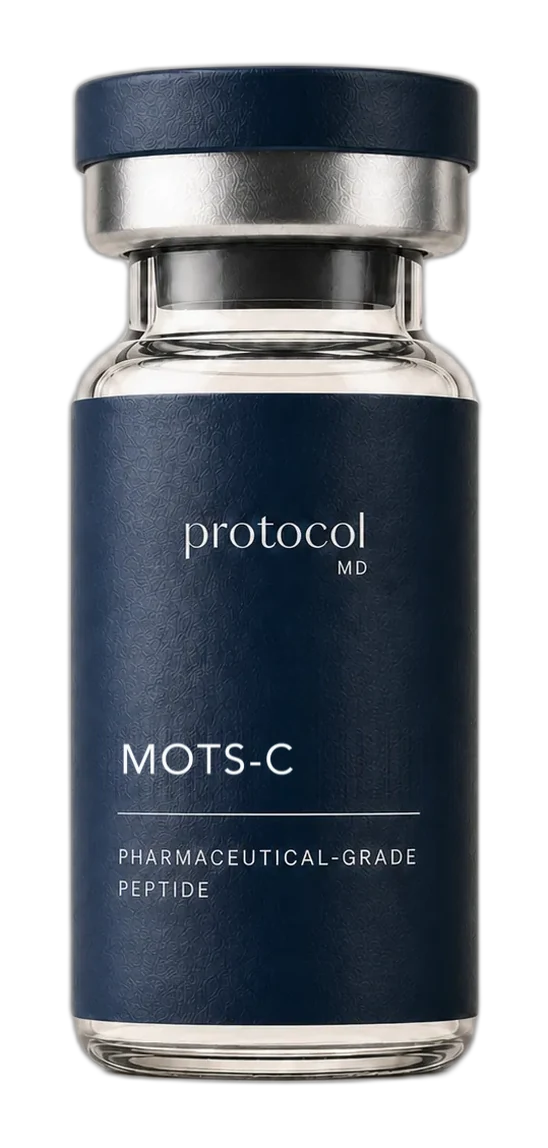
Protocol MD's MOTS-c therapy is physician-prescribed and compounded at a licensed 503A pharmacy. Compounded MOTS-c is not FDA-approved. It is a prescription, not a supplement. How to take MOTS-c in a supervised protocol: the injection is subcutaneous (under the skin), typically in the abdomen or thigh, delivered with a small-gauge needle provided with the protocol. The mots-c injection technique, storage, and reconstitution instructions are covered in onboarding. The mots-c half life in circulation is estimated at a few hours based on animal pharmacokinetic data; clinical protocol frequency is determined by the prescribing physician accordingly.
MOTS-c has a compelling mechanism and a growing evidence base — but its clinical picture is still developing, and whether it makes sense for you is a physician's call after a full metabolic intake.
FAQ
Frequently Asked Questions
What is MOTS-C?
MOTS-c (Mitochondrial Open Reading Frame of the Twelve S rRNA type-c) is a 16-amino-acid peptide encoded in the mitochondrial genome. It acts as a mitokine — a hormone-like signal from mitochondria — that activates AMPK, promotes fat oxidation, improves insulin sensitivity, and declines with age.
What does MOTS-C do?
MOTS-c activates AMPK, the cellular energy sensor that shifts metabolism toward fat burning and away from energy storage. In animal models, it prevents and reverses diet-induced obesity, improves insulin sensitivity, and mimics metabolic effects of exercise. Early human data shows improved physical performance markers in older adults.*
What is the MOTS-C dosage?
In the 2022 Kim human RCT, researchers used 10 mg twice weekly (20 mg/week) by subcutaneous injection. Animal studies used weight-based dosing not directly applicable to humans. A physician determines the appropriate dose and frequency based on individual metabolic assessment.
Is MOTS-C FDA-approved?
No. MOTS-c is not FDA-approved. It is available through licensed 503A compounding pharmacies by physician prescription and is not the same as an FDA-approved drug.
Is MOTS-C safe?
In the published human trial, MOTS-c was well tolerated with no serious adverse events. The most common reactions were mild injection site effects. MOTS-c is not FDA-approved, long-term human safety data is limited, and use should follow a physician evaluation and prescription, not self-directed use.
Does MOTS-C cause cancer?
Current research does not suggest MOTS-c promotes cancer growth. Some preclinical studies indicate it may inhibit glycolysis-dependent cancer cell metabolism. However, evidence is limited and individuals with malignancy history should discuss MOTS-c with their oncologist before starting any peptide protocol.
How is MOTS-C administered?
MOTS-c is administered by subcutaneous injection, typically into the abdomen or thigh using a small-gauge needle. It is reconstituted from lyophilized powder using bacteriostatic water. Injection technique, storage, and reconstitution are covered in the prescribing physician's protocol.
What is the difference between MOTS-C and other peptides like BPC-157 or NAD+?
MOTS-c is a mitochondria-derived metabolic regulator that works through AMPK activation. BPC-157 is a tissue-repair peptide that promotes healing through growth factor pathways. NAD+ is a coenzyme involved in energy metabolism and DNA repair. They have distinct mechanisms and different clinical applications.
Citations & Sources
- Lee C, Zeng J, Drew BG, et al. The mitochondrial-derived peptide MOTS-c promotes metabolic homeostasis and reduces obesity and insulin resistance. Cell Metab. 2015;21(3):443-454. PMID 25738459. https://pubmed.ncbi.nlm.nih.gov/25738459/
- Kim SJ, Mehta HH, Wan J, et al. Mitochondria-derived peptide MOTS-c: a biosignature of cellular stress and aging. Aging. 2022. NCT04000152. https://pubmed.ncbi.nlm.nih.gov/35292676/
- Reynolds JC, Lai RW, Woodhead JST, et al. MOTS-c is an exercise-induced mitochondrial-encoded regulator of age-dependent physical decline and muscle homeostasis. Nat Commun. 2021;12(1):470. PMID 33469031. https://pubmed.ncbi.nlm.nih.gov/33469031/
- Fuku N, Liu X, Yoshida M, et al. Mitochondrial Genome-Encoded Small Peptides Associated with Human Longevity. J Gerontol A Biol Sci Med Sci. 2015. PMID 26245253. https://pubmed.ncbi.nlm.nih.gov/26245253/
Educational only — this article does not diagnose, prevent, treat, or cure any condition, and it is not medical advice. MOTS-c is a compounded prescription peptide, not an FDA-approved drug. Protocol MD has a commercial interest in MOTS-c therapy. A licensed physician evaluates each patient individually; individual results vary. Not available in all states. Consult a licensed physician before beginning any peptide therapy program.
Published November 10, 2026.