01
Is NAD+ a Peptide?
NAD+ is not a peptide. NAD+ (nicotinamide adenine dinucleotide) is a coenzyme, a helper molecule that enzymes need to do their work. A peptide is a short chain of amino acids joined by peptide bonds. NAD+ contains no amino acids and no peptide bonds.
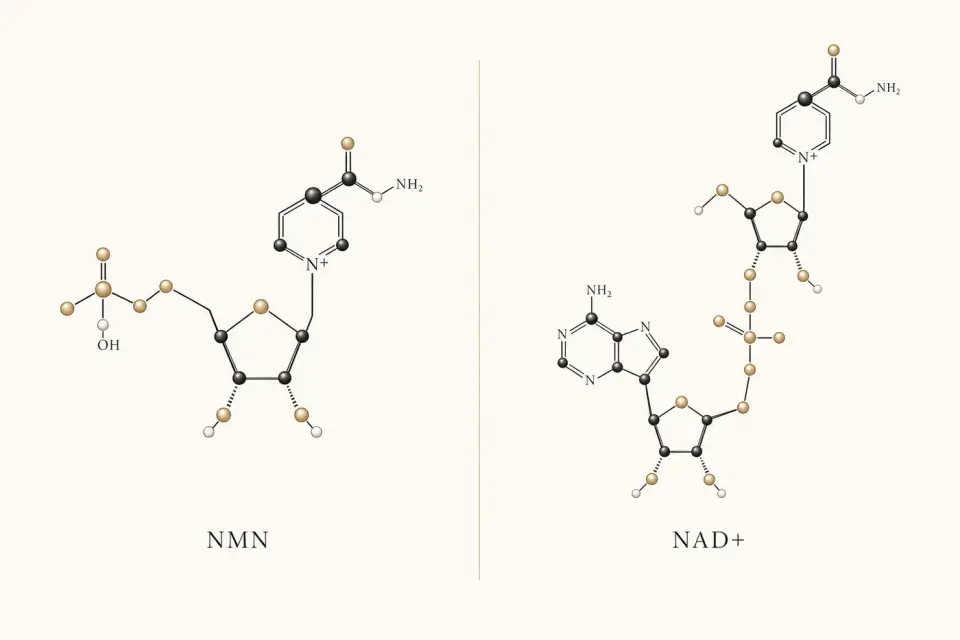
NAD+ is a dinucleotide: two nucleotides joined through their phosphate groups. One nucleotide carries adenine. The other carries nicotinamide, a form of vitamin B3. The NIH PubChem record for NAD+ lists its formula as C21H27N7O14P2.
Compare that with real peptides. Sermorelin is a 29-amino-acid fragment of growth hormone-releasing hormone. BPC-157 is a chain of 15 amino acids. Both are built from the same building blocks as proteins. NAD+ is built from the same kind of building blocks as DNA and RNA.
| NAD+ | Peptides (e.g., sermorelin, BPC-157) | |
|---|---|---|
| What it is | Coenzyme (a dinucleotide) | Short chain of amino acids |
| Building blocks | Nucleotides (adenine and nicotinamide) | Amino acids |
| Peptide bonds | None | Yes |
| How it works | Used by many enzymes inside every cell | Usually binds a receptor to send a signal |
| Compounded form FDA-approved? | No | No |
So the answer to "is NAD+ a peptide" is no. NAD+ is a coenzyme, and calling it a peptide is a labeling mistake, not a scientific category.
02
Why Do People Call NAD+ a Peptide?
People call NAD+ a peptide by mistake. The label comes from how injectable NAD+ is handled, not from what the molecule is.
Many telehealth clinics list NAD+ on the same menu as peptides like sermorelin and BPC-157, which is how it got pulled into conversations about peptide therapy. Licensed 503A compounding pharmacies prepare it in multi-dose vials under a physician's prescription. Patients inject it under the skin with small insulin-style needles, and a physician oversees treatment.
That shared workflow created shared vocabulary. Many people now say "NAD+ peptide" or "NAD plus peptide" when they mean injectable NAD+. The difference is real, though. Many GLP-1 medications are true peptides, as our GLP-1 peptide explainer covers. NAD+ is not.
None of those labels changes the chemistry. NAD+ is a coenzyme, whatever it is called on a clinic menu.
03
What People Mean by "NAD+ Peptide"
Searches for "NAD+ peptide" are almost always questions about injectable NAD+. "What is NAD+ peptide," "what is NAD+ peptide used for," "NAD+ peptide benefits," "NAD+ peptide injection," "NAD+ peptide dosage" and "NAD+ peptide side effects" all ask the same thing: what injectable NAD+ does and how it is given.
The sections below answer each of those questions using the accurate name, NAD+. The short version: NAD+ is a coenzyme with real biology behind it and limited human data on injections.
04
What Is NAD+ Used For?
NAD+ therapy is used to support cellular energy metabolism and healthy aging. Patients most often ask about it for energy and mental clarity, especially when they feel tired all the time.
NAD+ has two core jobs. First, it carries electrons in the reactions that turn food into ATP, the cell's energy currency. Second, enzymes use it up to maintain cells: sirtuins use NAD+ to regulate gene expression and metabolism, and PARP enzymes use it to repair damaged DNA. An enzyme called CD38 breaks NAD+ down.
NAD+ levels fall with age in several tissues. A study of human skin samples found NAD+ levels dropped as age increased. Rising CD38 activity is one driver of that decline. A 2026 review notes that large human studies have not found the same decline in whole blood with healthy aging, so the picture is still being worked out.
That age-related decline is the reasoning behind NAD+ therapy. Our complete NAD+ guide covers the basics, and NAD+ injections before and after covers what patients report. The goal is to support processes that depend on NAD+, not to treat a disease.
05
NAD+ Benefits: What the Research Shows
The strongest evidence for NAD+ benefits comes from animal studies and oral precursor trials, not from injected NAD+ in humans. A 2026 review called the human evidence for IV NAD+ sparse and preliminary.
In mice, raising NAD+ improves mitochondrial function, insulin sensitivity and muscle performance. A 2018 review in Cell Metabolism summarizes this in vivo evidence across metabolic, cardiovascular and neurodegenerative models.
Most of that work used precursors, mainly NMN and NR, which cells convert into NAD+ (see NMN vs. NAD+ and NMN benefits). In a 6-week crossover trial, NR was well tolerated and raised NAD+ in healthy middle-aged and older adults. In a 10-week trial, NMN improved muscle insulin sensitivity in women with prediabetes.
Human studies of injected NAD+ are small and short. A 2019 pilot study of a 6-hour IV infusion found NAD+ was rapidly cleared from plasma for at least the first 2 hours. For the oral side of the comparison, see our NAD+ supplement guide.
The fair summary: NAD+ benefits are biologically plausible and well supported in animals, but human evidence for injected NAD+ is still early. Our NAD+ benefits breakdown goes deeper.
06
NAD+ Injection: How It Is Given
An NAD+ injection is a subcutaneous shot of compounded NAD+ into the fatty tissue of the abdomen or thigh. It is the route used at home.
Three routes are used. Subcutaneous injections take seconds at home after training. IV infusions deliver larger amounts in a clinic; in one real-world study, IV NAD+ infusions averaged about 97 minutes. Compare the two in NAD+ IV therapy and NAD+ injections. Oral products usually rely on precursors like NMN and NR rather than NAD+ itself.
Injectable NAD+ is compounded by licensed 503A pharmacies under a physician's prescription, and compounded drugs are not FDA-approved. Our 503A explainer covers how that system works.
Physician-prescribed NAD+ follows the same steps: an online assessment, a physician decision, and a pharmacy that fills the prescription. Subcutaneous injection is the route most patients use for ongoing treatment.
07
NAD+ Dosage
There is no single standard NAD+ dosage. No NAD+ injection is FDA-approved, so there is no official label dose.
A physician sets the dose for each patient based on the route, the patient's goals, other medications and how well the first doses are tolerated. Side effects like nausea and flushing are reported most often during IV infusions, which is one reason protocols start low and adjust.
Subcutaneous and IV doses are not interchangeable milligram for milligram. Our NAD+ dosage guide explains how physicians think about frequency, injection sites and titration. If you searched "NAD+ peptide dosage," the answer is the same: the right NAD+ dosage is set by a physician, not by a chart.
08
NAD+ Side Effects
NAD+ side effects are usually short-lived. A 2026 review of IV NAD+ lists nausea, cramping, flushing and chest discomfort as the reported adverse effects.
In a 2026 real-world study, people receiving IV NAD+ reported GI symptoms, a faster heart rate and chest pressure during infusions. All symptoms resolved once the infusion ended, but they made infusions run longer.
Long-term safety data are lacking. Safety in pregnancy and breastfeeding has not been established. People with a history of cancer should raise it with their physician, because NAD+ supports cell growth pathways. Our full NAD+ side effects guide covers what to watch for.
Most reported NAD+ side effects are tied to infusion speed and dose, which is one reason a physician guides dosing.
09
The Bottom Line
NAD+ is a coenzyme, not a peptide. Here is what to know:
- NAD+ is not a peptide. It has no amino acids or peptide bonds; it is a dinucleotide coenzyme.
- The "peptide" label is a mistake. It comes from how injectable NAD+ is compounded, prescribed and injected.
- NAD+ powers energy production and DNA repair. Levels fall with age in some tissues, partly because of CD38.
- Human evidence for injected NAD+ is early. Most benefits data come from animal studies and oral precursors like NMN and NR.
- A physician sets the route and dosage. There is no FDA-approved NAD+ injection and no official label dose.
- Side effects are mostly tied to IV infusions. Nausea, flushing, cramping and chest discomfort are reported and resolve after the infusion.
NAD+ is a coenzyme, not a peptide. It ended up on peptide menus because of how it is compounded and injected, and it should be judged on the NAD+ evidence itself.
FAQ
Frequently Asked Questions
What is NAD+ used for?
NAD+ therapy is used to support cellular energy metabolism and healthy aging. NAD+ helps cells make energy and is used by enzymes that repair DNA. Searches for "what is NAD+ peptide used for" are asking about this same injectable NAD+.
Is NAD+ a peptide or a supplement?
NAD+ is neither. It is a coenzyme found in every cell. Oral NAD+ products are sold as supplements. Injectable NAD+ is a compounded prescription product. Neither form is a peptide.
Can you take NAD+ orally instead of injecting it?
Most oral products use precursors like NMN or NR, which the body converts into NAD+. NR has been shown to raise NAD+ levels in a human trial. Injection delivers NAD+ itself.
Is NAD+ FDA-approved?
No. Compounded NAD+ is not FDA-approved, and compounded drugs in general are not FDA-approved. Licensed 503A pharmacies compound it under an individual physician's prescription.
How long does it take for NAD+ injections to work?
There is no reliable trial data on a timeline. Human studies of injected NAD+ are small and short. Patient reports vary, and some people notice no change. A physician can review your response and adjust the plan.
Citations & Sources
- Verdin E. NAD+ in aging, metabolism, and neurodegeneration. Science. 2015;350(6265):1208-1213. PMID 26785480. https://pubmed.ncbi.nlm.nih.gov/26785480/
- Covarrubias AJ, Perrone R, Grozio A, Verdin E. NAD+ metabolism and its roles in cellular processes during ageing. Nat Rev Mol Cell Biol. 2021;22(2):119-141. PMID 33353981. https://pubmed.ncbi.nlm.nih.gov/33353981/
- Camacho-Pereira J, et al. CD38 dictates age-related NAD decline and mitochondrial dysfunction through an SIRT3-dependent mechanism. Cell Metab. 2016;23(6):1127-1139. PMID 27304511. https://pubmed.ncbi.nlm.nih.gov/27304511/
- Massudi H, et al. Age-associated changes in oxidative stress and NAD+ metabolism in human tissue. PLoS One. 2012;7(7):e42357. PMID 22848760. https://pubmed.ncbi.nlm.nih.gov/22848760/
- Rajman L, Chwalek K, Sinclair DA. Therapeutic potential of NAD-boosting molecules: the in vivo evidence. Cell Metab. 2018;27(3):529-547. PMID 29514064. https://pubmed.ncbi.nlm.nih.gov/29514064/
- Martens CR, et al. Chronic nicotinamide riboside supplementation is well-tolerated and elevates NAD+ in healthy middle-aged and older adults. Nat Commun. 2018;9:1286. PMID 29599478. https://pubmed.ncbi.nlm.nih.gov/29599478/
- Yoshino M, et al. Nicotinamide mononucleotide increases muscle insulin sensitivity in prediabetic women. Science. 2021;372(6547):1224-1229. PMID 33888596. https://pubmed.ncbi.nlm.nih.gov/33888596/
- Grant R, et al. A pilot study investigating changes in the human plasma and urine NAD+ metabolome during a 6 hour intravenous infusion of NAD+. Front Aging Neurosci. 2019;11:257. PMID 31572171. https://pubmed.ncbi.nlm.nih.gov/31572171/
- Alangari A, et al. Narrative review of intravenous NAD+ and NAD+ precursors in wellness and translational medicine. Front Aging. 2026;7:1887175. PMID 42787547. https://pubmed.ncbi.nlm.nih.gov/42787547/
- Reyna K, et al. Intravenous infusion of NAD+ versus nicotinamide riboside (NR): a retrospective tolerability pilot study in a real-world setting. Front Aging. 2026;7:1652582. PMID 41704678. https://pubmed.ncbi.nlm.nih.gov/41704678/
- National Library of Medicine. Nicotinamide adenine dinucleotide. PubChem compound summary. https://pubchem.ncbi.nlm.nih.gov/compound/Nicotinamide-adenine-dinucleotide
- National Library of Medicine. Sermorelin. PubChem compound summary (CID 16132413). https://pubchem.ncbi.nlm.nih.gov/compound/16132413
- National Library of Medicine. BPC-157. PubChem compound summary (CID 9941957). https://pubchem.ncbi.nlm.nih.gov/compound/9941957
- National Human Genome Research Institute. Peptide. Talking Glossary of Genomic and Genetic Terms. https://www.genome.gov/genetics-glossary/Peptide
- NIH Office of Dietary Supplements. Niacin: fact sheet for health professionals. https://ods.od.nih.gov/factsheets/Niacin-HealthProfessional/
- U.S. Food and Drug Administration. Compounding and the FDA: questions and answers. https://www.fda.gov/drugs/human-drug-compounding/compounding-and-fda-questions-and-answers
Important safety information: NAD+
Educational only — this article does not diagnose, prevent, treat, or cure any condition, and it is not medical advice. Protocol MD sells compounded medications and has a commercial interest in this topic. A licensed physician evaluates each patient individually; individual results vary. Not available in all states. Consult a licensed physician before beginning any treatment program.
Published November 12, 2026.