01
What Is Liposomal NAD+?
Liposomal NAD+ is an oral supplement that packs NAD+ inside liposomes, which are tiny spheres built from the same kind of fat that forms cell membranes. NAD+ (nicotinamide adenine dinucleotide) is a coenzyme found in every cell. It carries electrons in mitochondrial energy production and fuels DNA repair and sirtuin enzymes.
NAD+ levels fall with age. In human skin samples from 49 people, tissue NAD+ correlated negatively with age in both men and women. That decline explains why NAD+ products sell so well. Searches for "liposomal NAD" and "NAD+ liposomal" describe this same product type.
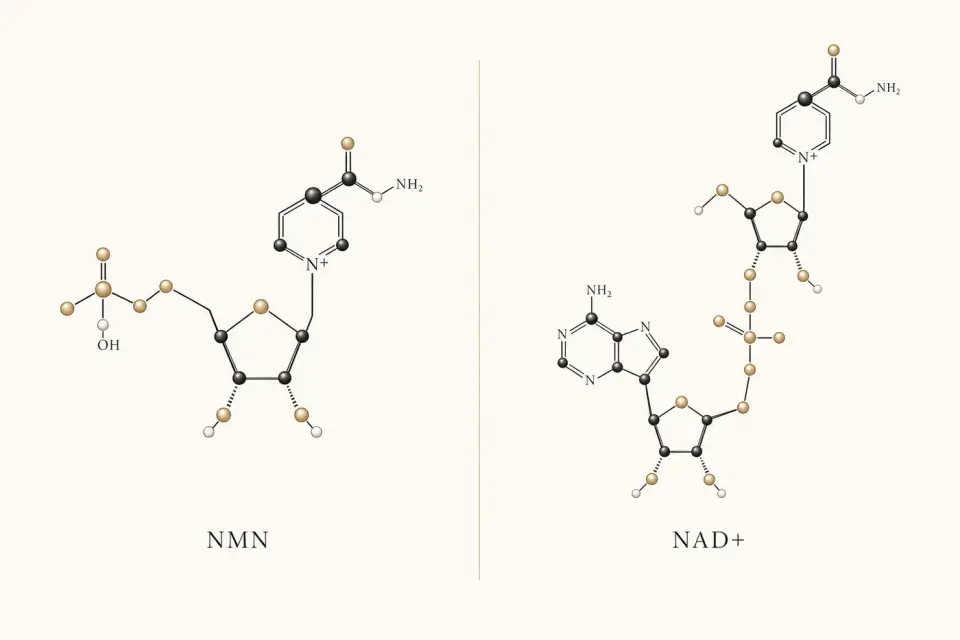
Liposomal NAD+ is one of several routes. Others include precursors such as those compared in our NMN vs NAD+ guide, IV infusions covered in our NAD+ IV therapy article, and NAD+ therapy by injection. For the basics, start with our guides to what NAD+ is and its forms and why NAD+ declines. In short, liposomal NAD+ is oral NAD+ in a lipid shell.
02
Why Plain Oral NAD+ Struggles to Raise NAD+ Levels
Oral NAD+ is hard to deliver intact because digestive and cell-surface enzymes break it down before cells can use it. An older rat study of intestinal digestion reported that the small intestine rapidly hydrolyzed NMN, a fragment produced when NAD+ is digested, into nicotinamide riboside.
Enzymes outside the gut add a second barrier. The enzyme CD38 sits on cell surfaces, and more than 90% of it faces outward and breaks down NAD+. Cells also have a limited ability to import it. A review of NAD+ in immune cells notes that most cell types cannot take up NAD+ directly, with neurons as an exception.
That is why precursors became the standard approach. In a pilot study, a single oral dose of NR raised human blood NAD+ as much as 2.7-fold in one individual, and the same paper tested three single doses in 12 healthy people. Mouse work shows that NR and NMN are processed through the gut microbiota and the liver before they supply NAD+. Plain oral NAD+ therefore has a digestion problem and a cell-uptake problem. Liposomes aim at the first one.
03
How Liposomes Are Supposed to Help, and Where They Fall Short
Liposomes are designed to shield their contents from digestion, but liposomes themselves are fragile in the gut. Reviews describe several ways liposomes can aid oral absorption, including sticking to membranes and lymphatic uptake.
The same literature names stability as the main concern. Conventional liposomes are vulnerable to gastric acid, bile salts and pancreatic lipases, which reduce the number of intact liposomes and let the payload leak. Reviewers also report that polymer coatings and modified lipids can improve stability. Whether a given capsule or liquid survives digestion depends on its formulation. Liposomes are a reasonable idea with a known weak point.
04
Does Liposomal NAD+ Work? What Human Studies Show
The evidence that liposomal NAD+ raises NAD+ in people is limited to one small, manufacturer-funded study. That non-randomized crossover study enrolled 14 adults who took 1,000 mg of a liposomal NAD+ product daily for two weeks. Average intracellular NAD+ rose about 64%. The company that makes the product funded the study, and its owner and employees are among the authors. Small, unrandomized studies cannot separate a product effect from chance or other factors.
No study we found compared liposomal NAD+ with plain oral NAD+ or with NR in the same people. A registered Phase 0/1 randomized, placebo-controlled trial of a liposomal NAD+ product in adults aged 45 to 75 is listed on ClinicalTrials.gov. We did not find published results.
Cell work adds a little. In a 2025 lab study, a liposomal NAD+ formulation raised intracellular NAD+ and cell survival in human aortic endothelial cells compared with NAD+ alone, but not in human keratinocytes. Cell studies do not show what happens after a capsule is swallowed. So does liposomal NAD+ work? It may raise NAD+, but that is not yet shown in a controlled human trial.
05
Liposomal NAD+ Benefits: What Is and Is Not Shown
No study has shown clinical benefits from liposomal NAD+ itself. Claims about liposomal NAD+ benefits usually borrow from NAD+ biology and from precursor trials.
Raising NAD+ and improving health are different outcomes. In a 2 x 6-week randomized, placebo-controlled crossover trial in healthy middle-aged and older adults, oral NR was well tolerated and raised NAD+. In a separate randomized crossover trial, 12 older men took 1 g of NR daily for 21 days, and muscle NAD+ metabolites rose without a change in muscle mitochondrial energy measures.
Those results come from NR, not from liposomal NAD+, and they do not transfer. For broader context, see our articles on NAD+ benefits and NMN benefits. Liposomal NAD+ benefits remain a hypothesis.
06
Liposomal NAD+ vs Injection: How the Routes Differ
Liposomal NAD+ vs injection is a comparison between a swallowed dietary supplement and an injected, physician-prescribed compounded medication. The table summarizes the main differences. NR is included because it has the strongest oral human data.
| Liposomal NAD+ (oral) | Oral NR (precursor) | NAD+ injection (compounded) | |
|---|---|---|---|
| Route | Swallowed | Swallowed | Injected under a physician's direction |
| What it delivers | NAD+ inside lipid vesicles | A vitamin B3 precursor the body converts to NAD+ | NAD+ itself |
| Human data on NAD+ levels | One small, non-randomized, manufacturer-funded study; a registered trial without published results | Randomized trials in blood and muscle | See our NAD+ injections guide |
| Clinical outcome evidence | None found | Exploratory; muscle mitochondrial measures unchanged in one trial | See our NAD+ injections guide |
| Regulatory status | Dietary supplement; no FDA approval before sale | Dietary supplement; no FDA approval before sale | Compounded medication; not FDA-approved |
| Medical oversight | None required | None required | Physician evaluation before prescribing |
The supplement rows follow FDA's own description. FDA does not have the authority to approve dietary supplements before they are marketed. The NR row draws on the randomized crossover trial and the muscle study cited above.
Injection skips the digestive tract, so gut breakdown is not the barrier. Injected NAD+ raises its own questions, which we cover in our NAD+ injections guide, our NAD+ dosage article, and our look at what to realistically expect. If you are weighing access, our explainer on NAD+ injections near me covers whether you need a clinic nearby.
Protocol MD offers NAD+ therapy as a compounded medication prescribed only after a physician evaluation. Compounded medications are not FDA-approved, and a physician decides whether it is appropriate. How it works explains the process, and our article on 503A compounding explains how FDA views compounded products. Read the Important safety information before deciding. The route you choose should rest on evidence and medical oversight, not on marketing.
07
Liposomal NAD+ Side Effects and Who Should Be Careful
Liposomal NAD+ side effects are not well characterized, because almost no safety trials of the product itself exist. The one published human study recorded no adverse events, but one participant taking an antidepressant reported more depressive symptoms and dropped out. The study cannot say whether the supplement played any role.
Related precursor trials describe good tolerability over weeks. The randomized NR crossover trial found it well tolerated. Total vitamin B3 intake from all supplements is worth checking, because NAD+ precursors are B3 forms. The NIH Office of Dietary Supplements lists an adult upper limit of 35 mg per day for supplemental niacin, and notes that 3,000 mg per day or more can cause nausea, vomiting and liver damage. StatPearls notes that flushing, a common niacin effect, can occur at doses as low as 30 mg per day.
People who are pregnant, are breastfeeding, have liver disease, or take prescription medicines should check with a physician first. FDA advises talking to a doctor or pharmacist before using any supplement, because some interact with medicines. Our NAD+ side effects guide covers the injectable and IV forms. Liposomal NAD+ side effects remain largely unstudied.
08
Liposomal NAD+ Reviews: What They Can and Cannot Tell You
Liposomal NAD+ reviews describe how people feel, not whether their NAD+ levels changed. Reviews are experience reports. They cannot separate a product effect from placebo response, sleep, diet or stress. Our article on what NAD+ reviews measure and miss explains the pattern in more detail.
Lab results are a different kind of information. Our guide to reading blood test results and our bloodwork panels cover general health markers. Reviews are stories, so treat them as stories.
09
Best Liposomal NAD+ Supplement: How to Judge a Product
No liposomal NAD+ supplement has shown it is the best, because no head-to-head human trials exist. People searching for the best liposomal NAD+ are usually asking which product to buy. A more useful question is what the evidence supports for any liposomal NAD+ supplement.
Start with how supplements are regulated. FDA does not test dietary supplements before they are sold, and the agency does not routinely analyze their contents. Then use this checklist:
- Check the Supplement Facts panel. FDA requires it to declare the amount of each dietary ingredient per serving.
- Look for independent testing. Third-party testing for identity and amount fills the gap left by the lack of FDA analysis.
- Be wary of disease claims. A product sold as a supplement and represented to treat or prevent a disease meets the definition of a drug.
- Ask a physician about interactions. This matters most if you take prescription medicines.
A good product still cannot make an unproven idea proven. Judge liposomal NAD+ by its evidence, not its packaging.
10
What Else to Consider for Low Energy
Low energy has many possible causes, and NAD+ is only one of them. Sleep, diet, activity, medications and medical conditions all matter. Our guides to how to increase energy naturally and why you may always feel tired cover the common causes and when to see a doctor. Persistent fatigue deserves a medical evaluation before any supplement.
11
The Bottom Line
Liposomal NAD+ is an appealing idea that has not yet earned strong claims. These points sum up the evidence:
- Liposomal NAD+ is unproven. One small, manufacturer-funded, non-randomized study of 14 adults is the only published human data we found.
- The design is plausible but fragile. Liposomes can protect cargo in theory, yet conventional liposomes struggle with stomach acid, bile salts and lipases.
- NR has stronger human data. Randomized trials show oral NR raises NAD+, although clinical benefit is not established.
- Reviews and labels are not evidence. FDA does not approve or test dietary supplements before sale.
- Injection is a different, physician-supervised route. It is a compounded medication, it is not FDA-approved, and a physician decides whether it fits.
Liposomal NAD+ is a plausible idea that still needs controlled human trials. Judge it by the evidence, not the packaging.
FAQ
Frequently Asked Questions
What is liposomal NAD+?
Liposomal NAD+ is an oral supplement that places NAD+ inside liposomes, which are fat-based carriers. The goal is to protect NAD+ from digestion. It is one of several ways people try to raise NAD+, as outlined in the forms section above.
Does liposomal NAD+ work?
Liposomal NAD+ is not proven to work. One small, manufacturer-funded, non-randomized study of 14 adults reported a roughly 64% rise in intracellular NAD+. No controlled trial has shown clinical benefit.
Is liposomal NAD+ effective compared with NR or NMN?
Is liposomal NAD+ effective? That is untested head to head. Oral NR has randomized trial data showing higher NAD+ levels, and the NMN vs NAD+ comparison above covers the precursor side.
What are the side effects of liposomal NAD+?
Liposomal NAD+ side effects are not well studied. The only published human study recorded no adverse events, though one participant withdrew. FDA advises checking with a doctor or pharmacist before using a supplement.
How does liposomal NAD+ compare with NAD+ injections?
Liposomal NAD+ is a swallowed supplement, while injection is a prescribed compounded medication that bypasses the gut. FDA does not approve supplements before they are marketed, and compounded medications are not FDA-approved either. See the Important safety information for NAD+.
Are liposomal NAD+ reviews reliable?
Liposomal NAD+ reviews are experience reports, not measurements of NAD+ levels. They cannot show whether a product raised NAD+ in your cells. FDA does not test dietary supplements before sale, so check labels and independent testing.
Citations & Sources
- Massudi H, et al. Age-associated changes in oxidative stress and NAD+ metabolism in human tissue. PLoS One. 2012;7(7):e42357. PMID 22848760. https://pubmed.ncbi.nlm.nih.gov/22848760/
- Trammell SAJ, et al. Nicotinamide riboside is uniquely and orally bioavailable in mice and humans. Nat Commun. 2016. https://pmc.ncbi.nlm.nih.gov/articles/PMC5062546/
- Martens CR, et al. Chronic nicotinamide riboside supplementation is well-tolerated and elevates NAD+ in healthy middle-aged and older adults. Nat Commun. 2018;9:1286. https://pmc.ncbi.nlm.nih.gov/articles/PMC5876407
- Elhassan YS, et al. Nicotinamide riboside augments the aged human skeletal muscle NAD+ metabolome and induces transcriptomic and anti-inflammatory signatures. Cell Rep. 2019;28(7):1717-1728. PMID 31412242. https://pubmed.ncbi.nlm.nih.gov/31412242/
- Digestion and absorption of NAD by the small intestine of the rat. J Nutr. 1983;113(2):412-420. PMID 6218262. https://pubmed.ncbi.nlm.nih.gov/6218262/
- Nicotinamide riboside and nicotinamide mononucleotide facilitate NAD+ synthesis via enterohepatic circulation. Sci Adv. 2025;11(12):eadr1538. https://pmc.ncbi.nlm.nih.gov/articles/PMC11927621/
- The multi-faceted ecto-enzyme CD38: roles in immunomodulation, cancer, aging, and metabolic diseases. Front Immunol. 2019;10:1187. https://pmc.ncbi.nlm.nih.gov/articles/PMC6555258
- Review of NAD+ and immune cell metabolism. PMC9292562. https://pmc.ncbi.nlm.nih.gov/articles/PMC9292562
- Potential of liposomes for enhancement of oral drug absorption. PMID 26768542. https://pubmed.ncbi.nlm.nih.gov/26768542
- Review of challenges and approaches for the oral delivery of liposomes. PMC6362257. https://pmc.ncbi.nlm.nih.gov/articles/PMC6362257
- A liposomal formulation enhances the anti-senescence properties of nicotinamide adenine-dinucleotide (NAD+) in endothelial cells and keratinocytes. Curr Issues Mol Biol. 2025;47(9):722. https://www.ncbi.nlm.nih.gov/pmc/articles/PMC12468054/
- Increased intracellular NAD+ levels via oral supplementation with a novel liposomal delivery method: a non-randomized crossover study. Manufacturer-funded; reported in the Journal of Applied Natural Medicine. https://ndnr.com/increased-intracellular-nad-levels-via-oral-supplementation-with-a-novel-liposomal-delivery-method-a-non-randomized-crossover-study/
- ClinicalTrials.gov. RENEWAL-NAD+: oral NAD+ in a healthy cohort. NCT07336836. https://clinicaltrials.gov/study/NCT07336836
- U.S. Food and Drug Administration. Questions and answers on dietary supplements. https://www.fda.gov/food/information-consumers-using-dietary-supplements/questions-and-answers-dietary-supplements
- NIH Office of Dietary Supplements. Niacin fact sheet for consumers. https://ods.od.nih.gov/factsheets/Niacin-Consumer/
- StatPearls. Niacin toxicity. NCBI Bookshelf NBK559137. https://www.ncbi.nlm.nih.gov/books/NBK559137/
Important safety information: NAD+
Educational only — this article does not diagnose, prevent, treat, or cure any condition, and it is not medical advice. Protocol MD sells compounded medications, including NAD+, and has a commercial interest in this topic. Compounded medications are not FDA-approved. A licensed physician evaluates each patient individually; individual results vary. Not available in all states. Consult a licensed physician before beginning any treatment program.
Published November 13, 2026.